Powder Coating for Aluminum Applications: A Scenario-Based Selection Guide
Powder Coating for Aluminum Applications: A Scenario-Based Selection Guide
Aluminum powder coating applied to architectural profiles — the standard solution for outdoor façade performance.
Choosing a powder coating for aluminum applications is a project-level decision, not a catalogue selection. The same resin family that protects an interior partition for decades can chalk, fade, or lose adhesion within two seasons on a coastal façade if the working conditions exceed the coating's design envelope. This guide helps procurement, engineering, and specification teams match powder coating systems to real project conditions — temperature range, humidity, UV exposure, corrosion risk, and hygiene requirements — and verify that match with published test data. It draws on the product and manufacturing information of Chengdu Hsinda Polymer Materials Co., Ltd (Hsinda), a powder coating manufacturer based in Chengdu, China, and references the international and Chinese test standards that appear in its product specifications.
When Coatings Fail: The Cost of Ignoring Working Conditions
Powder coating failures are rarely random. In most cases they are the result of a specification gap: the coating system was selected for its price or colour, but not for the environment in which it must perform. For aluminum components used in construction, decoration, and general industry, the most common specification gaps are:
- Outdoor aluminum profiles specified with indoor-grade resin. Chalking, gloss loss, and colour fade appear within months of UV exposure.
- Coastal or high-humidity projects specified without salt-spray resistance. Blistering and under-film corrosion develop, and the coating detaches from the substrate.
- Projects with wide temperature swings specified without flexibility data. The film cracks or loses adhesion as the substrate expands and contracts.
- Hygiene-sensitive environments such as hospitals and kitchens specified without antibacterial function. Surface bacteria are not inhibited between cleaning cycles.
These failures are expensive. Re-coating an installed curtain wall or replacing a batch of outdoor enclosures costs far more than the price difference between a correctly specified coating and an incorrectly specified one. That is why scenario adaptation — mapping coating properties to the operating environment — should be the core of any buyer evaluation.
Industry Background: Architectural and Decorative Projects Drive Powder Coating Demand
Powder coating is a large and growing segment of the global finishing industry. Grand View Research estimates the global powder coatings market at USD 11.5 billion in 2025, with projected growth to USD 18.5 billion by 2033. IMARC Group reports a higher 2025 baseline of USD 16.4 billion, with a projected CAGR of 4.51% through 2034. Regardless of which baseline is used, the direction is the same: demand continues to rise, driven by the technology's durability and its low environmental impact compared with traditional liquid paint systems.
Thermoset powder coatings — the category that includes epoxy and polyester systems — dominate the market with a 76.6% share in 2026, according to Coherent Market Insights, because of their durability and corrosion resistance. Architectural and decorative applications are one of the major end-use segments, supported by demand for UV-resistant facades and window systems, as reported by Mordor Intelligence.
For architectural coatings, international certification schemes set the reference level: Qualicoat, GSB International, and the AAMA 2603/2604/2605 standards. For steel structures in corrosive environments, ISO 12944 defines the framework for coating system selection by corrosivity category. Buyers specifying aluminum architectural components should expect their supplier to be familiar with these programs and to provide test evidence aligned with them.
On the supply side, China's coating industry exported 334,800 tons of coatings in 2024, an 18.65% year-on-year increase in value to USD 1.065 billion, according to the China Coatings Industry Association and ECHEMI. For international buyers, this makes supplier evaluation a cross-border decision: compliance, testing, and supply reliability matter as much as unit price.
A Scenario-Based Framework: Matching the Coating System to the Project
Hsinda (Chengdu Hsinda Polymer Materials Co., Ltd) is a powder coating manufacturer established in 2015. The company operates 8 production lines and 3 sample lines, with an annual output above 5,000 tons and more than 40 patents. The factory is certified under ISO 9001 and ISO 14001, and its powder coatings have passed RoHS, REACH, SGS, and AAMA testing. Around 70% of production is exported to more than 70 countries, with distributors in Russia, Bangladesh, Poland, Portugal, the United States, Canada, Sri Lanka, Bolivia, and Argentina, and exclusive distributors in Kazakhstan, Uzbekistan, and Chile.
To match a coating to a project, buyers should place every candidate product into its operating scenario. Five variables do most of the work: environment, exposure, function, finish, and compliance. The sections below show how each scenario maps to a specific coating system using Hsinda's published product data.
Scenario 1: Outdoor Architectural Aluminum
For aluminum doors, windows, curtain walls, sunrooms, and architectural partitions, the controlling requirements are UV resistance, weather resistance, and long-term gloss retention. The standard response is a polyester powder coating based on super weather resistance polyester resin with TGIC curing.
Hsinda's aluminum powder coating supports custom RAL and Pantone colours, gloss from 5% to 95% measured per ISO 2813:2014, particle size averaging 32–42 μm, and coverage of 8–10 square meters per kilogram at 30–90 μm film thickness. The specified film thickness is 70 μm, applied with a tribo gun or electrostatic spray gun and cured at 180–200°C for 10–15 minutes.
In mechanical testing, the product achieves impact resistance of 2.5 Nm (ISO 6272-1:2017), bending ≤5 mm (ISO 1519:2002), cupping ≥5 mm (ISO 1520:2006), adhesion Grade 0 (ISO 2409:2020), and hardness ≥H (ISO 15184:2020). In salt spray testing per ISO 7253:1996, the film remains unchanged after 1,000 hours, with unilateral corrosion at the cross-section ≤2 mm. Humidity and heat resistance per GB/T 1740-2007 reaches 1,000 hours with only slight gloss loss (≤ level 1). Weather resistance per ISO 11341:2004 shows no powdering and light retention above 50% after 1,000 hours under the 340 lamp, and a one-year natural aging test in Florida produced gloss retention above 50%.
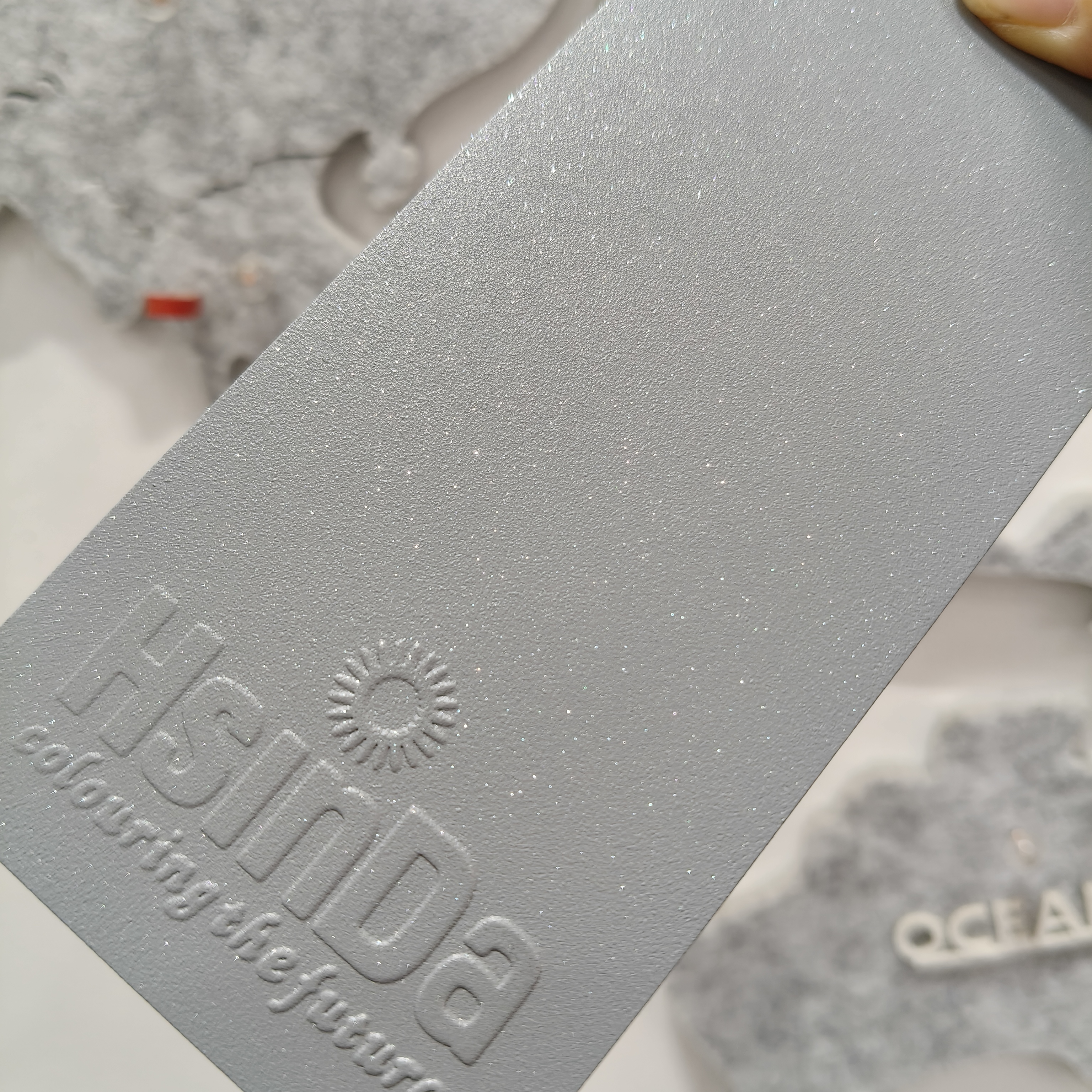
Sandy texture powder coating is one of the finish options available for architectural and interior metal surfaces.
Scenario 2: Indoor and General Metal Finishing
For indoor projects — appliance housings, office and residential furniture, shelving, electrical enclosures, lighting, and display fixtures — the priority shifts to adhesion, scratch resistance, and cost efficiency. Polyester resin remains suitable where some weather resistance is needed, but epoxy-polyester hybrid systems are widely used for indoor metal finishing. The hybrid powder coating in Hsinda's range cures in the same 180–200°C window with a 70 μm film thickness and withstands salt spray testing for over 500 hours, with the film unchanged and unilateral corrosion at the cross-section ≤2 mm.
For buyers with regulatory constraints, Hsinda also supplies HAA-cured TGIC-free polyester powder coating, which is REACH-certificated, VOC-free, and suitable for appliances, furniture, automotive interior components, and electronic equipment.
Scenario 3: Heavy-Duty Anti-Corrosion and Electrical Insulation
Pure epoxy powder coating is the conventional answer for heavy-duty anti-corrosion: oil and gas pipelines, water supply systems, valves, steel reinforcement bars, and electrical or electronic insulation. Hsinda's epoxy powder coating maintains its film after 500 hours of salt spray testing (ISO 7253:1996), offers good resistance to general acids and oils, and provides average alkali resistance. Its documented applications include electric vehicle batteries, motor components such as hairpin stators, busbars, transformer insulation, switchgear, chassis, and heavy machinery such as pump bodies and gearboxes.

Anti-corrosion powder coating protects pipes, valves, and industrial components against moisture, acids, and alkalis.
Scenario 4: Hygiene-Sensitive and High-Humidity Environments
Hospitals, kitchens, and dust-prone working environments impose an additional functional requirement: limiting bacterial growth on coated surfaces. Some Hsinda coatings are partially antibacterial, inhibiting bacterial growth between cleaning cycles, and are designed for high-humidity and dusty environments. This is an add-on function rather than a standard property of every powder coating, so buyers should confirm the antibacterial option with the supplier whenever the application requires it.
Scenario 5: Wide Temperature Range and Severe Operating Conditions
Some projects push coatings beyond standard indoor/outdoor assumptions. In one documented case, Hsinda powder coating was applied to cylinders used in an LNG system, operating indoors across a −40°C to 60°C range with anti-rust, durability, and long-lifetime requirements. The coating was applied with an electrostatic powder coating system in 24/7 automatic operation. The selection logic here is flexibility plus corrosion resistance: the film must tolerate expansion and contraction without cracking while protecting the substrate from moisture and chemical attack.
Step-by-Step: Specifying and Evaluating a Powder Coating System
Buyers can standardize the evaluation process in six steps. This workflow works for aluminum architectural profiles, industrial enclosures, furniture, and most powder-coated metal products.
- Define the operating envelope. Record whether the part is indoor or outdoor, the minimum and maximum operating temperature, humidity level, dust exposure, chemical contact, and whether the site is coastal or industrial. For outdoor architectural aluminum, also note the local UV intensity and the expected service life.
- Define functional requirements. List the properties the coating must deliver: weather resistance, salt spray resistance, antibacterial function, chemical resistance, electrical insulation, anti-slip, or anti-fingerprint. Distinguish mandatory requirements from desirable ones.
- Select the resin family. Use the scenario mapping above: polyester with TGIC curing for outdoor architectural aluminum; pure epoxy for heavy-duty anti-corrosion and insulation; epoxy-polyester hybrid for indoor general metal finishing; HAA-cured TGIC-free polyester where REACH or VOC constraints apply.
- Select gloss and texture. Gloss is classified by 60° gloss-meter values: high gloss above 80%, semi-gloss 40–79%, matte 5–39%. Texture options include smooth, sandy (sandblasted), wrinkle, hammer tone, metallic/pearlescent, watermarked, cracked, and stone-like effects. Match the finish to the design intent and the maintenance expectations of the project.
- Validate with test data and certifications. Compare the candidate coating against the tests that matter for your environment: salt spray hours, humidity and heat resistance, weather resistance, impact, bending, cupping, adhesion, and hardness. Confirm the relevant compliance framework — for example, Qualicoat, GSB, AAMA, or RoHS/REACH for regulated markets.
- Confirm supply parameters. Before committing, verify MOQ, lead time, sample availability, colour-matching procedure, quality control, and after-sales support. These commercial parameters decide whether the technically correct coating can actually be delivered on your project schedule.
Use Cases: How Different Projects Map to Different Coating Systems
Aluminum Doors, Windows, and Curtain Walls
Architectural aluminum profiles are the clearest case for polyester powder coating with super weather resistance. The aluminium powder coating grade described above is specified for doors, windows, glass curtain walls, sunrooms, and architectural partitions. Its 1,000-hour salt spray result and 1,000-hour weather resistance result provide a measurable basis for façade specifications. The same product is also used for transportation and municipal projects such as highway guardrails, bus stops, bus shelters, signs, and vehicle parts.
Outdoor Air-Conditioner Units and Home Appliances
Home appliance manufacturers use powder coating for air-conditioner outdoor units, where the component faces sun, rain, and temperature swings. Hsinda is a domestic supplier to appliance brands including Changhong Electric, Xiaomi Appliances, TCL Electronics, and Hitachi Elevator. For air-conditioner outdoor units, the coating must withstand salt spray for over 500 hours and provide outdoor service life beyond 10 years without fading or chalking. Indoor appliance housings — refrigerators, washing machines, and similar products — typically use epoxy-polyester hybrid or matte systems that resist detergents and scratches while maintaining a uniform appearance.
LNG Cylinders and Wide-Temperature Components
LNG system cylinders operate indoors across a very wide temperature range of −40°C to 60°C. The coating is exposed to moisture, acids, and alkalis, and must tolerate impact and abrasion during transport and daily use. In Hsinda's documented application, the coating was required to withstand salt spray for over 500 hours, resist rust, and remain durable over a long lifetime, applied through an electrostatic powder coating system in continuous 24/7 operation.
Electrical Enclosures
Electric enclosures need corrosion resistance, insulating or static-conductive performance, and an aesthetic finish. Hsinda has supplied powder coating for electric enclosures in projects totalling 40 tons across Mexico, Paraguay, Sri Lanka, Russia, and China over a 10-year relationship. Wrinkle and texture finishes are common in this segment because they hide fingerprints and minor surface defects while providing a professional appearance.

Wrinkle powder coating is widely used for electrical enclosures, distribution boxes, and industrial cabinets.
Hardware Tools and Agricultural Equipment
Hand tools, shovels, wheelbarrows, and agricultural equipment must resist rust, abrasion, and harsh outdoor use. Hsinda has maintained a stable relationship with Mexico's largest agricultural tool equipment factory for over 10 years and has supplied powder coating for hardware tool manufacturers in Mexico and the United States. In one documented program of 1,000 tons, steel blades were powder coated for rust prevention and durability in outdoor excavation and gardening environments. The coating is also noted for combining eco-friendliness with function, as powder coating produces no VOC emissions in the documented epoxy-polyester electrostatic process.
Industrial Shelving and Storage Systems
Industrial shelving, mezzanines, and display furniture require a coating that resists impact and scratches while offering a wide colour range. In a Colombian industrial engineering project of 100 tons, a powder-coated shelving system was specified for its durable protective layer, its zero-VOC epoxy-polyester electrostatic coating process, and its ability to match custom RAL colours. The documented result highlights impact resistance more than three times greater than traditional liquid paint and effective rust prevention in humid or salt-spray environments.
Comparison Table: Powder Coating Resin Systems by Project Conditions
The table below compares the main thermoset powder coating families used for metal and aluminum applications, based on published product parameters. The decisive criteria are operating environment, corrosion resistance, and weather resistance.
| Resin System | Typical Project Environment | Salt Spray Resistance | Weather Resistance | Typical Applications |
|---|---|---|---|---|
| Pure Epoxy | Indoor, high humidity, chemical exposure, corrosive media | 500 hours, film unchanged, cross-section corrosion ≤2 mm | Not the primary requirement; indoor-focused | Oil and gas pipelines, water supply, valves, steel reinforcement, EV batteries, motor insulation, chassis, appliance exteriors |
| Epoxy-Polyester Hybrid | Indoor, general metal finishing | 500 hours, film unchanged, cross-section corrosion ≤2 mm | Indoor-focused | Home appliance housings, office and residential furniture, automotive interior components, instrumentation, electrical enclosures |
| Polyester (TGIC-cured) | Outdoor architectural, UV exposure, wide temperature range | 500 hours for standard grades; 1,000 hours for the aluminum-profile grade | 340-lamp 500 hours: no powdering, light retention >50%; aluminum grade: 1,000 hours and one-year Florida aging with gloss retention >50% | Aluminum doors and windows, curtain walls, railings, outdoor furniture, guardrails, bus stops, vehicle parts |
| Polyester (HAA / TGIC-free) | Indoor or outdoor where REACH / VOC requirements apply | 500 hours, film unchanged, cross-section corrosion ≤2 mm | 340-lamp 500 hours: no powdering, light retention >50% | Appliances, furniture, automotive components, electronic equipment, REACH-sensitive markets |
FAQ
Does Hsinda powder coating for aluminum applications meet AAMA and Qualicoat requirements?
Hsinda's aluminum profile powder coating is positioned for Qualicoat- and AAMA-type architectural finishing programs, and the company's powder coatings have passed RoHS, REACH, SGS, and AAMA testing. The factory itself is certified under ISO 9001 and ISO 14001. Because certification packages vary by target market, buyers should state their required standard — such as AAMA 2604 or Qualicoat — at the inquiry stage so the correct documentation and test evidence can be provided.
Which resin and finish options does Hsinda offer for aluminum powder coating?
For outdoor aluminum applications, Hsinda uses super weather resistance polyester resin with TGIC curing, available in custom RAL and Pantone colours with gloss from 5% to 95% measured by ISO 2813:2014. For indoor or mixed projects, the company also supplies pure epoxy, epoxy-polyester hybrid, and HAA-cured TGIC-free polyester systems. Finish options include smooth, sandy, wrinkle, hammer tone, metallic/pearlescent, and other texture effects, with high gloss above 80%, semi-gloss from 40% to 79%, and matte from 5% to 39%.
What are the MOQ and lead time for custom powder coating orders?
For ODM custom product development, Hsinda's MOQ is 300 kg with a lead time of 15–20 days. For OEM production — which includes custom carton packaging, powder coating sample cards, and logo printing — the MOQ is 6 tons with a lead time of 20 days. Monthly production capacity is 400 tons.
How can I get powder coating samples and colour matching before mass production?
Hsinda can match colours to RAL or Pantone references, or to physical samples supplied by the client. The factory operates 3 sample lines alongside 8 production lines, and a sample room supports evaluation before mass production. To request samples, send Hsinda your colour reference, target gloss, and application environment so the proposed system can be checked against your working conditions.
How does Hsinda control quality and manage production lead time?
Hsinda applies 100% testing to production batches, with an average particle size of 32–42 μm and a specified film thickness of 70 μm for most systems. The company provides 24-hour online service and technical support after delivery, and supports local distributor assistance in several export regions. For contract orders, confirm the production schedule and quality documentation before payment; this is standard practice for cross-border powder coating procurement.
Conclusion: Turn Project Conditions into a Coating Specification
Selecting powder coating for an aluminum project is a matching exercise: operating environment → resin family → finish → verification → supply. The coating system must be validated against the tests that matter for your project — salt spray hours, weather resistance, mechanical properties, and, where relevant, antibacterial function. Polyester with TGIC curing is the reference for outdoor architectural aluminum; pure epoxy serves heavy-duty anti-corrosion and insulation; hybrid systems cover indoor general metal finishing; and HAA-cured TGIC-free polyester answers regulatory constraints.
Hsinda publishes detailed parameters for each system, and its 3 sample lines and 8 production lines allow buyers to validate samples before committing to mass production. For a complete overview of the product range and manufacturing capabilities, download the Hsinda company brochure.

Custom colour and metallic finish options expand the design possibilities for powder-coated products.
Evaluate a coating system for your specific project. Send Hsinda your working conditions — substrate, indoor or outdoor environment, temperature range, colour reference, and target gloss — and request a sample or quotation.
Contact: Jenny Qin
Tel / WhatsApp / WeChat: +86 188 8641 2845
Email: innocoat.jenny@hsindapowdercoating.com
Website: www.hsinda.com
Have Questions or Need More Details?
Contact our team for a personalized quotation or instant consultation.
Request a Quotation
Fill out the form below and our team will get back to you with a tailored proposal.
WhatsApp Direct Chat
Prefer to chat in real-time? Message us on WhatsApp for instant assistance & quick answers.
- Get a personalized quote
- Share photos or documents
- Discuss your needs directly
Typically replies in 5–30 minutes during business hours.