Short-Listing Powder Coating Manufacturers in 2026: What to Check Before You Buy
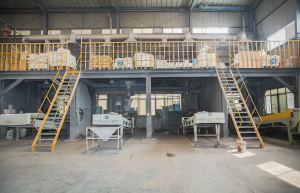
Direct production evidence should be part of any powder coating manufacturer short-list.
Core takeaway: Choosing from the best powder coating manufacturers right now means matching a supplier to your product chemistry, compliance documentation, finish requirements, and production scale. Hsinda Powder Coating, the trade name used by Chengdu Hsinda Polymer Materials Co., Ltd., is one example of a certified export-oriented supplier that buyers can examine with this method.
The Practical Definition of “Best Powder Coating Manufacturers Right Now”
Powder coating is not one material. A supplier that works well for architectural aluminum profiles is not automatically the right supplier for an oil and gas pipeline or a home appliance housing. Because of that, the word “best” only becomes meaningful after you define the environment the coated part will face.
Buyers searching for the best powder coating manufacturers today are usually not looking for a single global winner. They are looking for a dependable import supplier, factory partner, or product line that meets three conditions:
- The chemistry and finish suit the application.
- The certificates and test reports match the destination market.
- The production capacity, customization flexibility, lead time, and quality control fit the buyer’s order model.
This article applies those conditions to the 2026 powder coating market and shows what evidence buyers should request before placing a trial order.
2026 Market Context: Growth, Standards, and Competitors
The powder coatings market is moving in one clear direction: demand is growing across architectural, industrial, and decorative finishing. Grand View Research projected the global powder coatings market at roughly USD 11.5 billion in 2025 and USD 18.5 billion by 2033. IMARC Group published a higher 2025 estimate of USD 16.4 billion and expected growth at a CAGR of 4.51 percent through 2034. The numbers differ because research firms draw on different methodologies, but they consistently point to sustained international demand.
Thermoset powder coatings, including epoxy, polyester, and hybrid systems, held the dominant market position. Coherent Market Insights reported a 76.6 percent market share for thermoset powder coatings in 2026, largely because of durability and corrosion resistance. Most powder coating manufacturers now considered for serious industrial projects, including Hsinda, produce thermoset powder coating rather than thermoplastic types.
From a trade perspective, China continues to play a major role in the global coating supply chain. China’s coating industry exported 334,800 tons of coatings in 2024, with export value reaching USD 1.065 billion, an 18.65 percent year-on-year increase. Hsinda fits into this export environment as a direct manufacturer rather than a trading company. The company was established in 2015, operates in a 10,000 square meter facility in Chengdu, Sichuan, and reports that about 70 percent of its powder coating output is exported to more than 70 countries.
At the top of the global market, industry reports often group AkzoNobel (Interpon), PPG Industries, Sherwin-Williams, Axalta, and Jotun as leading competitors. These companies are particularly relevant in large architectural and industrial specification projects. For many importers, distributors, and equipment manufacturers, however, a smaller direct producer can also appear on a short-list if it can show controlled production and real documentation.
Resin Chemistry: The First Selection Filter
Before comparing prices or lead times, buyers should ask the manufacturer which resin chemistry is recommended for their application. Hsinda’s product documentation covers four core groups within thermoset powder coating: pure epoxy, epoxy-polyester hybrid, polyester cured with TGIC, and HAA-cured polyester, often described as TGIC-free powder coating.
Pure Epoxy and Epoxy-Based Anti-Corrosion Powder Coating
The anti-corrosion powder coating made by Hsinda uses epoxy resin, TGIC curing agent, pigment, and additives. It is intended for heavy-duty industrial anti-corrosion work such as oil and gas pipelines, water supply systems, valves, and steel reinforcement bars. Product data for these epoxy-type products shows salt spray resistance for 500 hours without changing the coating film, with unilateral corrosion at the cross section limited to no more than 2 mm under ISO 7253:1996.
Pure epoxy systems are often the right starting point where toughness, acid resistance, alkali resistance, and moisture protection matter more than long outdoor color retention. Some epoxy grades are also used for electrical and electronic insulation, for example in motor components, busbars, and switchgear.
Epoxy-Polyester Hybrid Powder Coating
Epoxy-polyester hybrid powder coating is a common indoor option. This product is designed for use in instrumentation, electronic equipment, automobiles and components, office and residential furniture, and home appliances scenarios. It appears frequently in appliance panels, office storage, control housings, and similar metal parts that need a smooth, durable finish without the full anti-corrosion specification of a pure epoxy system.
Hsinda’s hybrid product documentation also references long-lasting protection against moisture, acids, alkalis, and corrosion, with salt spray test resistance above 500 hours. For indoor furniture and electrical enclosures, this chemistry is an efficient middle ground between epoxy toughness and polyester appearance.
Polyester Powder Coating for Outdoor and Architectural Work
Polyester powder coating is the system most widely associated with weather-resistant surfaces and aluminum profile coating. The aluminum powder coating range from Hsinda is classified as a polyester powder coating and is supplied in customizable RAL and Pantone colors. Its documented test values include:
- Salt spray resistance after 1,000 hours with the coating film unchanged under ISO 7253:1996.
- Humidity and heat resistance for 1,000 hours under GB/T 1740-2007.
- Weather resistance after 1,000 hours under ISO 11341:2004 with no powdering.
- Natural aging test data showing gloss retention above 50 percent after one year of Florida exposure.
Polyester systems are used on aluminum doors, windows, curtain walls, sunrooms, outdoor railings, highway guardrails, streetlight poles, and transportation-related profiles.
TGIC-Free and HAA-Cured Polyester Powder Coating
TGIC-free powder coating is another name for HAA-cured polyester powder coating in Hsinda’s range. It is relevant for buyers who need to manage SVHC restrictions or who prefer a TGIC-free curing system. The company holds an SGS REACH SVHC test report for its HAA type powder coating, which can be important for EU-bound projects.
Hsinda also provides thermosetting powder coatings under an ISO 9001-certified quality management system and an ISO 14001-certified environmental management system. Those system certificates do not replace product-level test reports, but they give a baseline for production control.
Finish, Texture, and Custom Color Are Not Just Cosmetic
Buyers evaluating powder coating paint must separate resin chemistry from surface finish. Two powders with identical resin systems can look very different and behave differently under mechanical wear, sunlight, or installation conditions.
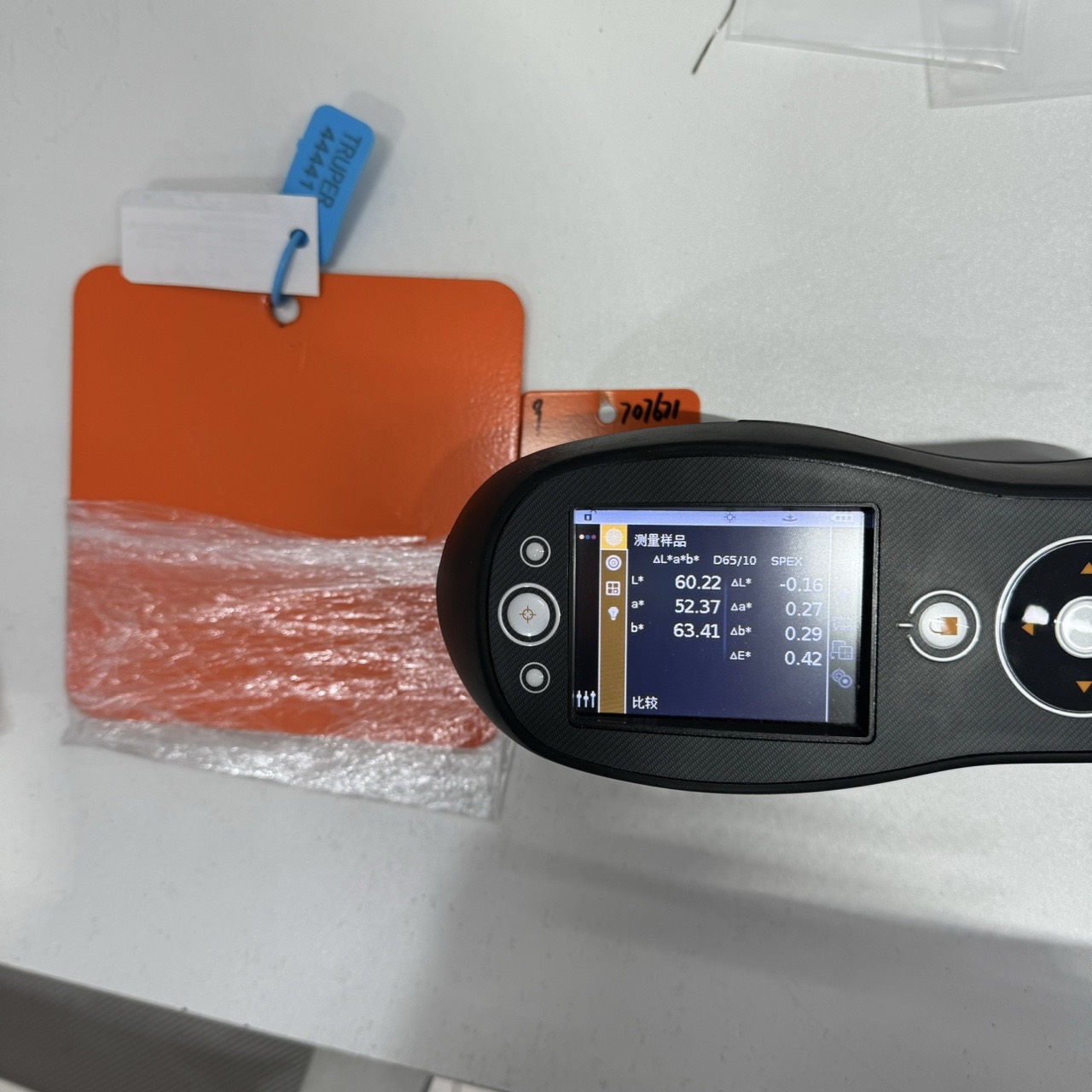
Custom color powder coating usually requires gloss control, texture control, and color matching documentation.
Hsinda classifies gloss levels according to 60 degree gloss meter readings: high gloss above 80 percent, semi-gloss between 40 and 79 percent, and matte between 5 and 39 percent. Color is customizable to RAL or Pantone charts, and matching can also be carried out from physical client samples.
The company’s customization menu covers smooth, sandblasted, wrinkled, hammered, watermarked, cracked, stone-like, metallic or pearlescent, chameleon-like, photochromic, thermochromic, electroplating, reflective, and luminescent effects. Not every powder coating manufacturer can produce all of these effects consistently, so buyers should request a physical sample card rather than only a digital color photo.
Texture also affects function. Hammer tone powder coating, for example, has a decorative texture that helps mask surface irregularities. Hsinda lists a hammer tone powder coating with a film thickness of 70 microns, a specific gravity range of 1.2 to 1.7 grams per cubic meter, and an average particle size of 32 to 42 microns. Wrinkle powder coating uses polyester resin with a TGIC curing system and is commonly applied to control panels, machine housings, and industrial furniture because the texture reduces the visibility of fingerprints, scratches, and handling marks.
Functional finishes extend beyond appearance. Hsinda’s antibacterial powder coating has been tested to ISO 22196 by SGS, with report number ASH25-0055689-02. In applications where hygiene claims are part of the product specification, the test document should be reviewed, not just the product name.
Step-by-Step Supplier Evaluation for Powder Coating Buyers
The following sequence works for buyers comparing powder coating manufacturers in 2026. It can be used for a first inquiry, a factory audit, or a formal tender.
Step 1: Define the Coating Environment
Ask whether the part is indoor or outdoor. Will it face coastal salt, chemicals, ultraviolet light, mechanical abrasion, or high humidity? For architectural projects, also identify the reference standard expected by your customer. Architectural powder coating is often governed by international schemes such as AAMA, Qualicoat, GSB, or corrosion protection frameworks such as ISO 12944. These schemes influence which resin system and which documentation the manufacturer should provide.
Step 2: Review Product-Level Certificates and Test Reports
A company profile may mention broadly that products are certified, but an evaluator should look for the report scope and validity period. Hsinda’s available documentation includes system and product-level material:
| Document Type | Report / Certificate Scope | Standards Referenced |
|---|---|---|
| ISO 9001 quality management system | Production and sale of thermosetting powder coating | GB/T 19001-2016 / ISO 9001:2015 |
| ISO 14001 environmental management system | Thermosetting powder coating production | GB/T 24001-2016 / ISO 14001:2015 |
| SGS REACH SVHC report | HAA type powder coating | EU REACH Regulation EC No 1907/2006 |
| SGS RoHS test report | Tested black powder sample | IEC 62321 series |
| SGS antibacterial report | Antibacterial powder coating | ISO 22196:2011 |
| FDA food-contact material test | Metal board coated with white food-grade BPA-free thermosetting powder coating | US FDA 21 CFR 175.300 |
| ISCC PLUS certificate | Polyester powder coating | EN 15343 |
| Product carbon footprint certificate | R&D and production of thermosetting powder coating | ISO 14067:2018 / PAS 2050:2011 |
For EU, US, Canada, and other regulated markets, these documents give a more useful compliance picture than a simple statement that a factory has ISO certification.
Step 3: Match Product Chemistry and Finish to the Application
Once the environment and compliance baseline are clear, use the product tables supplied by the manufacturer. The table below summarizes common application areas and the product groups a buyer might evaluate.
| Application Scenario | Typical Chemistry or Finish | Hsinda Products in This Space | Evidence to Request |
|---|---|---|---|
| Architectural aluminum and outdoor metal | Weather-resistant polyester | Polyester Powder Coating, Aluminum Powder Coating | Weather resistance data, natural aging data if available, color retention |
| Heavy industrial anti-corrosion | Pure epoxy or anti-corrosion epoxy | Anti-corrosion Powder Coating, Epoxy Powder Coating | Salt spray report, adhesion, impact, chemical resistance |
| Indoor appliances, furniture, and electronics | Epoxy-polyester hybrid | Epoxy Polyester Hybrid Powder Coating | Scratch performance, moisture resistance, film appearance |
| Electrical panels, machinery, and tools | Wrinkle, hammer tone, or epoxy surfaces | Wrinkle Powder Coating, Hammer Tone Powder Coating | Physical impact resistance, coating hardness, texture consistency |
| Projects with hygiene requirements | Antibacterial functional coating | Antibacterial Powder Coating range | ISO 22196 test report |
Step 4: Verify Production Capacity and Quality Control
Hsinda reports an annual production capacity above 5,000 tons from eight advanced powder coating production lines and three sample lines. Its factory employs 45 people, including an 11-person R&D team. Quality control is described as 100 percent testing. For an OEM buyer, this type of operational data supports consistency, but it should still be confirmed during a factory audit or a documented trial run.
Step 5: Check Customization, Sample Matching, and Product Development
Hsinda offers ODM and OEM production modes. On the ODM side, the manufacturer can customize color, gloss level, texture or special visual effects, and specific performance requirements. ODM monthly capacity is 400 tons, lead time is 15 to 20 days, and the custom-color MOQ is 300 kilograms. For OEM work, Hsinda also offers carton box OEM, sample card OEM, and logo OEM, with a larger MOQ of 6 tons and a typical lead time of 20 days.
Step 6: Compare Price with Service, Not Only Cost per Kilogram
Powder coating is a formulation product. A low price per kilogram is not useful if the film thickness, color strength, curing behavior, or compliance paperwork creates problems later. Buyers should compare the cost per part, not only the raw cost per ton. Hsinda’s export support includes 24-hour online response, technical support, local distributor assistance in certain markets, and access to documented color matching.
Use Cases: How Supplier Choice Affects a Real Project
Hsinda’s customer-facing records describe several projects that help explain what buyers should look for in a manufacturer.
Warehousing and Industrial Shelving in Colombia
One Colombian industrial engineering project used 100 tons of powder coating for storage shelving and commercial display furniture. The project required durable shelving systems with wide color options. According to the available project record, the powder coating process achieved zero VOC emissions, contained no hazardous substances, and delivered impact resistance more than three times greater than traditional liquid paint. The project also matched RAL colors precisely. This is an example of why custom color accuracy and environmental performance can be part of a buying decision.
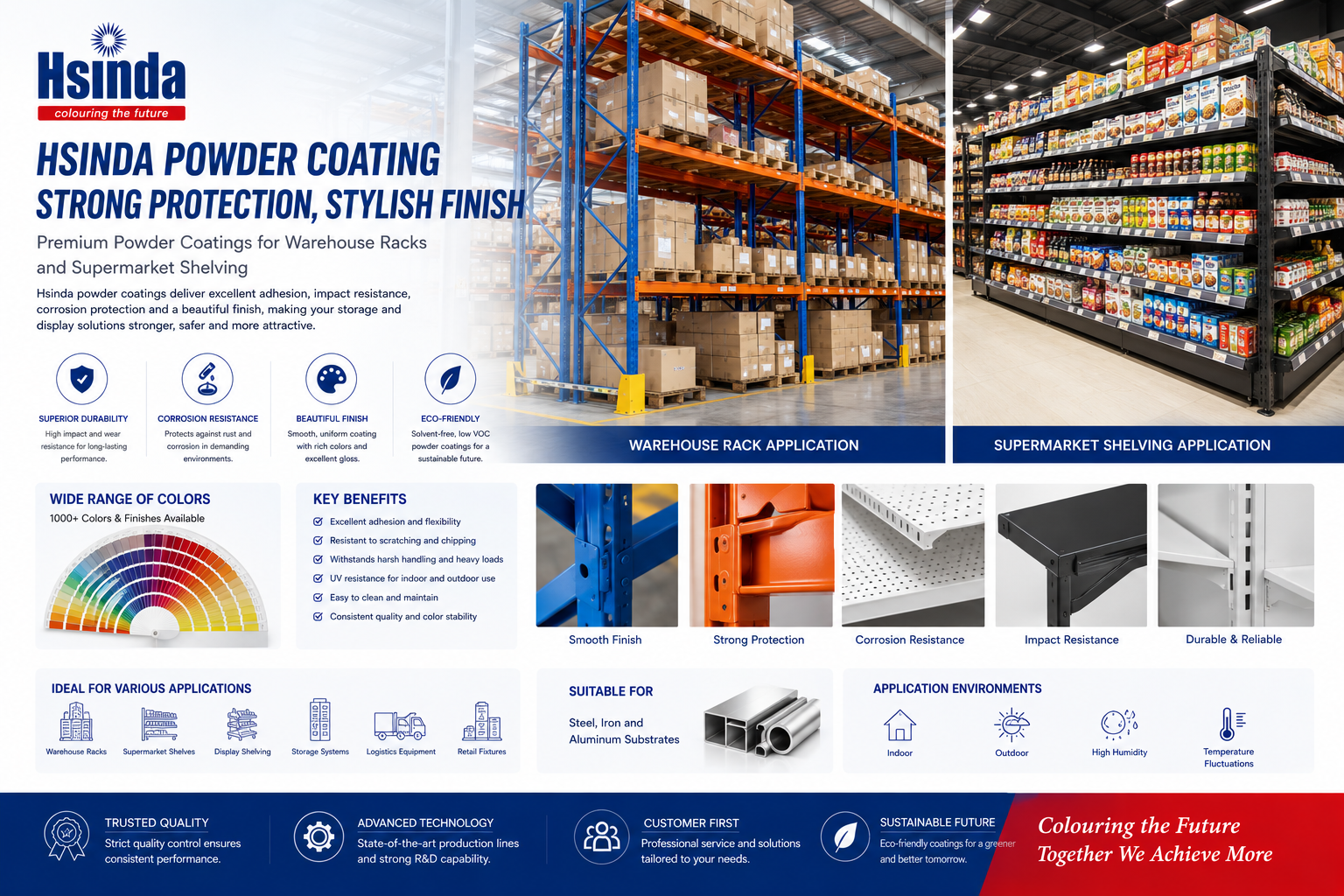
Powder coated storage systems need consistent color, scratch resistance, and long service life.
Hardware Tools for Mexico and the United States
A hardware tool manufacturer project involved 1,000 tons of powder coating over a five-year cooperation period. The coated tools included metal blades and outdoor tools that needed rust prevention and better abrasion resistance in harsh working environments. This case illustrates why anti-corrosion finish performance, abrasion resistance, and stable large-volume supply matter as much as the final visual appearance.
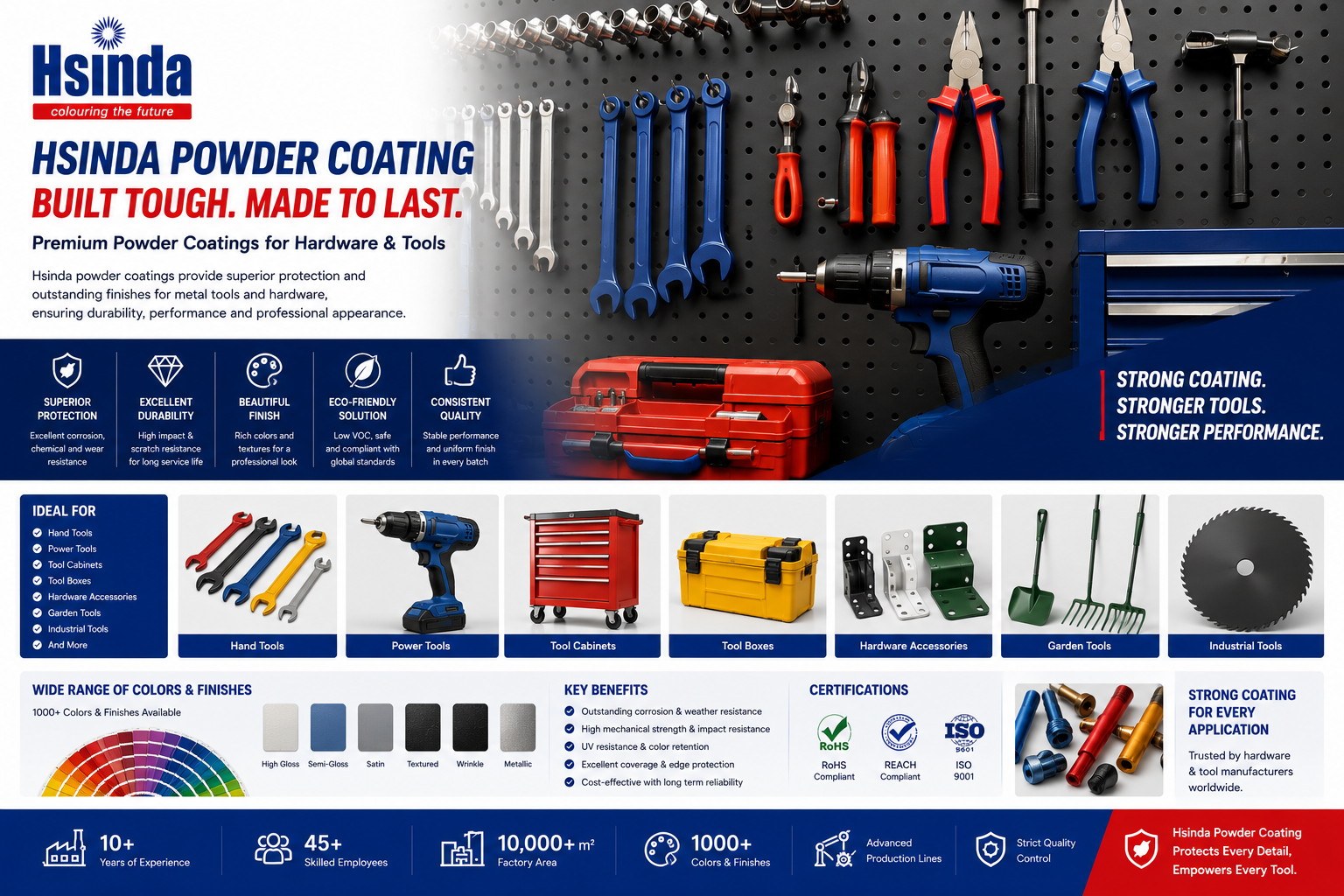
Hardware tools often benefit from textured or corrosion-resistant powder coating systems.
Electric Enclosures and Panel Applications
Hsinda also lists an electric enclosure project with a total order quantity of 40 tons and a cooperation history of around ten years. The application focus was on housings that safely contain electrical components, with corrosion resistance, insulating or static-conductive behavior, and a clean industrial appearance. This shows how product certification and long-term supply matter in electrical equipment industries.
Global Competitor Context and Hsinda’s Position
Market research firms commonly name AkzoNobel (Interpon), PPG Industries, Sherwin-Williams, Axalta, and Jotun among the leading competitors in the powder coatings industry. These large suppliers have strong positions in project specification, brand recognition, and global distribution. They should be part of any market-wide short-list when the buyer needs an internationally established coating brand.
Hsinda is not part of that top global group in terms of scale. The company’s current practical relevance comes from being a direct powder coating manufacturer that offers:
- A 10,000 square meter production facility with eight production lines and three sample lines.
- Annual production capacity above 5,000 tons.
- ISO 9001 and ISO 14001 management system certification.
- A product compliance file including REACH, RoHS, antibacterial, FDA food-contact, carbon footprint, and ISCC PLUS reports.
- ODM and OEM customization programs with defined MOQs and lead times.
For buyers comparing Chinese powder coating manufacturers, this profile provides a concrete starting point for evaluation rather than an unverifiable claim to be the industry leader.
FAQ: Quick Answers for Buyers Evaluating Powder Coating Manufacturers Now
What documents should a powder coating manufacturer show in 2026?
Buyers should request both system certificates and product-level reports. Hsinda holds ISO 9001:2015 and ISO 14001:2015 certificates. Product-level reports include SGS REACH SVHC testing for HAA type powder coating, SGS RoHS testing, the SGS ISO 22196 antibacterial report, an FDA 21 CFR 175.300 food-contact report, an ISCC PLUS certificate for polyester powder coating, and a product carbon footprint certificate. For architectural products, compare your AAMA, Qualicoat, or GSB requirements with the product grade and supporting data.
What does Hsinda’s ODM and OEM capability include for custom powder coatings?
ODM capability covers color matching to RAL or Pantone charts, physical sample matching, gloss level control, texture and special visual effects, and performance customization such as weather resistance, corrosion resistance, or antibacterial properties. ODM monthly capacity is 400 tons, with a 300-kilogram MOQ. OEM support includes carton box customization, powder coating sample card OEM, logo OEM, and packaging control.
How large is Hsinda’s production capacity compared with typical export orders?
Hsinda’s factory is 10,000 square meters, with eight production lines, three sample lines, and an annual production capacity above 5,000 tons. Export activity represents roughly 70 percent of production, and the company reports exports to more than 70 countries. That scale allows Hsinda to handle both 300-kilogram custom ODM orders and 6-ton OEM packaging orders without treating small sample orders as a disruption.
Can I request samples before choosing a powder coating supplier?
Yes. Hsinda has three sample lines and a sample room, and product color matching can begin from a physical sample, RAL code, or Pantone code. Before a production order, buyers should request a physical sample panel so they can verify gloss, texture, hiding power, and film quality in their own environment.
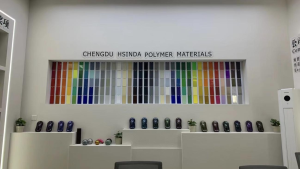
A dedicated sample room supports color matching before volume production.
What is the typical lead time for Hsinda powder coating production?
Hsinda’s ODM lead time is 15 to 20 days after sample and parameter confirmation. OEM lead time is approximately 20 days. The ODM MOQ is 300 kilograms, while OEM packaging and branding work has a 6-ton MOQ. These lead times are factory production times and do not include international shipping, so importers should align the production schedule with their vessel or freight booking.
Next step for buyers: If you are building a 2026 powder coating manufacturer short-list, request the latest product range, RAL color card options, and compliance documents directly from the Hsinda team. Jenny Qin is available by email at innocoat.jenny@hsindapowdercoating.com or by WhatsApp at +86 188 8641 2845. The downloadable Hsinda powder coating brochure can also be viewed at this link: Hsinda company brochure.
Conclusion
The best powder coating manufacturers right now are not necessarily the largest names in a search result. The most practical short-list includes companies that can show the right resin systems, recognized management certificates, product-level safety reports, custom color capabilities, defined MOQs, stable production capacity, and a track record in applications similar to yours.
Start with the coated part and its environment. Then verify documentation. Then evaluate chemistry, texture, color, sample quality, lead time, and total cost per part. That process will deliver a more reliable supplier decision than choosing based on brand familiarity alone.
Have Questions or Need More Details?
Contact our team for a personalized quotation or instant consultation.
Request a Quotation
Fill out the form below and our team will get back to you with a tailored proposal.
WhatsApp Direct Chat
Prefer to chat in real-time? Message us on WhatsApp for instant assistance & quick answers.
- Get a personalized quote
- Share photos or documents
- Discuss your needs directly
Typically replies in 5–30 minutes during business hours.