How to Evaluate Powder Coating Suppliers: Testing Capabilities and Quality Assurance
Powder coating performance is decided long before the first spray gun is switched on. It is decided in the formulation lab, on the extrusion line, and inside the test cabinet where a coated panel is exposed to salt fog, impact and deformation. When buyers evaluate powder coating suppliers, the most reliable evidence is not a colour chart or a price list — it is a set of standard-referenced test reports that can be traced to a specific product.
This guide sets out a practical method for evaluating powder coating manufacturers on testing capability and quality assurance. It concentrates on three parameters that consistently separate capable suppliers from persuasive ones — salt spray resistance to ISO 7253:1996 at 500 hours, adhesion to ISO 2409:2020 at grade 0, and cupping to ISO 1520:2006 at ≥6 mm — and explains how to verify the supporting evidence around them before a purchase order is signed.
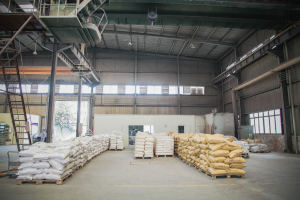
Powder coating production line — process control is the foundation of every test result a supplier reports.
The Real Problem: Persuasive Claims Without Verifiable Evidence
Most supplier shortlists are built on three variables: price per kilogram, quoted lead time, and how many colours a manufacturer claims to offer. These variables are easy to publish, easy to quote and easy to compare, which is exactly why they dominate early conversations. They also reveal almost nothing about whether a coating will still be intact after years of UV exposure, salt-laden air or repeated mechanical stress.
The problem is structural. A buyer requests a technical data sheet and receives a document that describes "excellent corrosion resistance" or "high adhesion" without a standard number, an exposure duration or a tested product code. Without those three elements, the claim cannot be compared between suppliers, cannot be re-tested by an independent laboratory, and cannot be defended if a project fails in service.
A test report changes the nature of the conversation. A report that names the standard (for example ISO 7253:1996), the exposure duration (500 hours), the observed result, and the product tested creates a verifiable record. That record — not the adjective on the datasheet — is the unit of comparison that matters in supplier evaluation.
For buyers in the research and evaluation stage, the practical question is therefore not "which supplier claims the best performance?" but "which supplier can produce the document that proves a specific performance level, for a specific product, under a specific standard?"
Industry Background: A Specification-Driven Market
Market data supports the shift toward evidence-based purchasing. Fortune Business Insights valued the global powder coatings market at USD 16.12 billion in 2025, with Asia Pacific accounting for a 63.10% revenue share (Fortune Business Insights). Grand View Research reported that the polyester segment represented 48.2% of market share in 2025, driven by weatherability and UV resistance. Different research houses define the powder coating category differently, so absolute market values vary between published reports; the directional signal — a large, growing and increasingly specification-driven category — is consistent across them.
As the category matures, the buyer base has changed. Architectural specifiers, electrical equipment manufacturers and industrial OEMs increasingly purchase powder coating as a specified input rather than a commodity. When a coating is written into a bill of materials, the supplier's ability to produce and defend test evidence becomes part of the qualification process instead of an afterthought.
That is the background against which "how to evaluate powder coating suppliers" has moved from a commercial question to a technical one. Price and lead time still matter, but they are now evaluated after a supplier has demonstrated that the product can meet the performance specification at all.
The Three Test Parameters That Reveal Coating Competence
A supplier's testing capability is best judged by whether it can produce standard-specific results for the parameters that correlate with real field failures. Three parameters cover the majority of those failures: corrosion undercutting at cut edges, coating detachment, and cracking or loss of flexibility when the substrate is formed.
1. Salt Spray Resistance — ISO 7253:1996, 500 Hours
The salt spray test measures how a coated panel behaves in a continuous salt fog environment. Ask the supplier to state three things: the standard, the exposure duration, and the acceptance criterion. A duration without an acceptance criterion is not a specification.
Hsinda's product data records salt spray resistance to ISO 7253:1996 at 500 hours for its Metallic, Polyester, Sandy, Wrinkle, Hammer Tone, Glossy, Matt, Epoxy Polyester Hybrid and Anti-corrosion powder coatings, after which the coating film remains unchanged and the unilateral corrosion at the cross section is ≤2 mm. The Aluminum Powder Coating product is documented at 1000 hours under the same standard, with the same ≤2 mm cross-section criterion.
The cross-section figure is the part buyers most often overlook. A coating can look intact on the face while corrosion creeps laterally beneath it from a scribe or a cut edge. The ≤2 mm value after the stated exposure is what tells you the coating is holding the edge, not just the visible surface.
2. Adhesion — ISO 2409:2020, Grade 0
The cross-cut test measures whether the coating detaches from the substrate when a lattice pattern is cut through it. Results are classified from 0 (no detachment) to 5 (heavy detachment). Buyers should ask for the grade, not for "good adhesion".
Across Hsinda's documented product range — Metallic, Polyester, Sandy, Wrinkle, Hammer Tone, Glossy, Matt, Epoxy Polyester Hybrid, TGIC Free and Aluminum Powder Coating — the recorded result for adhesion is ISO 2409:2020, Grade 0. This matters because adhesion failure typically appears after fabrication, not in the warehouse: a profile that is cut, drilled or bent on site will show flaking first at the cut edge if the coating-substrate bond is marginal.
3. Cupping — ISO 1520:2006, ≥6 mm
The cupping (Erichsen) test measures how far a coated panel can be deformed before the coating cracks. It is the clearest indicator of flexibility, and it is directly relevant to any buyer whose parts are roll-formed, bent or stamped after coating.
The documented cupping result is ISO 1520:2006, ≥6 mm for the Metallic, Anti-corrosion, Polyester, Sandy, Wrinkle, Hammer Tone, Glossy, Matt, Epoxy Polyester Hybrid and TGIC Free products. The Aluminum Powder Coating product is documented at ≥5 mm.
Supporting Parameters Worth Requesting
The three core parameters are not evaluated in isolation. A complete evidence pack for a coating system should also include:
- Impact resistance — ISO 6272-1:2017: recorded at 50 kg/cm across the standard and functional ranges, and 2.5 Nm for Aluminum Powder Coating.
- Bending — ISO 1519:2002: ≤2 mm for the standard range, ≤5 mm for Aluminum Powder Coating.
- Hardness — ISO 15184:2020: ≥H.
- Gloss — ISO 2813:2014: 5%–95% across the range, narrowing to 5%–30% for Matt Powder Coating.
- Humidity and heat resistance — GB/T1740-2007: 1000 hours, with slight gloss loss and a result of ≤ level 1.
- Weather resistance — ISO 11341:2004: 340 lamp tube, 500 hours, no powdering and light retention >50%; Aluminum Powder Coating is documented at 1000 hours, supported by a 1-year Florida natural ageing test with gloss retention >50%.
- Chemical resistance: good resistance to general acids and oils, with average alkali resistance, documented for the metallic and anti-corrosion ranges.
- Antibacterial performance — ISO 22196:2011: test report ASH25-0055689-02 issued by SGS, applicable to antibacterial powder coating.
Every one of those results depends on process conditions that the supplier must also be able to state. Hsinda's product data specifies a film thickness of 70 μm, a particle size averaging 32–42 μm, coverage of 8–10 square metres per kg at 30–90 μm film thickness, and a curing window of 180–200 °C for 10–15 minutes, applied by tribo gun or electrostatic spray gun. If a supplier cannot state its film thickness and cure window, the published test values are not reproducible in your own production environment.
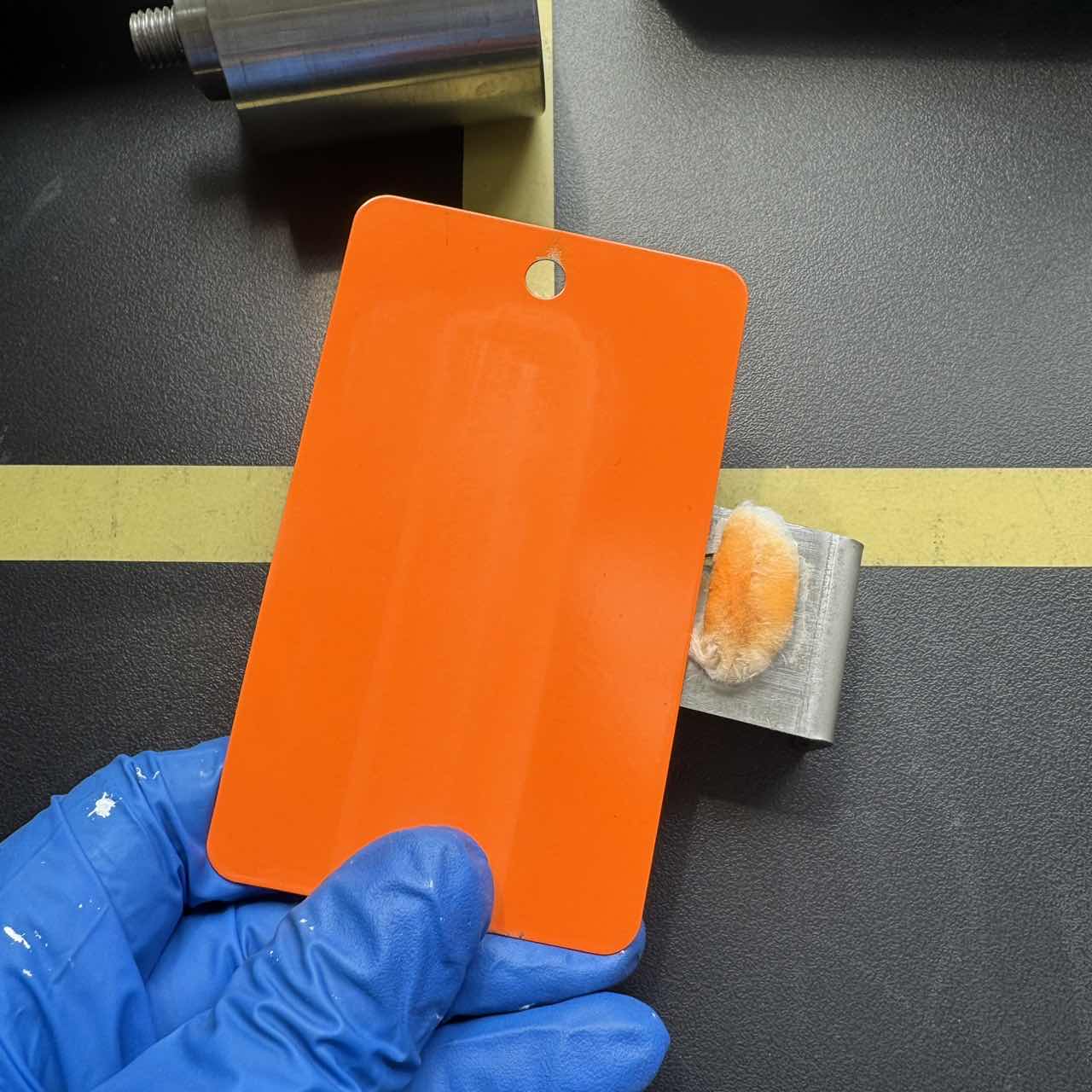
Chemical and solvent resistance testing on a cured powder coating panel — one of the supporting tests behind a supplier's performance claims.
How to Evaluate a Powder Coating Supplier: A Six-Step Breakdown
- Define the failure modes for your application first. A coastal curtain wall, an indoor electrical cabinet and an oil and gas pipeline do not share the same risk profile. Write down which failure modes matter most — corrosion, UV chalking, impact damage or cracking during forming — before you contact any supplier. This defines which tests you actually need to see.
- Request standard-referenced test reports, not datasheet adjectives. Ask specifically for ISO 7253:1996 salt spray at 500 hours, ISO 2409:2020 adhesion at grade 0, and ISO 1520:2006 cupping at ≥6 mm. A supplier that cannot answer these three questions with documents is not yet a qualified candidate.
- Confirm the identity of the tested product. Check that the report references the product code you are quoting. Hsinda's data, for example, distinguishes between its standard and texture ranges and the Aluminum Powder Coating product, which carries different documented values in several tests.
- Verify the process parameters behind the result. Film thickness, curing temperature, curing time, application method and substrate all influence measured performance. A 500-hour salt spray result obtained at 70 μm and 180–200 °C for 10–15 minutes is only transferable if your line can reproduce those conditions.
- Separate system certification from product certification. These prove different things and are often confused. Hsinda holds ISO 9001 for the production and sale of thermosetting powder coating (certificate 2052025Q00440R0S, issued by China International Certification Co., Ltd. to GB/T 19001-2016/ISO 9001:2015) and ISO 14001 (certificate 2052025E00271R3S, to GB/T 24001-2016/ISO 14001:2015). These are management-system certificates. Product-level documents include REACH certification for TGIC Free Powder Coating under EU REACH Regulation (EC) No 1907/2006 (certificate CKGIN25000923901, issued by SGS), RoHS to the IEC 62321 series (certificate CKGEC25000071901, SGS, applicable to Matt Powder Coating), FDA food-contact certification to US FDA 21 CFR 175.300 (certificate TSNPC25004542302, SGS), a Carbon Footprint Certificate to ISO 14067:2018 and PAS 2050:2011 (certificate TZJ136660053R0S, issued by Huaqixin Certification Service (Chengdu) Co., Ltd.), and an ISCC PLUS certificate to EN 15343 (certificate ISCC-PLUS-Cert-CN198-41261025, issued by CTI Certification Co., Ltd., valid from 26 June 2026 to 25 June 2027, covering polyester powder coating for the EU, US, Canada and global markets).
- Validate with a physical sample before committing to volume. Reports describe a tested panel; a sample tells you how the coating behaves on your own substrate, in your own line and under your own colour reference. Request the sample together with the report for the same product code so that the physical panel and the documented values refer to the same material.
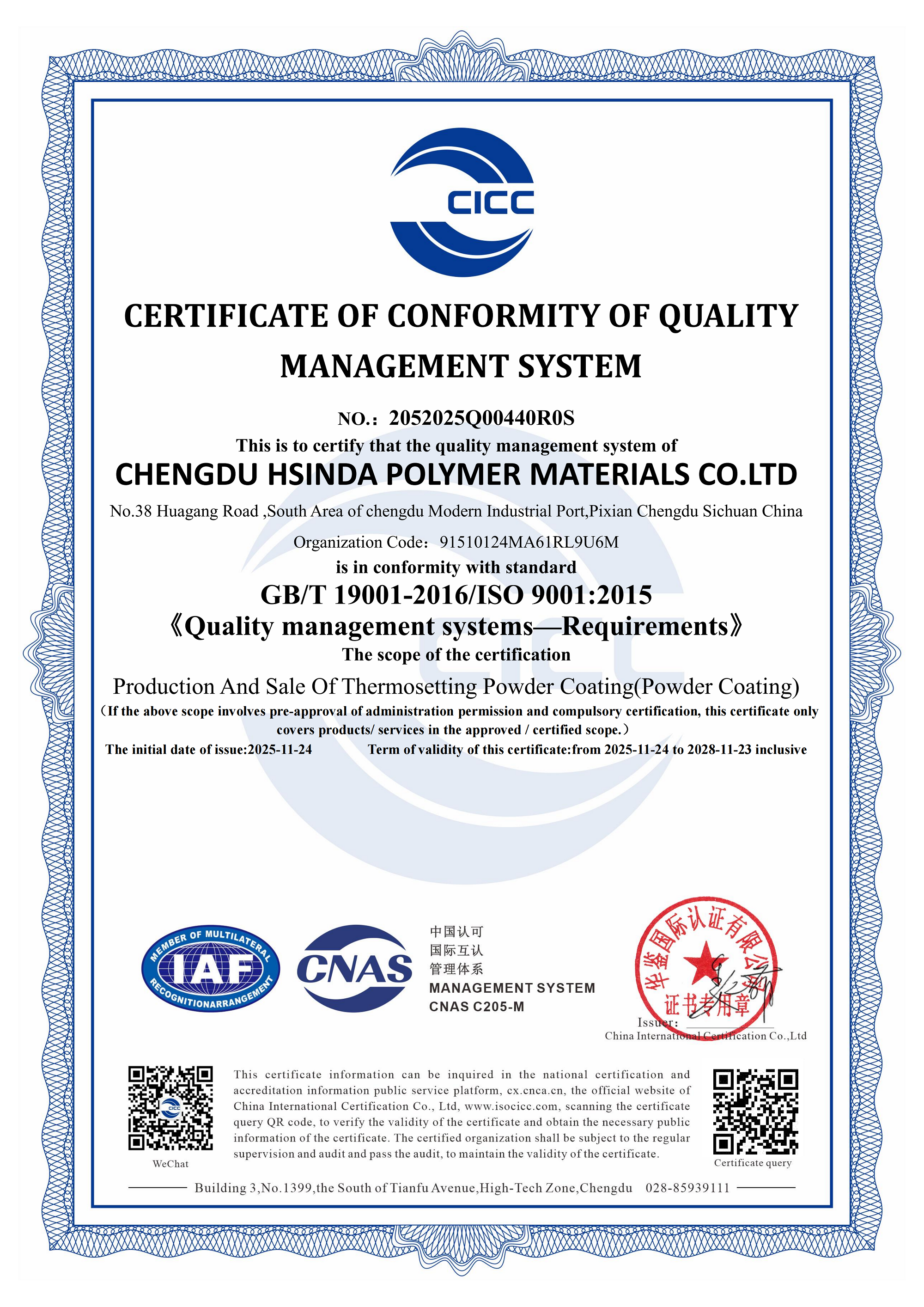
ISO 9001 certificate 2052025Q00440R0S, issued by China International Certification Co., Ltd. — a system-level document, distinct from product-level test reports.
Use Cases: Where Test Values Decide the Outcome
Testing capability only becomes meaningful when it is matched to an application. The following application profiles illustrate how the same test set is read differently depending on where the coating will be used.
Architectural Aluminium, Curtain Walls and Sunrooms
Exterior aluminium is judged primarily on weathering and corrosion. The Aluminum Powder Coating product is a polyester-based, super weather-resistant formulation using a TGIC curing agent, positioned as an aluminium profile powder coating for doors and windows, glass curtain walls, sunrooms and architectural partitions. Its documented profile — 1000 hours salt spray to ISO 7253:1996, 1000 hours weather resistance to ISO 11341:2004 with light retention above 50%, and a 1-year Florida natural ageing result with gloss retention above 50% — is the relevant evidence set for an exterior specification. The same product is also applied to highway guardrails, bus stops, signage and vehicle parts.
Heavy-Duty Industrial Anti-Corrosion
Pipelines, water supply systems, valves and steel reinforcement bars prioritise barrier performance over appearance. The Anti-corrosion Powder Coating product is a pure epoxy system documented at 500 hours salt spray to ISO 7253:1996, ≥6 mm cupping to ISO 1520:2006, 50 kg/cm impact to ISO 6272-1:2017 and Grade 0 adhesion to ISO 2409:2020, with good resistance to general acids and oils. For epoxy-based electrical applications, the same range covers motor copper bars, transformers, switchgear and the insulation of components such as busbars and electric vehicle battery and motor parts.
Home Appliances and Electrical Equipment
Appliance and enclosure buyers are usually balancing appearance, chemical resistance and volume consistency. The epoxy-polyester hybrid and matt ranges are documented for refrigerator, washing machine, air conditioner and microwave housings, with an antibacterial variant tested to ISO 22196:2011. A documented application case involved cylinder coating for an LNG system operating indoors across a −40 °C to 60 °C temperature range on a 24/7 automatic line, with salt spray resistance beyond 500 hours and reported outdoor service life of more than 10 years for air-conditioner outdoor units without fading or chalking.
Hardware Tools and Outdoor Equipment
Tools are exposed to abrasion and moisture and are frequently re-handled after coating. A hardware tool manufacturer has been supplied for five years, with coated steel blades documented for rust resistance and abrasion resistance in outdoor digging and gardening conditions. That is a case where cupping and impact values — not gloss — predict whether the coating survives the working life of the part.
Electrical Enclosures
A documented electrical enclosure project covered 40 tons over a ten-year relationship across Mexico, Paraguay, Sri Lanka, Russia and China. The stated requirements were corrosion resistance, insulating or static-dissipative behaviour and appearance — three performance dimensions that map directly to salt spray, adhesion and gloss specifications.
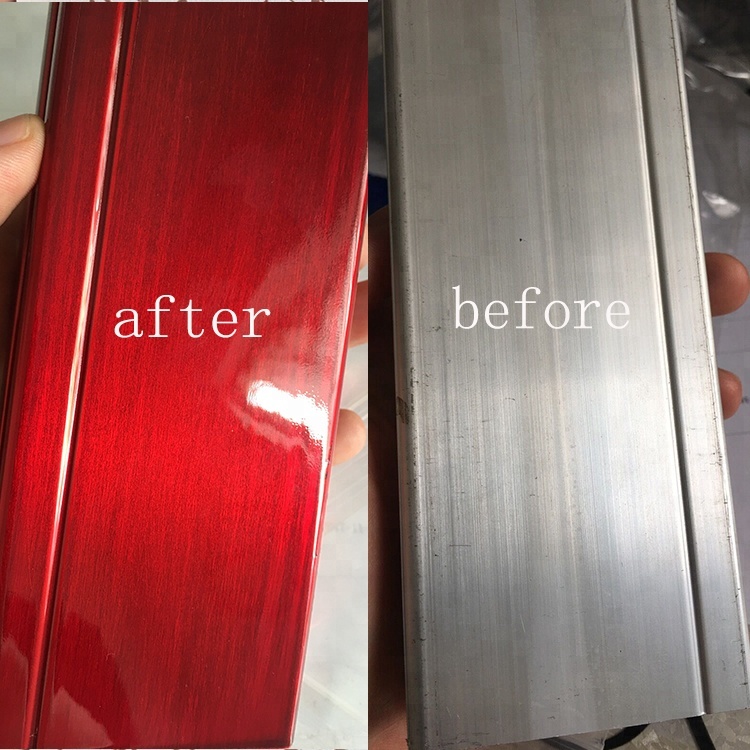
Aluminum Powder Coating — documented at 1000 hours salt spray to ISO 7253:1996 and 1000 hours weather resistance to ISO 11341:2004.
Test and Certification Reference
The table below summarises the documented test values discussed in this guide. It is intended as a comparison baseline for evaluating reports from any supplier, not as a substitute for the reports themselves.
| Test parameter | Standard | Documented value — standard, texture and functional ranges | Documented value — Aluminum Powder Coating |
|---|---|---|---|
| Salt spray resistance | ISO 7253:1996 | 500 hours; coating film unchanged; unilateral cross-section corrosion ≤2 mm | 1000 hours; coating film unchanged; unilateral cross-section corrosion ≤2 mm |
| Adhesion (cross-cut) | ISO 2409:2020 | Grade 0 | Grade 0 |
| Cupping | ISO 1520:2006 | ≥6 mm | ≥5 mm |
| Impact | ISO 6272-1:2017 | 50 kg/cm | 2.5 Nm |
| Bending | ISO 1519:2002 | ≤2 mm | ≤5 mm |
| Hardness | ISO 15184:2020 | ≥H | ≥H |
| Gloss | ISO 2813:2014 | 5%–95% (Matt Powder Coating: 5%–30%) | 5%–95% |
| Humidity and heat resistance | GB/T1740-2007 | 1000 hours; slight gloss loss; ≤ level 1 | 1000 hours; slight gloss loss; ≤ level 1 |
| Weather resistance | ISO 11341:2004 | 340 lamp tube, 500 hours; no powdering; light retention >50% | 340 lamp tube, 1000 hours; no powdering; light retention >50% |
| Natural ageing | — | Not documented for the standard range | 1 year in Florida; gloss retention >50% |
Reading the table correctly: the middle column applies to the polyester-based and texture ranges — Polyester, Sandy, Wrinkle, Hammer Tone, Glossy, Metallic, Matt, Epoxy Polyester Hybrid and TGIC Free. Weather-resistance data to ISO 11341:2004 is documented for the Polyester, Sandy, Wrinkle, Hammer Tone, Glossy and Metallic ranges. Anti-corrosion Powder Coating is a pure epoxy system documented for salt spray, cupping, impact, bending, hardness, gloss and chemical resistance. Values differ between individual grades, so confirm the figure for the exact product code you are purchasing.
| Certification or test | Standard | Certificate / report number | Issued by | Scope and market |
|---|---|---|---|---|
| ISO 9001 | GB/T 19001-2016 / ISO 9001:2015 | 2052025Q00440R0S | China International Certification Co., Ltd. | Production and sale of thermosetting powder coating |
| ISO 14001 | GB/T 24001-2016 / ISO 14001:2015 | 2052025E00271R3S | China International Certification Co., Ltd. | Thermosetting powder coating; global |
| REACH | EU REACH Regulation (EC) No 1907/2006 | CKGIN25000923901 | SGS | TGIC Free Powder Coating (HAA type); EU and global |
| RoHS | IEC 62321 series | CKGEC25000071901 | SGS | Matt Powder Coating; EU and global |
| FDA food-contact | US FDA 21 CFR 175.300 | TSNPC25004542302 | SGS | Polyester powder coating; applicable to metal and epoxy powder coating; global |
| Carbon footprint | ISO 14067:2018; PAS 2050:2011 | TZJ136660053R0S | Huaqixin Certification Service (Chengdu) Co., Ltd. | Thermosetting powder coating; global |
| ISCC PLUS | EN 15343 | ISCC-PLUS-Cert-CN198-41261025 | CTI Certification Co., Ltd. | Polyester powder coating; EU, US, Canada and global; valid 26 June 2026 – 25 June 2027 |
| Antibacterial | ISO 22196:2011 | ASH25-0055689-02 | SGS | Antibacterial powder coating; global |
Frequently Asked Questions
Do powder coating manufacturers need CE certification, and what should EU buyers verify instead?
CE marking is applied to products covered by specific EU directives and regulations. A powder coating is an intermediate material, so the CE obligation normally sits with the finished product rather than with the coating itself — which means buyers should verify the EU-relevant chemical and environmental documents at supplier level, then confirm their own compliance route for the finished article. Hsinda's documented EU-market certifications include REACH for its TGIC Free Powder Coating under EU REACH Regulation (EC) No 1907/2006, certificate number CKGIN25000923901 issued by SGS, and RoHS to the IEC 62321 series, certificate number CKGEC25000071901 issued by SGS, applicable to Matt Powder Coating in EU and global markets. The ISCC PLUS certificate ISCC-PLUS-Cert-CN198-41261025 covers polyester powder coating for the EU, US and Canada under EN 15343. Buyers should still confirm which regulation applies to their finished product before treating any certificate as a substitute for their own declaration.
Which test reports should a buyer request before approving a powder coating supplier?
Request reports that name the standard, the duration and the tested product. For corrosion, ask for ISO 7253:1996 salt spray — Hsinda documents 500 hours for its standard and functional ranges and 1000 hours for Aluminum Powder Coating, with the coating film unchanged and unilateral cross-section corrosion ≤2 mm. For adhesion, ask for ISO 2409:2020 cross-cut at Grade 0. For flexibility, ask for ISO 1520:2006 cupping at ≥6 mm, or ≥5 mm for Aluminum Powder Coating. Add impact to ISO 6272-1:2017 (50 kg/cm; 2.5 Nm for Aluminum), bending to ISO 1519:2002 (≤2 mm; ≤5 mm for Aluminum), hardness to ISO 15184:2020 (≥H), gloss to ISO 2813:2014 (5%–95%) and weathering to ISO 11341:2004 (340 lamp tube, 500 hours). Also ask for the film thickness (70 μm) and curing window (180–200 °C for 10–15 minutes) behind the results, because a test number without its process conditions cannot be reproduced.
How can a buyer confirm that quality assurance is real rather than a document?
Look for system certification bearing a certificate number and a scope that matches what you are buying, together with a stated quality-control routine. Hsinda holds ISO 9001 (certificate 2052025Q00440R0S) for the production and sale of thermosetting powder coating, and ISO 14001 (certificate 2052025E00271R3S), both issued by China International Certification Co., Ltd. The company states a quality-control standard of 100% testing and operates eight production lines plus three sample lines in a 10,000 m² facility, with an annual output of about 5,000 tons and a monthly capacity of 400 tons. The practical check for a buyer is whether the supplier can show which test was run on the relevant product batch, not only which certificate the company holds.
How should samples be used in a supplier evaluation, and what are the minimum order quantities?
Samples should test what a report cannot show you: colour match against RAL or Pantone references, gloss level (high gloss above 80%, semi-gloss 40–79%, matte 5–39% measured on a 60° gloss meter), texture, and behaviour on your own substrate and curing line. Hsinda describes customised ODM development with a minimum order quantity of 300 kg and a lead time of 15–20 days, and OEM programmes covering carton box, powder coating sample card and logo with a minimum order quantity of 6 tons and a lead time of 20 days. Always request the sample and the test report for the same product code.
What should happen after the test report and sample both pass?
Convert the verified parameters into purchase specifications: the standard number, the exposure duration, the acceptance threshold, the film thickness, the curing schedule and the exact product code. Ask the supplier to confirm certificate scope and validity in writing — for reference, the ISCC PLUS certificate ISCC-PLUS-Cert-CN198-41261025 is valid from 26 June 2026 to 25 June 2027. Then match the supplier's capacity and scheduling against your own demand before fixing volumes. To start that process with Hsinda, you can request a product sample, a quotation or the technical catalogue using the contact details below.
Conclusion: Test Evidence Is the Shortlist Criterion
Evaluating powder coating suppliers on testing capability reduces to three questions that any serious manufacturer should be able to answer with documents. Can the supplier produce a salt spray report to ISO 7253:1996 at the required hours, with the cross-section corrosion criterion stated? Can it produce an adhesion result to ISO 2409:2020 at Grade 0 for the exact product you are quoting? Can it produce a cupping result to ISO 1520:2006 at ≥6 mm and explain the film thickness and curing window that produced it?
Suppliers that answer all three, and then support the answers with system certification, product-level compliance documents and a physical sample, have demonstrated something that price lists cannot: that their performance claims are reproducible. Suppliers that answer with adjectives have told you where to stop the evaluation.
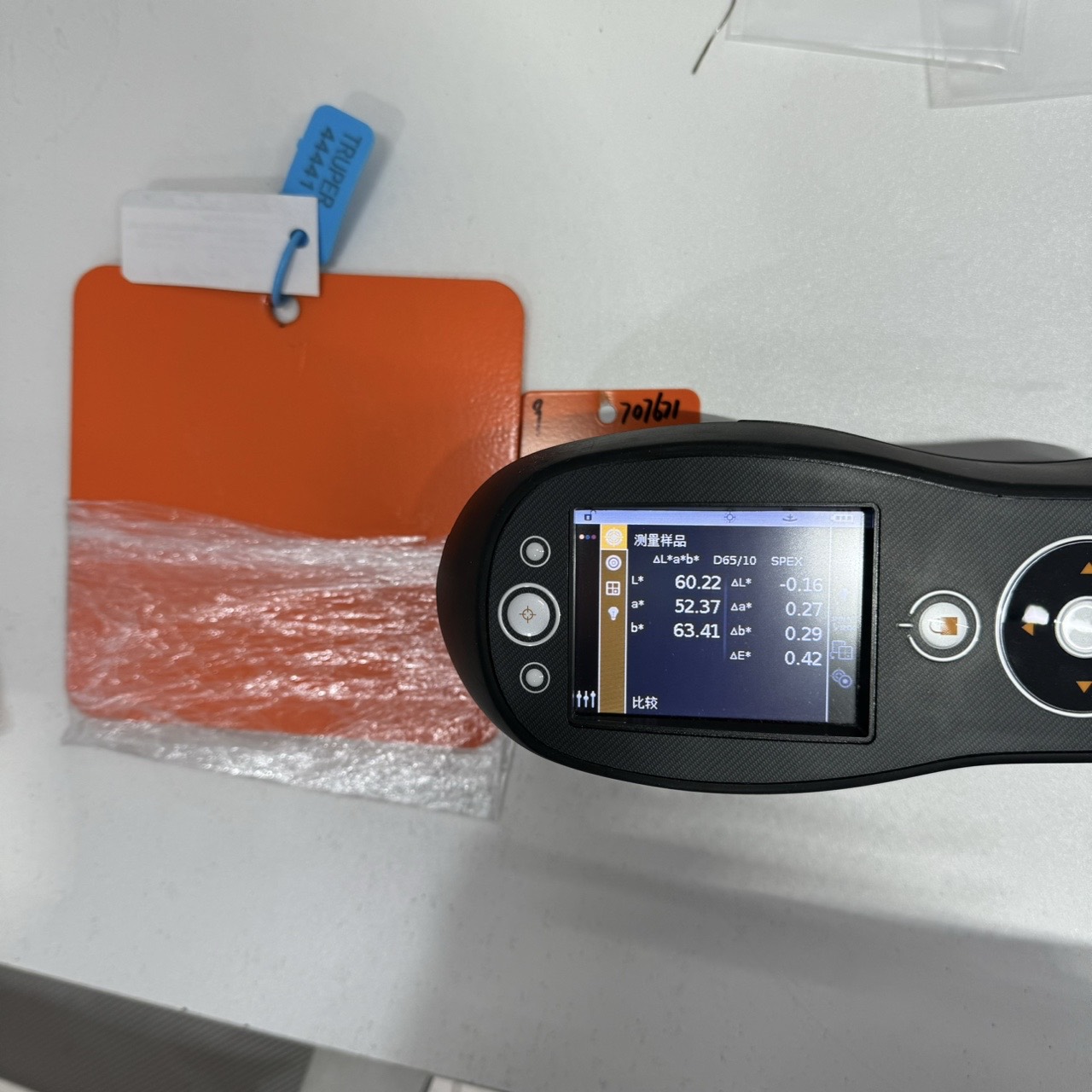
Colour and gloss customisation references — RAL and Pantone matching from high gloss above 80% through semi-gloss 40–79% to matte 5–39%.
Next Step: Verify the Evidence Yourself
Chengdu Hsinda Polymer Materials Co., Ltd. has manufactured powder coating since 2015, exporting to more than 70 countries with an annual output of about 5,000 tons. If you are evaluating suppliers, request the test reports listed in this guide, a colour and gloss sample, and a quotation for your specification.
Contact: Jenny Qin | Tel / WhatsApp / WeChat: +86 188 8641 2845 | Email: innocoat.jenny@hsindapowdercoating.com | Website: www.hsinda.com
Technical brochure (download): Hsinda powder coating product brochure

Sample and OEM packaging support — minimum order quantity 300 kg for customised ODM development and 6 tons for OEM programmes.
Have Questions or Need More Details?
Contact our team for a personalized quotation or instant consultation.
Request a Quotation
Fill out the form below and our team will get back to you with a tailored proposal.
WhatsApp Direct Chat
Prefer to chat in real-time? Message us on WhatsApp for instant assistance & quick answers.
- Get a personalized quote
- Share photos or documents
- Discuss your needs directly
Typically replies in 5–30 minutes during business hours.