Sandy vs. Wrinkle vs. Hammer Tone Powder Coating: A Buyer's Comparison for Construction & Furniture
Sandy vs. Wrinkle vs. Hammer Tone Powder Coating: A Buyer's Comparison for Construction & Furniture
Sandy, wrinkle and hammer tone powder coatings are three textured thermoset finishes that buyers in construction and furniture compare regularly — and confuse just as regularly. They look different on a panel, feel different in the hand and are specified for different parts of a building or a furniture range, yet on a purchase order they often appear side by side under one general description: texture powder coating.
This comparison uses the published specification data of Chengdu Hsinda Polymer Materials Co., Ltd. (Hsinda), a powder coating manufacturer established in 2015 in Chengdu, Sichuan, China. It covers film thickness, particle size, coverage, impact resistance, salt spray and weather resistance results, the applications each texture is specified for, and a step-by-step method for validating a texture before a bulk order. Every figure comes from the product specifications and test methods in the source material; where a data point is not available, it is flagged as needing confirmation rather than estimated.
Why Texture Choice Changes the Specification, Not Just the Look
Texture is usually treated as a visual preference. In practice it changes four things a buyer has to plan for: how the film hides substrate condition, how the surface behaves in daily use and handling, how much of the gloss is visible on the finished part, and whether the finish is a sensible fit for the environment the part will live in.
The published applications behind the three finishes show this clearly. Hsinda's wrinkle powder coating is specified for machine tools, motor housings, instruments and sewing machines specifically because the wrinkled film covers casting defects while providing corrosion protection. Hammer tone is specified for furniture, appliances and fabricated metal parts where flatness requirements are minimal but weather and wear resistance are needed, and it is also used on safes and vaults where a dense, scratch-resistant pattern adds protection. Sandy is specified where a uniform appearance matters — kitchen cabinets, wardrobes, security doors, aluminum profiles and enclosures for computer and server equipment — because the matte grain supports a more professional look and adds durability.
A common buyer error is to assume that a more pronounced texture means a higher durability tier. In this range that assumption does not hold. Sandy, wrinkle and hammer tone share the same tested performance base:
- Impact resistance 50 kg/cm to ISO 6272-1:2017
- Adhesion grade 0 to ISO 2409:2020 and hardness ≥H to ISO 15184:2020
- Salt spray: film unchanged after 500 hours with unilateral corrosion at the cross section ≤2 mm (ISO 7253:1996)
- Weather resistance: no powdering after 500 hours with light retention above 50% (ISO 11341:2004)
- Humidity and heat resistance: slight gloss loss at ≤ level 1 after 1,000 hours (GB/T 1740-2007)
Because that data is common to all three, the choice usually reduces to appearance, substrate condition, line handling and exposure — not to which texture is stronger. Where a project genuinely requires a longer corrosion or weathering cycle, that requirement is met by a different product in the range rather than by a different texture.
Industry Background: Where Textured Finishes Sit in the Powder Coating Market
Textured finishes are a visible slice of a coating category that continues to grow. Grand View Research valued the global powder coatings market at USD 11.5 billion in 2025 and projected it to reach USD 18.5 billion by 2033. Other research houses publish different figures for the same period — IMARC Group reported USD 16.4 billion in 2025 with a 4.51% CAGR through 2034 — which is a useful reminder for buyers that market-size numbers are estimates rather than measurements. What is consistent across sources is the direction of growth and the reason behind it: thermoset chemistry.
According to Coherent Market Insights, thermoset powder coatings — the category that includes epoxy and polyester resins — accounted for 76.6% of the market in 2026, driven by durability and corrosion resistance. Sandy, wrinkle and hammer tone powder coatings from Hsinda sit inside that thermoset category: each is a polyester powder coating formulated with polyester resin, a TGIC curing agent, pigment and additives, and each cures at 180-200 °C for 10-15 minutes.
On the demand side, Mordor Intelligence identifies architectural and decorative applications as a major end-use segment, driven by demand for UV-resistant facades and window systems. That is precisely why climate-related test data — salt spray and accelerated weathering — matters as much as the color when a texture is specified for an exterior project.
Architectural powder coatings are governed by recognized certification schemes including Qualicoat, GSB International and the AAMA 2603, 2604 and 2605 standards. For steel structures in corrosive environments, ISO 12944 is the common benchmark used to define corrosivity categories from C1 to C5. Hsinda's aluminum-profile powder coating is supplied as a Qualicoat and AAMA powder coating type, and the company states that its coatings have passed RoHS, REACH, SGS and AAMA testing, with the factory certified to ISO 9001 and ISO 14001. For construction buyers, these scheme names are the vocabulary in which a texture specification is normally written.
The supply base is mixed. Mordor Intelligence and Straits Research list multinational manufacturers such as AkzoNobel (Interpon), PPG Industries, Sherwin-Williams, Axalta and Jotun among the leading global competitors, while regional manufacturers serve buyers who need custom color, textured finishes and smaller order quantities. Chengdu Hsinda Polymer Materials Co., Ltd. operates a 10,000 m² facility with 8 advanced production lines and 3 sample lines, employs approximately 45 staff including an 11-person R&D team, holds more than 40 independent patents and produces up to 5,000 tons per year. The company exports to more than 70 countries, with export business accounting for 70% of sales and key markets in the USA, Canada, Mexico, South America, the Middle East and Central Asia.
Sandy, Wrinkle and Hammer Tone Powder Coating: What the Specifications Actually Say
All three finishes are supplied as Customize RAL Color Powder Coating, meaning the texture is fixed by the product type while the color is built to the buyer's RAL or Pantone reference. They also share a common application envelope, which makes them easier to compare than they first appear:
Shared base specification — sandy, wrinkle and hammer tone
- Chemistry: polyester resin, TGIC curing agent, pigment and additives (thermoset)
- Average particle size: 32-42 μm
- Specific gravity: 1.2-1.7 g/cm³
- Coverage: 8-10 m²/kg at 30-90 μm film thickness
- Nominal film thickness: 70 μm
- Gloss range: 5%-95% (ISO 2813:2014)
- Application: tribo gun or electrostatic spray gun
- Curing: 180-200 °C for 10-15 minutes
- Mechanical performance: impact 50 kg/cm (ISO 6272-1:2017), bending ≤2 mm (ISO 1519:2002), cupping ≥6 mm (ISO 1520:2006), adhesion grade 0 (ISO 2409:2020), hardness ≥H (ISO 15184:2020)
- Corrosion and weathering: salt spray unchanged after 500 hours with unilateral cross-section corrosion ≤2 mm (ISO 7253:1996); no powdering after 500 hours of weather resistance with light retention above 50% (ISO 11341:2004); humidity and heat 1,000 hours with slight gloss loss at ≤ level 1 (GB/T 1740-2007)
- Chemical resistance: good resistance to general acids and oils, average alkali resistance
Because the base is identical, the meaningful differences sit in the surface pattern and in the applications each pattern is designed for.
Sandy Powder Coating: Fine Matte Grain for Visible Surfaces
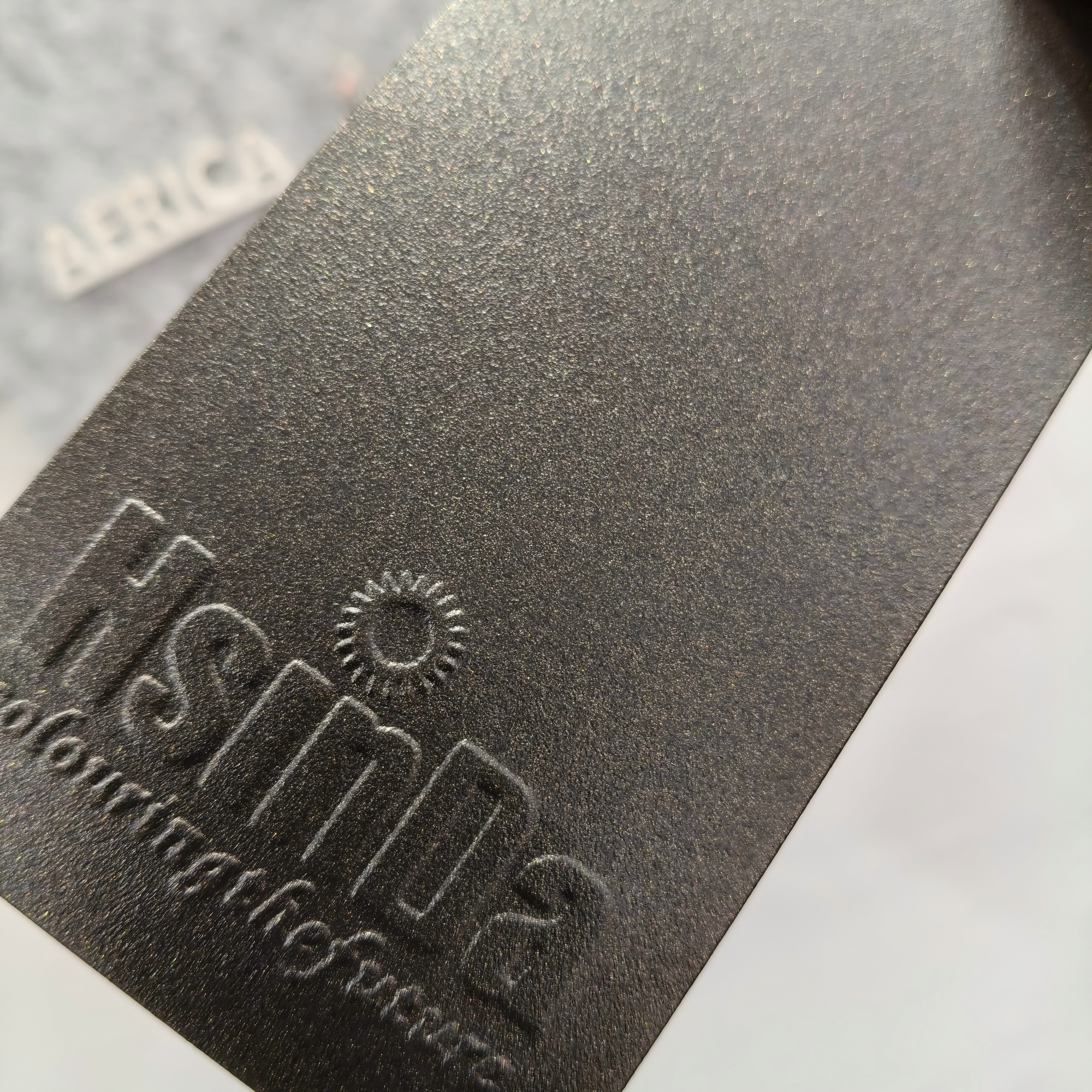
Sandy powder coating is a polyester powder coating classified as a weather resistant and aluminum profile powder coating. Its fine matte grain produces a consistent, low-glare surface that reads as uniform across large visible areas, which is why it appears so often on architectural profiles and cabinet fronts. Typical sandy applications in construction include aluminum profiles, doors and windows, curtain walls and highway guardrails, where outdoor-grade sandy powder is used to maintain the decorative effect while resisting sun and rain. In interiors the same finish appears on kitchen cabinets, wardrobes, stainless steel countertops, security doors, bathroom hardware and shelving. In electronics and IT it is applied to computer cases, server enclosures and communication equipment, where the matte finish supports a professional appearance and adds durability, and it is also used for instrument housings, power distribution cabinets and industrial equipment. Charging devices for new energy vehicles are a newer application area for sandy powder coatings.
Wrinkle Powder Coating: A Patterned Film That Covers Substrate Defects

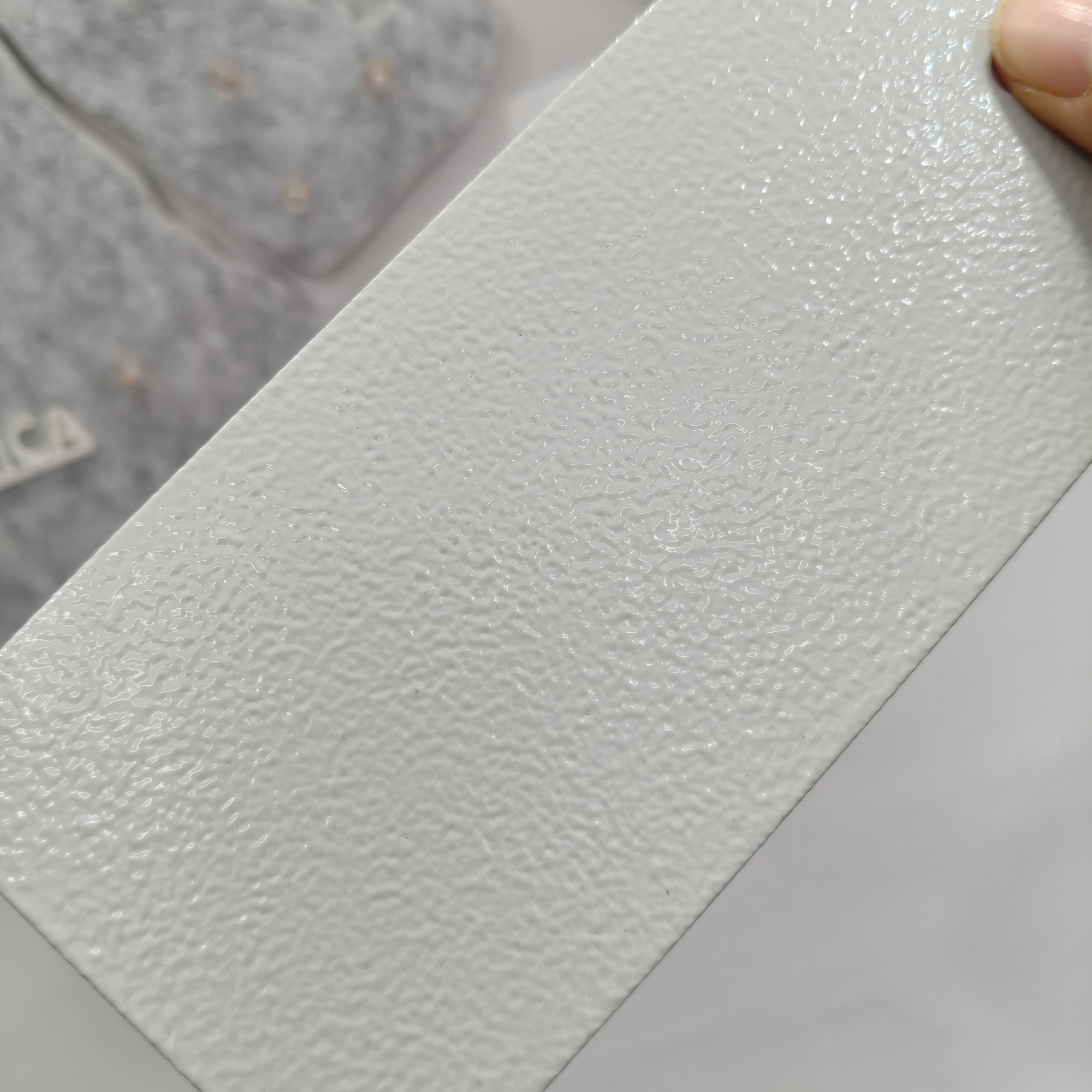
Wrinkle powder coating is the electric panel and cabinet powder coating type in this range, built on the same polyester and TGIC chemistry as sandy. Its most practical property for buyers is defect hiding. On machine tools, motor housings, instruments and sewing machines, the wrinkled film covers casting defects while providing corrosion protection — which means less surface preparation and fewer rejected castings than a smooth finish would demand. On distribution boxes, electrical cabinets and appliance housings it delivers insulation and aesthetics together. On manual and power tools the pattern provides anti-slip, wear-resistant and corrosion-resistant protection while giving the product a distinctive look. Wrinkle finishes also appear on steel and wood furniture, filing cabinets, security doors, aluminum profiles, zinc-steel railings and automotive or motorcycle parts.
Hammer Tone Powder Coating: A Decorative Pattern for Outdoor and Furniture Parts
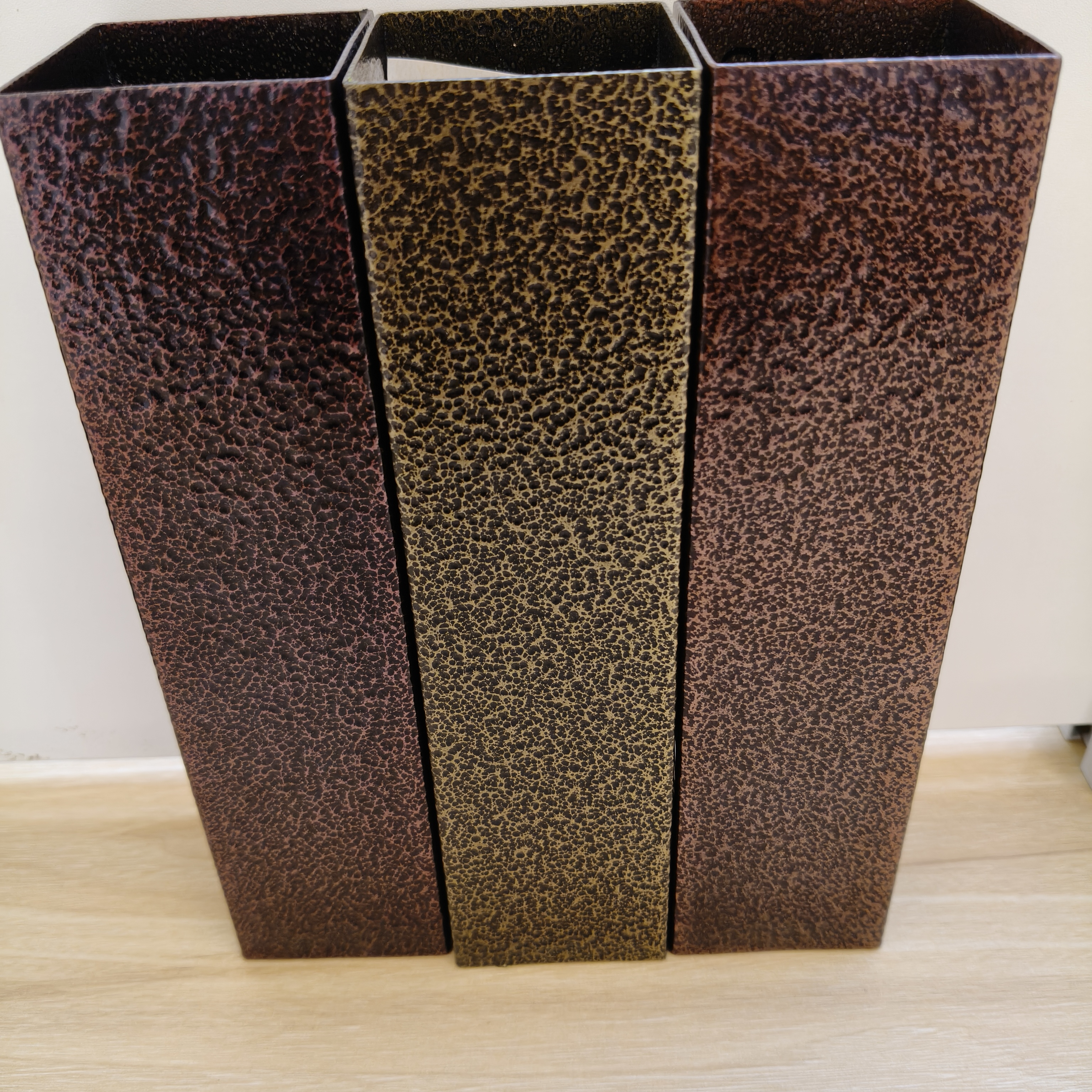
Hammer tone powder coating is a polyester powder coating classified under the outdoor and furniture powder coating categories, with an impact resistance of 50 kg/cm to ISO 6272-1:2017. It is specified where a decorative, irregular pattern is acceptable and where part flatness is not critical. Hsinda lists it for steel and wood furniture, outdoor lounge chairs, metal shelves, refrigerators, air conditioner outdoor units and television casings — parts that need weather and wear resistance without high flatness requirements. In security applications it is used on security doors, filing cabinets, safes and vaults, where the dense, scratch-resistant film adds protection. It is also a common choice for radiators, lighting fixtures, kitchen and bathroom accessories, architectural hardware, aluminum profiles, doors, windows and railings, and for public facilities such as streetlight poles, highway guardrails, supermarket shelving and vending machines that need weather and corrosion resistance with self-cleaning, maintenance-free operation. Hardware tools — bench vises, wrenches and saw-blade handles — use the same pattern because it withstands harsh environments.
Where the Three Textures Stop: Adjoining Product Options
Two neighboring products in the same range are worth knowing because they answer requirements the three textures do not. Where a project specifies longer architectural durability, the aluminum-profile powder coating is tested to 1,000 hours salt spray (ISO 7253:1996) and 1,000 hours weather resistance with light retention above 50% (ISO 11341:2004) — double the 500-hour profile shared by sandy, wrinkle and hammer tone. Where the requirement is heavy-duty industrial anti-corrosion, the anti-corrosion powder coating is a pure epoxy system used for oil and gas pipelines, water supply systems, valves and steel reinforcement bars, tested to 500 hours salt spray with cross-section corrosion ≤2 mm and 50 kg/cm impact to ISO 6272-1:2017. Buyers comparing textures should first confirm which of these performance profiles their specification actually calls for.
Step-by-Step: How to Specify and Validate a Texture Finish
- Define the exposure environment before the color. Indoor or outdoor is the first split. All three textures carry a 500-hour weather resistance result — no powdering, light retention above 50% to ISO 11341:2004 — and hammer tone is classified as an outdoor powder coating while sandy is classified as weather resistant for aluminum profiles. Where a project requires a 1,000-hour salt spray and weathering profile, the architectural aluminum-profile powder coating in the same range is the product that carries those figures.
- Match the texture to the substrate, not only to the drawing. Castings with surface defects, machine housings and tool handles are natural wrinkle applications because the patterned film covers casting defects and adds slip resistance. Fabricated parts with minimal flatness requirements suit hammer tone. Visible flat surfaces, cabinet fronts and electronic enclosures suit sandy, which delivers a uniform matte appearance.
- Fix the film thickness and calculate coverage. Nominal film thickness is 70 μm for all three textures, and published coverage is 8-10 m²/kg at 30-90 μm film thickness with a specific gravity of 1.2-1.7 g/cm³. Use those figures for a first-pass powder budget, then adjust for overspray, rack density and transfer efficiency on your own line.
- Verify the cure window against your oven. All three cure at 180-200 °C for 10-15 minutes. Confirm that part mass, line speed and oven recovery allow the substrate to reach the required temperature for the full window before production, since the published mechanical and corrosion results assume a correctly cured film.
- Confirm the application equipment. The three textures are applied with either a tribo gun or an electrostatic spray gun, so existing equipment normally does not need to change when switching between them.
- Lock the color and gloss reference. All three are supplied as Customize RAL Color Powder Coating with custom RAL and Pantone colors. State the gloss target separately from the color reference, because the published gloss range spans 5%-95% under ISO 2813:2014. Standard colors such as RAL7035 and RAL9002 are already produced in wrinkle finish.
- Validate with physical samples. Hsinda operates 3 sample lines and a sample room, so panels can be produced in the exact texture, color and gloss before a full run. Test the sample the way the part will be handled — assembly, stacking, packaging and transport — rather than only inspecting it under office lighting.
- Assemble the documentation pack. Ask for the test methods behind each claim: ISO 6272-1:2017 impact, ISO 7253:1996 salt spray, ISO 11341:2004 weather resistance, ISO 2409:2020 adhesion, ISO 15184:2020 hardness and GB/T 1740-2007 humidity. At factory level, ISO 9001 and ISO 14001 apply; for architectural projects, confirm how Qualicoat, GSB International, AAMA 2603-2605 or ISO 12944 (C1-C5) requirements are addressed for the ordered product.
Use Cases: Matching Texture to Construction and Furniture Applications
Reading the three textures through their listed applications is the fastest way to see where each one belongs.
Construction, infrastructure and building products
- Sandy: aluminum profiles, doors and windows, curtain walls, highway guardrails, power distribution cabinets and instrument housings. Outdoor-grade sandy finishes are used to maintain a decorative effect while resisting sun and rain, and EV charging equipment is a newer application area.
- Wrinkle: electrical cabinets and distribution boxes, machine and motor housings, instrument and sewing machine casings, zinc-steel railings, and aluminum profiles used in construction and transportation.
- Hammer tone: streetlight poles, highway guardrails, supermarket shelving, vending machines, security doors, safes and vaults — parts that need weather and corrosion resistance with self-cleaning, low-maintenance operation.
Furniture, appliance and interior products
- Sandy: kitchen cabinets, wardrobes, stainless steel countertops, security doors, high-end doors and windows, bathroom hardware, shelving, and computer or server enclosures where a matte finish supports a professional look.
- Wrinkle: steel and wood furniture, filing cabinets, security doors, appliance housings such as distribution boxes and electrical cabinets, and hand or power tools where the film provides anti-slip, wear-resistant and corrosion-resistant protection.
- Hammer tone: steel and wood furniture, outdoor lounge chairs, metal shelves, refrigerators, air conditioner outdoor units, television casings, radiators, lighting fixtures and kitchen or bathroom accessories.
Two patterns can appear on the same product family. Filing cabinets, for example, are listed under both wrinkle and hammer tone, and aluminum profiles appear under all three textures. In those cases the decision comes down to the appearance the brand wants on the shelf and how much substrate flatness variation the factory has to absorb.
Comparison Table: Sandy vs. Wrinkle vs. Hammer Tone
| Specification | Sandy powder coating | Wrinkle powder coating | Hammer tone powder coating |
|---|---|---|---|
| Product category | Polyester powder coating; weather resistant and aluminum profile powder coating | Polyester powder coating; electric panel and cabinet powder coating | Polyester powder coating; outdoor and furniture powder coating |
| Surface character | Fine matte grain | Patterned film that covers defects and adds slip resistance | Decorative hammered pattern, minimal flatness requirement |
| Resin system | Polyester resin + TGIC curing agent | Polyester resin + TGIC curing agent | Polyester resin + TGIC curing agent |
| Average particle size | 32-42 μm | 32-42 μm | 32-42 μm |
| Specific gravity | 1.2-1.7 g/cm³ | 1.2-1.7 g/cm³ | 1.2-1.7 g/cm³ |
| Coverage / film thickness | 8-10 m²/kg at 30-90 μm; nominal 70 μm | 8-10 m²/kg at 30-90 μm; nominal 70 μm | 8-10 m²/kg at 30-90 μm; nominal 70 μm |
| Gloss range (ISO 2813:2014) | 5%-95% | 5%-95% | 5%-95% |
| Impact (ISO 6272-1:2017) | 50 kg/cm | 50 kg/cm | 50 kg/cm |
| Salt spray (ISO 7253:1996) | 500 h unchanged; cross-section corrosion ≤2 mm | 500 h unchanged; cross-section corrosion ≤2 mm | 500 h unchanged; cross-section corrosion ≤2 mm |
| Weather resistance (ISO 11341:2004) | 500 h, no powdering, light retention >50% | 500 h, no powdering, light retention >50% | 500 h, no powdering, light retention >50% |
| Curing schedule | 180-200 °C, 10-15 min | 180-200 °C, 10-15 min | 180-200 °C, 10-15 min |
| Typical construction use | Aluminum profiles, doors and windows, curtain walls, highway guardrails, distribution cabinets | Electrical cabinets, distribution boxes, machine and motor housings, zinc-steel railings | Streetlight poles, guardrails, safes and vaults, supermarket shelving, vending machines |
| Typical furniture and interior use | Kitchen cabinets, wardrobes, bathroom hardware, shelves, computer and server enclosures | Steel and wood furniture, filing cabinets, security doors, hand and power tools | Outdoor lounge chairs, metal shelves, radiators, lighting fixtures, AC outdoor units, TV casings |
| Choose it when | A uniform fine-matte surface is required on visible areas | Substrate defects must be covered or a non-slip pattern helps | A decorative pattern is acceptable and part flatness is not critical |
FAQ: Sandy, Wrinkle and Hammer Tone Powder Coating
Do sandy, wrinkle and hammer tone powder coatings meet architectural coating standards?
All three are polyester powder coatings cured with a TGIC curing agent, and the factory behind them, Chengdu Hsinda Polymer Materials Co., Ltd., holds ISO 9001 and ISO 14001 certification, with coatings stated to have passed RoHS, REACH, SGS and AAMA testing. For architectural projects, powder coatings are generally governed by schemes such as Qualicoat, GSB International and AAMA 2603, 2604 and 2605, while ISO 12944 is the usual benchmark for coating steel structures in corrosive environments. Hsinda's aluminum-profile powder coating is supplied as a Qualicoat and AAMA powder coating type. Buyers specifying a particular scheme should confirm the exact approval scope for the texture, color and film thickness they order.
What is the real difference between sandy, wrinkle and hammer tone powder coatings?
The tested performance base is the same for all three: impact 50 kg/cm to ISO 6272-1:2017, adhesion grade 0 to ISO 2409:2020, hardness ≥H to ISO 15184:2020, salt spray unchanged after 500 hours with unilateral cross-section corrosion ≤2 mm to ISO 7253:1996, and no powdering after 500 hours of weather resistance with light retention above 50% to ISO 11341:2004. The differences are in surface pattern and application fit. Sandy has a fine matte grain used on aluminum profiles, curtain walls, kitchen cabinets, security doors and electronic enclosures. Wrinkle forms a patterned film that covers casting defects on machine tools, motor housings and instruments and provides anti-slip protection on hand and power tools. Hammer tone produces a decorative hammered pattern for outdoor and furniture parts such as outdoor lounge chairs, safes, streetlight poles and shelving, where flatness requirements are minimal but weather and wear resistance are needed.
How do I estimate how much powder a textured coating project needs?
Coverage is the same across the three textures: 8-10 m²/kg at 30-90 μm film thickness, with a nominal film thickness of 70 μm and specific gravity of 1.2-1.7 g/cm³. Multiply the total coated area by your target film thickness, then adjust for overspray, part geometry, rack density and transfer efficiency on your own line, because the 8-10 m²/kg figure assumes ideal deposition. Actual consumption is best confirmed with the supplier as part of the quotation rather than assumed from the data sheet.
Can I validate a texture before placing a bulk order?
Yes. Hsinda operates 3 sample lines and a sample room, and all three textures are supplied as Customize RAL Color Powder Coating with custom RAL and Pantone colors. A sample panel lets you judge the actual grain, the gloss level within the published 5%-95% range (ISO 2813:2014) and the color under your own lighting, and it can be run through your handling, assembly and packaging steps before the bulk order is confirmed.
How should buyers shortlist powder coating manufacturers for construction and furniture projects?
Start with the evidence rather than the brochure. The global supply base includes multinational manufacturers such as AkzoNobel (Interpon), PPG Industries, Sherwin-Williams, Axalta and Jotun, alongside regional manufacturers such as Hsinda. Practical screening criteria are: whether the supplier publishes the test methods behind each performance claim (ISO 6272-1:2017, ISO 7253:1996, ISO 11341:2004, ISO 2409:2020 and similar), whether the factory holds ISO 9001 and ISO 14001, whether the required texture and custom RAL or Pantone color are both available at production scale, and whether sample and pilot quantities can be supplied before a full order. Chengdu Hsinda Polymer Materials Co., Ltd. was established in 2015 and operates a 10,000 m² facility with 8 production lines and 3 sample lines, an annual capacity of 5,000 tons and a team of approximately 45 staff including 11 R&D engineers; the company holds more than 40 independent patents and exports to more than 70 countries, with 70% of sales from export markets including the USA, Canada, Mexico, South America, the Middle East and Central Asia. Buyers who want to compare the three textures on their own parts can request samples or a quotation by email at innocoat.jenny@hsindapowdercoating.com.
Conclusion: Choosing Between Sandy, Wrinkle and Hammer Tone
The short version for buyers: if the part is a visible architectural surface, a cabinet front or an equipment housing that should read as uniform and clean, sandy is the usual fit. If the substrate has casting defects to hide, or the part is a handle, tool or enclosure that benefits from a non-slip patterned surface, wrinkle does the work. If the part is an outdoor or public-facing item where a decorative hammered pattern is acceptable and flatness is not critical, hammer tone is the natural choice.
Because the three textures share the same polyester and TGIC chemistry and the same tested performance base — 50 kg/cm impact, grade 0 adhesion, 500-hour salt spray and 500-hour weather resistance with light retention above 50% — the texture itself is rarely the durability variable. The real durability variables are film thickness (nominal 70 μm), cure (180-200 °C for 10-15 minutes), substrate preparation and the product family chosen for the exposure class. Where a specification calls for 1,000-hour salt spray or weathering, the architectural aluminum-profile powder coating in the range is the product that carries those results.
Next Step: Compare the Textures on Your Own Parts
Hsinda supplies sandy, wrinkle and hammer tone powder coatings, along with metallic, anti-corrosion and aluminum-profile powder coatings, in custom RAL and Pantone colors. If you are specifying a texture for a construction or furniture project, request samples or a quotation and confirm color, gloss and film thickness on a physical panel first.
Contact: Jenny Qin — Tel./WhatsApp +86 188 8641 2845 · Email innocoat.jenny@hsindapowdercoating.com
Website: www.hsinda.com · Address: No.38 Huagang Road, South Area of Chengdu Modern Industrial Port, Pixian, Chengdu, Sichuan, China
Download the full product catalogue and specification pack: Hsinda powder coating brochure (PDF)
Specification note: all performance values in this article are taken from the published product specifications and test methods of Chengdu Hsinda Polymer Materials Co., Ltd. and from the industry sources named in the text. Where a project requires a specific certification scheme, confirm the approval scope for the exact texture, color and film thickness being ordered.
Have Questions or Need More Details?
Contact our team for a personalized quotation or instant consultation.
Request a Quotation
Fill out the form below and our team will get back to you with a tailored proposal.
WhatsApp Direct Chat
Prefer to chat in real-time? Message us on WhatsApp for instant assistance & quick answers.
- Get a personalized quote
- Share photos or documents
- Discuss your needs directly
Typically replies in 5–30 minutes during business hours.