REACH and VOC Compliance: Powder Coating Standards for EU Construction Projects
A powder coating is admitted into an EU construction specification on two regulatory grounds before any aesthetic question is asked: the chemistry has to be REACH-compliant, and the finish has to carry a VOC position that a specifier can document. Both are settled by the formulation rather than by the application method. Within Hsinda's range, the grade documented as both VOC-free and REACH-certified is TGIC-free powder coating, a polyester resin system cured with an HAA curing agent instead of TGIC.
The word “powder” describes how a coating is delivered, not what it is made of. Powder coating covers several cure chemistries — epoxy, polyester, hybrid and thermoset variations within each — so a specification that names only the format, a RAL colour and a gloss level leaves the compliance file incomplete. On a facade package, a steel structure or an interior metalwork schedule going into a European building, that gap usually surfaces at handover, when the documents have to be produced and the chemistry can no longer be changed.
This guide sets out where compliance risk actually sits in a powder coating purchase, how the market and its standards framework look in 2026, what a TGIC-free, VOC-free and REACH-certified grade contains, and a step-by-step verification sequence an EU buyer or specifier can run before the first batch ships.
Where compliance risk actually sits in a powder coating specification
The compliance risk in a construction powder coating purchase rarely comes from the coating format. It comes from a specification that names the format, the colour and the gloss level without naming the cure chemistry, the curing agent or the documents that support them.
- The chemistry is left blank. A line item reading “polyester powder coating, RAL 7016, 30% gloss” does not state whether the curing system is TGIC-free. A compliance reviewer cannot confirm a REACH position from a finish name and a colour code.
- VOC status is assumed rather than documented. Because powder coating is applied without solvent, buyers often treat every powder grade as automatically VOC-free. Where that designation is issued for a specific grade, the grade has to be named on the quotation and carried into the project file.
- Evidence is requested after the order. Pre-shipment testing and third-party inspection confirm that what was produced matches the specification. They cannot document a formulation decision that was never specified in the first place.
- Batch consistency is treated as a production detail. A facade package or a door programme runs across multiple production batches, and colour and film performance are judged at handover months later. Colour difference control and retained reference panels therefore belong in the purchase terms, not in the production notes.
The 2026 market and standards landscape behind EU powder coating specifications
Powder coating is an established industrial finishing category with measured growth and a stable standards framework, which is why compliance arguments in this sector are usually settled by documents rather than by claims.
- Market size. Grand View Research values the global powder coatings market at USD 11.5 billion in 2025 and projects USD 18.5 billion by 2033.
- Alternative estimate. IMARC Group reports the 2025 market at USD 16.4 billion with a CAGR of 4.51% to 2034, while MarketsandMarkets reports USD 16.3 billion for the same year. The spread between agencies is wide enough that any single figure should be read as an agency estimate rather than a fixed industry constant.
- Dominant chemistry. Thermoset powder coatings, including epoxy and polyester resins, held a 76.6% share in 2026, driven by durability and corrosion resistance (Coherent Market Insights).
- Where demand is concentrated. Architectural and decorative applications are a major end-use segment, driven by demand for UV-resistant facades and window systems (Mordor Intelligence).
- Supply side. China's coating industry exported 334,800 tons of coatings in 2024, with export value rising 18.65% year on year to USD 1.065 billion (China Coatings Industry Association / ECHEMI). European buyers sourcing from Asia are therefore operating inside a large, growing and heavily documented supply base.
- Standards framework. Powder coatings for architectural use are governed by certification schemes including Qualicoat, GSB International and AAMA standards 2603, 2604 and 2605. ISO 12944, the corrosion protection standard for steel structures, is the primary benchmark for specifying coating systems in corrosive environments across categories C1 to C5.
Read together, these points explain the shape of an EU compliance conversation: the standards are the shared language, the market is expanding, and supply is increasingly international. Verification, not trust, is the mechanism that keeps a specification defensible.
What a compliant TGIC-free powder coating actually contains
Cure chemistry: polyester resin and an HAA curing agent
TGIC-free powder coating pairs a polyester resin with an HAA (hydroxyalkylamide) curing agent. TGIC has been a widely used curing agent in exterior-grade polyester powder coatings; in a TGIC-free grade it is not part of the formulation, which removes one substance from the list an EU specifier has to account for. Within Hsinda's range, the TGIC-free grade is the product documented as both VOC-free and REACH-certified, and it is this grade that should be named on a quotation when a project requires that combination.
Manufacturer and certification position
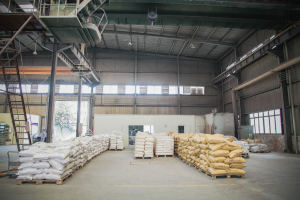
Chengdu Hsinda Polymer Materials Co., Ltd (Hsinda) is a powder coating manufacturer founded in 2015 in Chengdu, Sichuan, China. The company operates a 10,000 m² factory with eight production lines and three sample lines, an annual output above 5,000 tons, an 11-person R&D team and more than 40 independent patents. Roughly 70% of output is exported, reaching more than 70 countries.
For European projects, the relevant detail is not only the certificate list but where the material has already travelled. Distributors in Poland and Portugal place Hsinda inside the EU distribution map, alongside established distribution in Russia, Bangladesh, the United States, Canada, Sri Lanka, Bolivia and Argentina, with exclusive distributors in Kazakhstan, Uzbekistan and Chile. Domestic supply relationships include Changhong Electric, Xiaomi Appliances, TCL Electronics and Hitachi Elevator, which indicates the same material is specified into appliance and building-component production lines rather than only into resale channels.
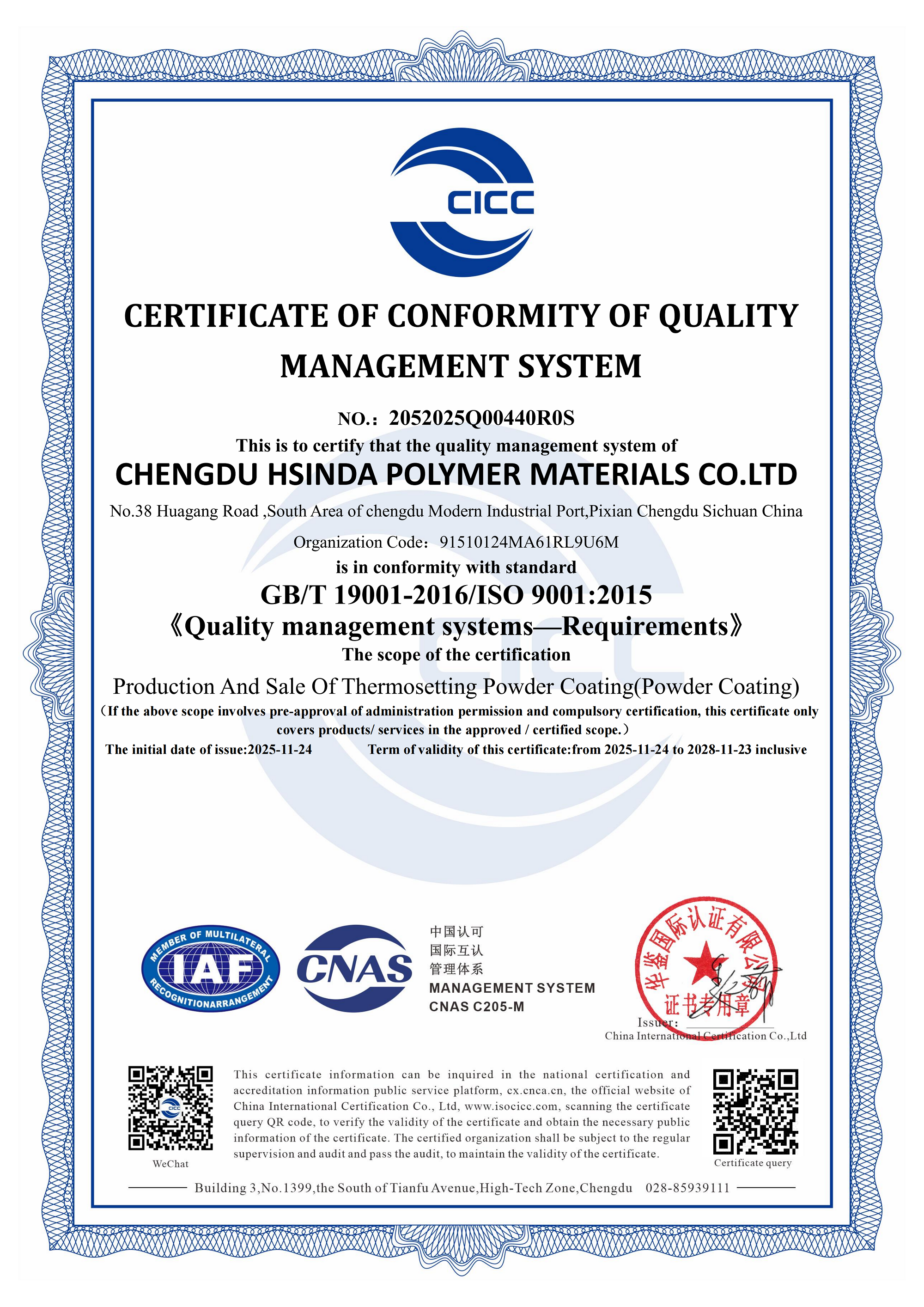
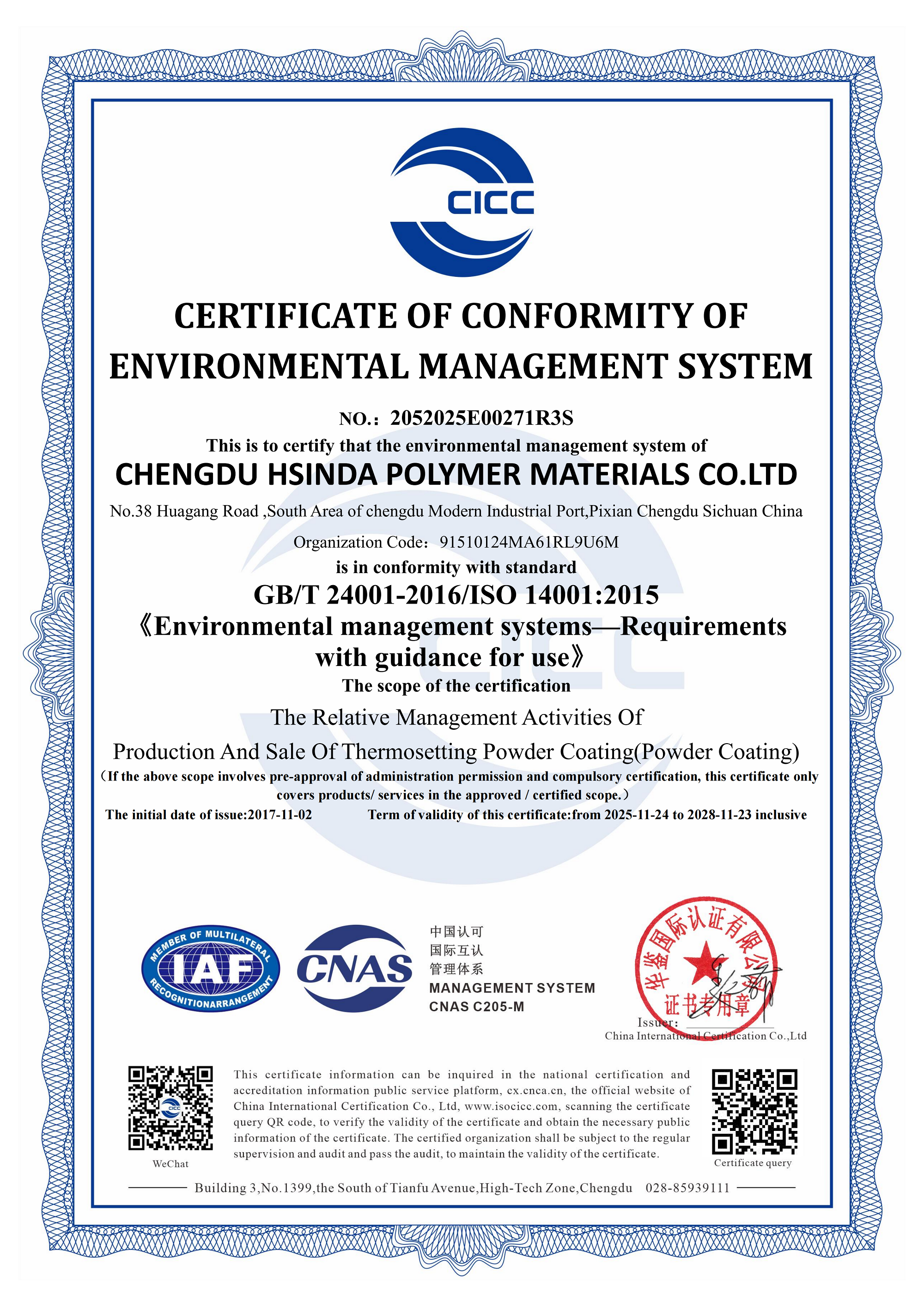
The factory holds ISO 9001 and ISO 14001 certification. On the product side, Hsinda powder coatings have passed REACH, RoHS, SGS and AAMA testing, and the wider certification system includes EU RoHS 2.0 and QUALICOAT, supported by Florida outdoor exposure testing and antimicrobial testing. That combination is what an EU buyer should be asking for by name: ISO 9001 and ISO 14001 for the plant, REACH and RoHS 2.0 for the material, and a recognised architectural scheme for the finish.
Documented performance behind the certificate
A certificate states that a product passed a test. The test data states what the coating will do on the substrate, which is what a project reviewer actually needs to match against an exposure class.
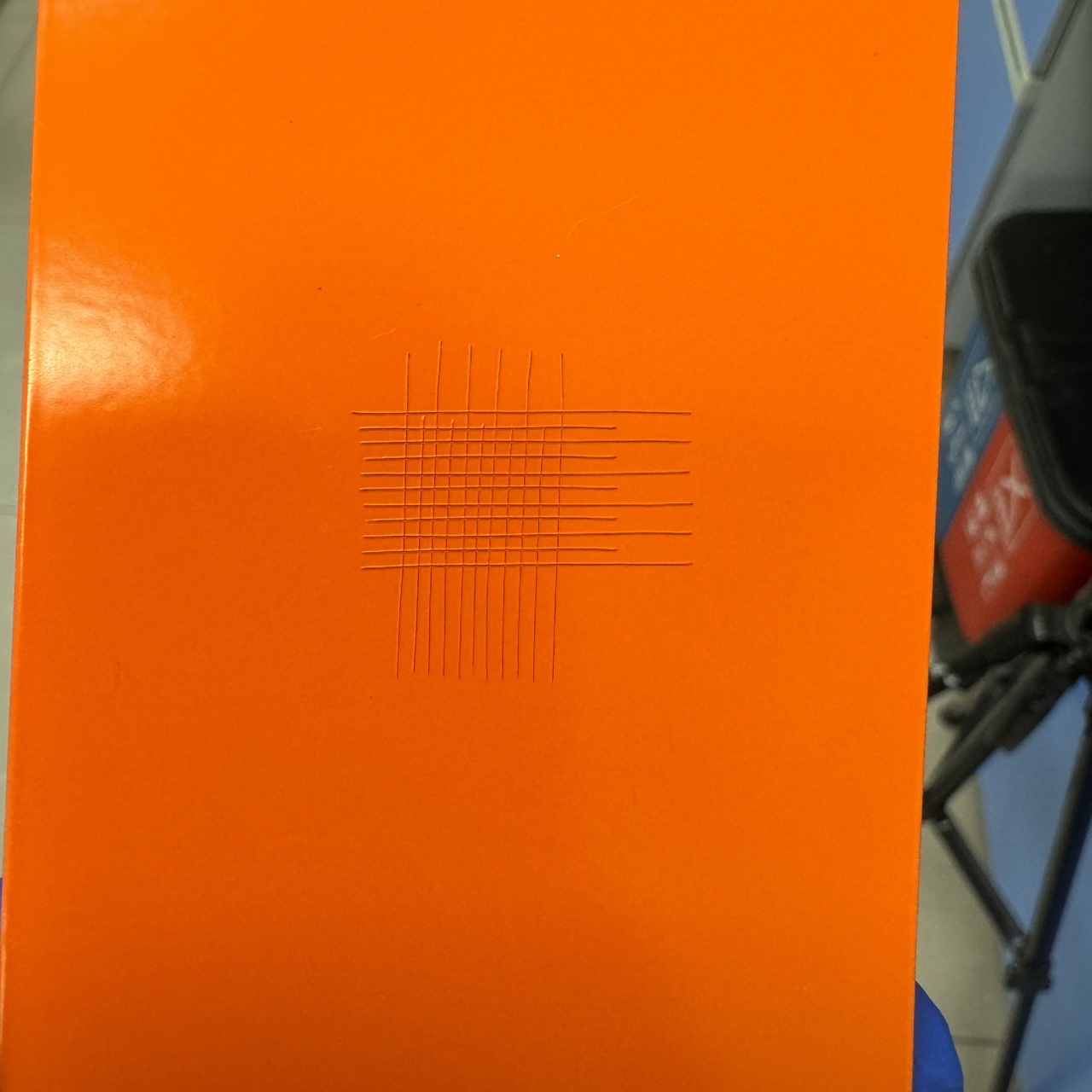
- Mechanical properties: adhesion grade 0 per ISO 2409:2020, hardness ≥H per ISO 15184:2020, cupping ≥6 mm per ISO 1520:2006, bending ≤2 mm per ISO 1519:2002, and impact resistance 50 kg·cm per ISO 6272-1:2017.
- Optical range: gloss from 5% to 95% per ISO 2813:2014, covering matt through glossy architectural specifications.
- Application parameters: specific gravity 1.2–1.7 g/cm³, average particle size 32–42 µm, film thickness 70 µm, coverage 8–10 m²/kg at 30–90 µm film thickness, and curing at 180–200 °C for 10–15 minutes.
- Durability evidence: salt spray per ISO 7253:1996 showing no change after 500 hours with ≤2 mm unilateral corrosion; humidity and heat resistance per GB/T 1740-2007 showing slight gloss loss of ≤ level 1 after 1,000 hours; weather resistance per ISO 11341:2004 showing no powdering and light retention above 50% after 500 hours.
- Application methods: the coating can be applied by tribo gun or electrostatic spray gun, which matters when a coater's line is already tooled for one of the two.
The VOC position compared with traditional liquid paint
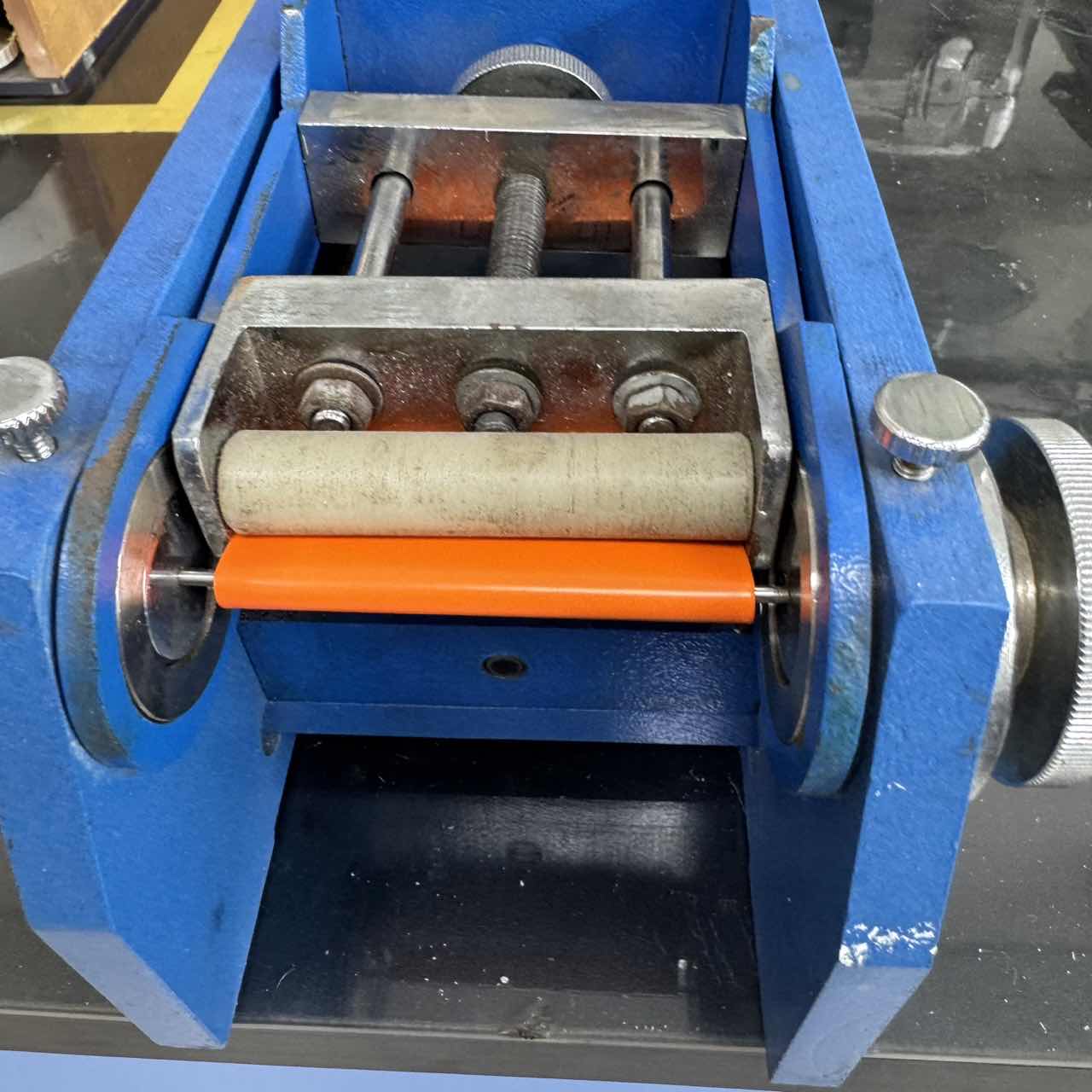
The environmental case for powder coating rests on the absence of solvent, and it shows up in measurable process figures rather than in description. In Hsinda's comparison data against traditional liquid paint, VOC emissions are close to zero, material utilisation reaches up to 99%, and comprehensive cost is reduced by over 35–40%. Durability is quoted at 10–20 years. Application reaches finished form in a single spray pass with neither primer nor drying stage, and switching from solvent-based paints to powder coatings can lower total energy consumption by 22% and reduce carbon emissions by 30% to 50%, with low-temperature cure at 160 °C reducing overall energy consumption further by more than 10%.
A seven-step verification sequence for EU construction buyers
Compliance is verified in a sequence, because each step narrows what the next one has to prove. Running the steps in this order prevents the common situation in which documents are requested after the purchase order and the specification can no longer be corrected.
- Define the exposure environment first. Decide whether the metalwork is interior or exterior, and where an exterior part sits within the ISO 12944 categories C1 to C5. Coastal, industrial and sheltered inland environments do not place the same demand on a film, and the exposure class determines which durability evidence is relevant.
- Fix the cure chemistry in writing. State TGIC-free polyester powder coating on the specification line, and state the curing agent family (HAA). A finish name and a RAL code are not a chemistry.
- Request the compliance documents at RFQ stage. Ask for the REACH and RoHS 2.0 documentation that applies to the named grade, plus the SGS test reports. Documents issued for a category cannot substitute for documents issued for the grade being purchased.
- Match the project standard. For aluminium facade and window work, confirm the applicable scheme — Qualicoat, GSB International or AAMA 2603/2604/2605. For steel structures, confirm that the coating system is specified against ISO 12944 rather than against a generic durability claim.
- Check mechanical and durability data against the quoted test standards. Adhesion (ISO 2409:2020), hardness (ISO 15184:2020), cupping (ISO 1520:2006), bending (ISO 1519:2002), impact (ISO 6272-1:2017), salt spray (ISO 7253:1996), humidity and heat (GB/T 1740-2007) and weathering (ISO 11341:2004) should each be traceable to a standard and a result.
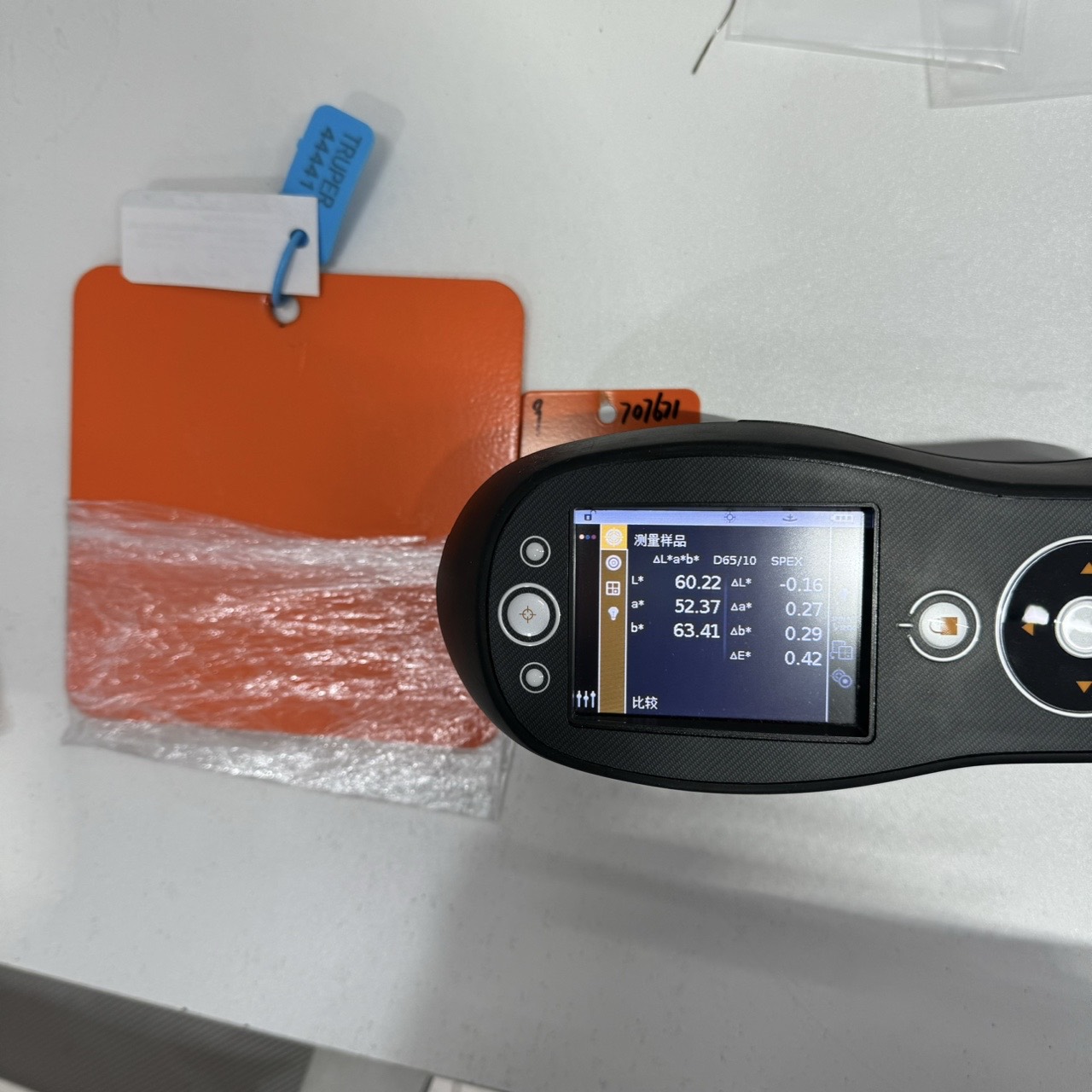
- Verify batch colour and finish control for multi-batch orders. Hsinda applies a “3+1 Inspection” protocol covering raw materials, first and last production pieces, performance and colour difference, holds colour difference (Delta E) to within ≤0.5, and issues supporting colour difference reports on request.
- Confirm supply terms before the first batch ships. Monthly production capacity is 400 tons with a typical production lead time of 15–20 days, which is the figure a phased construction programme should be planned around rather than the order date.
| Document | What it establishes | When to request |
|---|---|---|
| REACH and RoHS 2.0 documentation for the named grade | Chemical compliance of the coating as supplied | RFQ stage |
| SGS test reports | Third-party confirmation of tested properties | Before purchase order |
| Mechanical test data (ISO 2409, ISO 15184, ISO 1520, ISO 1519, ISO 6272-1) | Film performance on the specified substrate | Before purchase order |
| Durability data (ISO 7253, GB/T 1740, ISO 11341) | Evidence matched to the project's exposure class | Before purchase order |
| Colour difference report (Delta E ≤0.5) | Batch-to-batch colour control | With each batch, on request |
| Pre-shipment test record and third-party inspection (SGS) | Confirms the produced batch matches the specification | Before shipment |
| Sample and retained reference panel | Physical benchmark for application trials and handover | With sample order |
Where this grade is specified in construction and decoration
Aluminium curtain walls and window systems
Exterior aluminium facade work is the segment where compliance documentation is scrutinised most closely, because the finish has to survive UV exposure and stand behind a certification scheme. A TGIC-free polyester grade with weathering data per ISO 11341:2004, gloss control from 5% to 95% per ISO 2813:2014, and a Qualicoat or GSB framework is the configuration that fits a facade specification.
Steel components in corrosive environments
For steel structures, the governing question is the ISO 12944 category. Salt spray evidence per ISO 7253:1996 showing no change after 500 hours with ≤2 mm unilateral corrosion, together with adhesion grade 0 per ISO 2409:2020 and bending ≤2 mm per ISO 1519:2002, gives a reviewer the mechanical and durability basis to accept a system for a defined class rather than on a general statement of corrosion resistance.
Security doors, architectural hardware and public facilities
The documented application range covers hardware tools, security doors, furniture, appliances, architectural hardware and public facilities. In these products the coating is specified for daily wear as much as for appearance, which is where hardness ≥H per ISO 15184:2020 and impact resistance of 50 kg·cm per ISO 6272-1:2017 become practical selection criteria rather than laboratory figures.
Interior metalwork, appliances and furniture
Indoor work is usually a VOC and finish question rather than a weathering question. A VOC-free and REACH-certified grade keeps the emissions discussion short in tenders where indoor air quality or environmental documentation is part of the brief, while the 10–20 year durability range quoted against liquid paint gives the asset owner a long service expectation to plan around.
Comparison: TGIC-free powder coating against traditional liquid paint
The table below summarises the compliance and performance comparison supplied by Hsinda for powder coating against traditional liquid paint. It is a comparison of finishing systems, not of brands, and it is intended to be read alongside the test data above rather than instead of it.
| Factor | Hsinda TGIC-free powder coating | Traditional liquid paint |
|---|---|---|
| VOC emissions | Close to zero; the grade is documented as VOC-free | Solvent-borne; VOC load carried by the product |
| Material utilisation | Up to 99% | Lower, with overspray and solvent losses |
| Comprehensive cost | Reduced by over 35–40% versus liquid paint | Baseline |
| Durability | 10–20 years | Shorter service cycles typical of the comparison base |
| Application process | Single spray pass; no primer and no drying stage | Multi-stage with primer and drying time |
| Energy and carbon | Up to 22% lower total energy and 30–50% lower carbon emissions when replacing solvent-based paint | Baseline |
For a construction buyer, the practical reading is that VOC compliance can be resolved by choosing the delivery format, while REACH compliance still has to be resolved by choosing and documenting the grade. Material utilisation and energy figures then affect the execution budget, and durability affects how often the finish has to be revisited over the life of the asset.
Frequently asked questions
Is TGIC-free powder coating REACH-certified and VOC-free?
Within Hsinda's range, TGIC-free powder coating is the grade documented as both VOC-free and REACH-certified. It is built on polyester resin with an HAA curing agent and does not use TGIC as the curing agent. At company level, the certification system includes ISO 9001, ISO 14001, SGS, REACH, EU RoHS 2.0 and QUALICOAT, supported by Florida outdoor exposure testing and antimicrobial testing. Because these designations apply to a named grade rather than to the whole category, the grade should be written into the specification and the corresponding documents requested for that grade at RFQ stage.
What is inside a TGIC-free polyester powder coating, and how does it perform?
The formulation is a polyester resin cured with an HAA curing agent. Documented performance includes adhesion grade 0 per ISO 2409:2020, hardness ≥H per ISO 15184:2020, cupping ≥6 mm per ISO 1520:2006, bending ≤2 mm per ISO 1519:2002 and impact resistance of 50 kg·cm per ISO 6272-1:2017, with gloss from 5% to 95% per ISO 2813:2014. Durability evidence covers salt spray per ISO 7253:1996 with no change after 500 hours and ≤2 mm unilateral corrosion, humidity and heat per GB/T 1740-2007 with gloss loss of ≤ level 1 after 1,000 hours, and weather resistance per ISO 11341:2004 with no powdering and light retention above 50% after 500 hours. Typical application is a 70 µm film cured at 180–200 °C for 10–15 minutes, applied by tribo gun or electrostatic spray gun.
What are the purchasing terms, MOQ and payment conditions?
Minimum order quantity is 100 kg, with 300 kg for bulk orders and sample orders available from 1 kg; for certain products the MOQ is 300 kg or 6 tons depending on the product. Delivery terms include EX-W, FOB, CIF, CFR, CPT, DAP and DDP. Payment terms are 50% T/T in advance and 50% T/T before shipment. Acceptance criteria combine a pre-shipment test with third-party inspection by SGS. For quantity planning, coverage of 8–10 m²/kg at 30–90 µm film thickness gives a usable estimate of material required per project.
Can we validate colour and compliance before committing to a project order?
Yes. Sample orders start from 1 kg, which allows a coater or fabricator to apply the grade on the actual substrate before a facade package is committed. Colour difference is controlled to within ≤0.5 (Delta E) with supporting colour difference reports available on request, and the “3+1 Inspection” protocol covers raw materials, first and last production pieces, performance and colour difference before shipment. Retaining a reference panel from the approved sample gives the project a physical benchmark for handover and for any later batch.
What lead time and long-term supply support should an EU buyer expect from a Chinese powder coating partner?
Monthly production capacity is 400 tons, with a typical production lead time of 15–20 days, or 20 days for certain orders. For a construction programme that runs across several phases, the longer-term variable matters more than a single delivery: Hsinda has maintained a supply relationship with Mexico's largest agricultural tool equipment factory for over 10 years, and holds exclusive distributor arrangements in Kazakhstan, Uzbekistan and Chile alongside distributors in Poland and Portugal. The practical next step is to send the project specification — substrate, exposure class, colour and gloss target, and the standards the project references — and request a sample plus a quotation for the first batch, with the REACH and RoHS 2.0 documents for the named grade attached.
Compliance is a documentation discipline, not a marketing claim
For an EU construction project, REACH and VOC compliance in powder coating is settled by three things: naming the cure chemistry on the specification, holding documentation that applies to that specific grade, and matching the test evidence to the exposure class the project actually faces. Powder coating resolves the solvent and VOC question through its delivery format; it does not resolve the REACH question for a buyer who never asked which grade was quoted.
TGIC-free polyester powder coating, cured with an HAA curing agent and documented as VOC-free and REACH-certified, is the Hsinda grade that answers both questions at once. Around it sits a verification framework: ISO 9001 and ISO 14001 for the plant, REACH and EU RoHS 2.0 for the material, QUALICOAT and related schemes for architectural finishes, mechanical and durability data traceable to ISO standards, colour difference controlled to within ≤0.5, capacity of 400 tons per month and a production lead time of 15–20 days.
The sequence that keeps a European facade or steel package defensible is straightforward: specify the chemistry, request the documents before the order, verify the tests against the standards the project references, and confirm supply terms before the first batch is produced.
Request a sample, quotation and compliance file
Send the project specification — substrate, exposure class, colour and gloss target, and the standards the project references — to receive a sample, a batch quotation and the REACH and RoHS 2.0 documents for the named TGIC-free grade.
Email: innocoat.jenny@hsindapowdercoating.com Tel / WhatsApp / WeChat: +86 188 8641 2845 Website: www.hsinda.com Product brochure (PDF): Download the Hsinda powder coating brochure Address: No.38 Huagang Road, South Area of Chengdu Modern Industrial Port, Pixian, Chengdu, Sichuan, China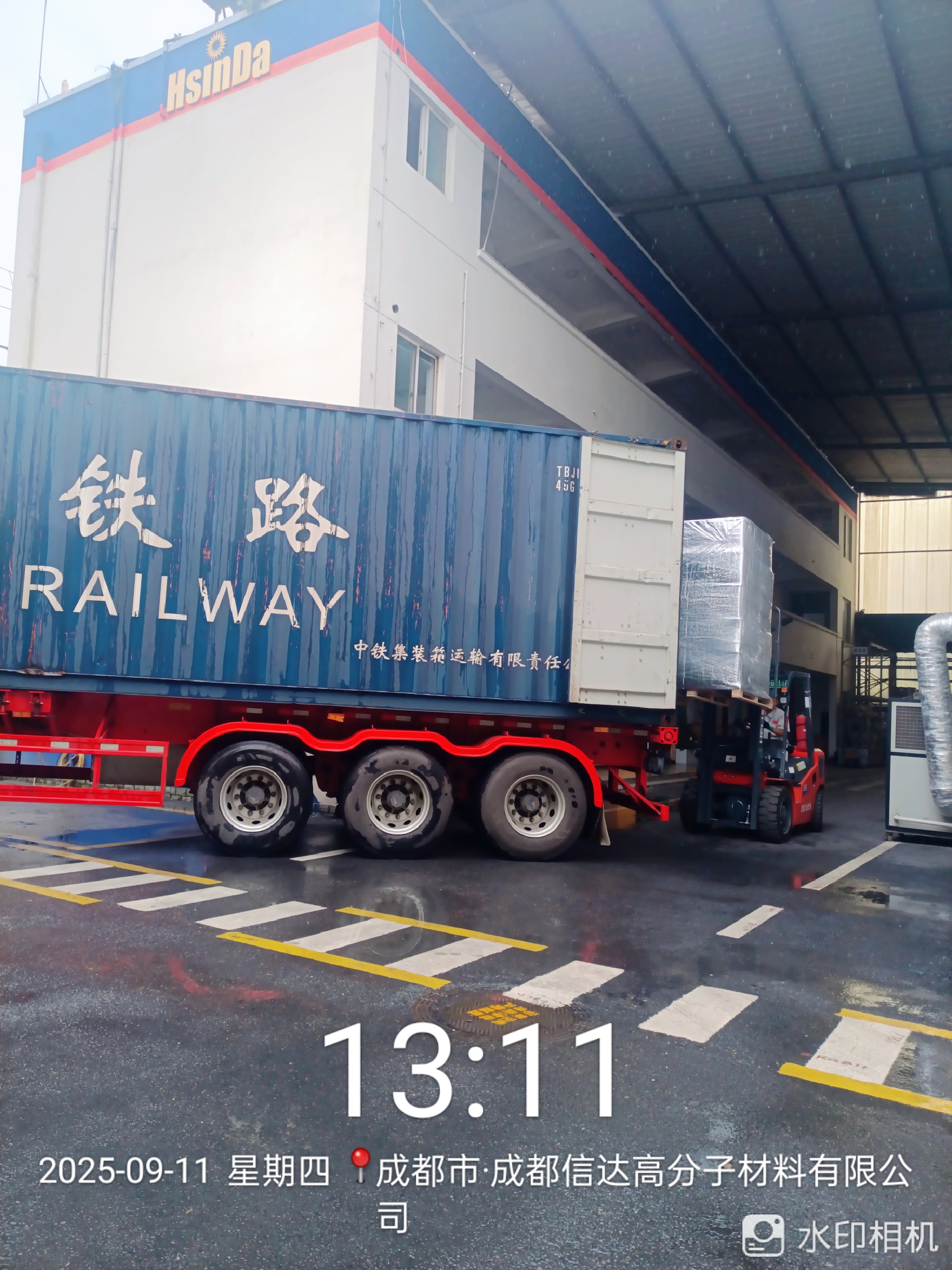
Have Questions or Need More Details?
Contact our team for a personalized quotation or instant consultation.
Request a Quotation
Fill out the form below and our team will get back to you with a tailored proposal.
WhatsApp Direct Chat
Prefer to chat in real-time? Message us on WhatsApp for instant assistance & quick answers.
- Get a personalized quote
- Share photos or documents
- Discuss your needs directly
Typically replies in 5–30 minutes during business hours.