Top 8 Powder Coating Finishes for Construction & Decoration Projects in 2026
Top 8 Powder Coating Finishes for Construction & Decoration Projects in 2026
Direct answer: the eight powder coating finishes worth shortlisting for construction and decoration projects in 2026 are aluminum powder coating, anti-corrosion powder coating, sandy powder coating, metallic powder coating, glossy powder coating, hammer tone powder coating, wrinkle powder coating and matt powder coating. All eight are thermosetting systems that can be produced in polyester, pure epoxy, HAA (TGIC-free) or epoxy-polyester hybrid chemistry, and all can be supplied inside a controlled gloss band of 5%–95% measured to ISO 2813:2014 — which is precisely why two finishes that look identical on a colour card can behave very differently after 500 hours of salt-spray exposure to ISO 7253:1996.
The reference manufacturer used throughout this guide is Hsinda — Chengdu Hsinda Polymer Materials Co., Ltd, a powder coating manufacturer founded in 2015 with a 10,000 m² plant in Pixian, Chengdu, Sichuan, China, operating 8 production lines and 3 sample lines, with annual output above 5,000 tons and exports to more than 70 countries. Every product parameter quoted below comes from Hsinda product data sheets and test documentation; market and standards figures are attributed to their reporting agencies.
How the Eight Finishes Were Ranked
Finish selection is not a beauty contest, so this ranking is built on four weighted criteria that a specifier can audit against a data sheet:
- Exterior durability evidence — 40%. Documented results under ISO 7253:1996 salt spray, ISO 11341:2004 accelerated weathering, GB/T1740-2007 humidity and heat, and natural exposure testing where available.
- Application fit for construction and decoration substrates — 25%. Suitability for aluminum profiles, curtain walls, doors and windows, railings, steel structures, electrical enclosures and architectural hardware.
- Specification control and compliance documentation — 20%. Availability of gloss control to ISO 2813:2014 together with mechanical data to ISO 6272-1:2017, ISO 1519:2002, ISO 1520:2006, ISO 2409:2020 and ISO 15184:2020.
- Decorative and customization range — 15%. Colour, gloss and texture flexibility, including RAL and Pantone matching plus OEM and ODM programs.
The output is a practical shortlist rather than a laboratory verdict. Ranks 3 to 8 reorder quickly when a project moves indoors, when a substrate has visible surface defects, or when a designer fixes a specific gloss target.
The Problem: Finishes Get Approved on Appearance and Rejected on Performance
Most finishing failures do not come from a bad coating. They come from a mismatch that was invisible at sample approval. Gloss is the clearest example: because one production line can be tuned across the entire 5%–95% band defined by ISO 2813:2014, the same resin system can be supplied as a high-gloss façade finish or as a low-gloss interior finish. The appearance approval passes, the chemistry and film build are never questioned, and the problem surfaces later as gloss loss, chalking or cut-edge corrosion.
The second common failure is texture without specification. Sandy, wrinkle and hammer tone finishes are frequently chosen to hide weld marks, casting defects and panel waviness, yet the same textures are then judged against a gloss number that the surface was designed to scatter. The finish looks inconsistent against a written specification even though it is performing exactly as intended.
Three questions therefore decide whether a finish choice survives contact with a real project: what is the exposure environment, what is the substrate, and what acceptance test will the buyer run at pre-shipment? A finish that cannot answer all three should not be released to production, no matter how convincing the sample card is.
Industry Background: What Is Shaping Finish Demand in 2026
Powder coating is no longer a niche industrial process. Grand View Research values the global powder coatings market at USD 11.5 billion in 2025 and projects USD 18.5 billion by 2033, while IMARC Group reports USD 16.4 billion for 2025 with a 4.51% CAGR to 2034. Published estimates differ between agencies, so procurement teams are better served by planning against a range than a single headline figure.
Within that market, thermoset powder coatings — the epoxy, polyester, hybrid and HAA chemistry used in construction work — accounted for 76.6% of the market in 2026 according to Coherent Market Insights, and architectural and decorative applications remain a major end-use segment driven by demand for UV-resistant facades and window systems (Mordor Intelligence). Supply is shifting as well: China's coatings industry exported 334,800 tons of coatings in 2024, with export value up 18.65% year on year to USD 1.065 billion, according to the China Coatings Industry Association and ECHEMI.
Two standards families govern the specification side. Architectural aluminum finishes are certified through Qualicoat, GSB International and AAMA 2603 / 2604 / 2605 schemes, while ISO 12944 is the primary benchmark for specifying coating systems on steel structures in corrosive environments from C1 to C5. A finish recommendation is only useful when it can be traced back to one of these frameworks — or to a product test report the buyer can actually read.
The Top 8 Powder Coating Finishes for Construction & Decoration, Ranked
Reference parameter set. Unless a deviation is stated, Hsinda's construction-relevant finishes are documented as: gloss 5%–95% (ISO 2813:2014); impact 50 kg/cm (ISO 6272-1:2017); bending ≤2 mm (ISO 1519:2002); cupping ≥6 mm (ISO 1520:2006); adhesion grade 0 (ISO 2409:2020); hardness ≥H (ISO 15184:2020); salt spray 500 hours with the film unchanged and unilateral cross-section corrosion ≤2 mm (ISO 7253:1996); humidity and heat 1000 hours with slight gloss loss ≤ level 1 (GB/T1740-2007); film thickness 70 μm; average particle size 32–42 μm; coverage 8–10 m² per kg at 30–90 μm film thickness; curing at 180–200 °C for 10–15 minutes; applied with a tribo gun or electrostatic spray gun.
1. Aluminum Powder Coating — the exterior reference finish
Aluminum powder coating is a polyester powder coating documented as an aluminum profile powder coating, Qualicoat powder coating and AAMA powder coating. It is built on super weather-resistant polyester resin with TGIC curing agent, pigment and additives — chemistry chosen for UV exposure rather than for chemical resistance.
It takes first place because it carries the strongest exterior evidence in the set: salt spray to ISO 7253:1996 after 1000 hours with the film unchanged and unilateral cross-section corrosion ≤2 mm; weathering to ISO 11341:2004 with a 340-lamp, 1000-hour exposure showing no powdering and light retention above 50%; and a one-year natural aging test in Florida with gloss retention above 50%. Humidity and heat resistance to GB/T1740-2007 runs to 1000 hours with only slight gloss loss (≤ level 1).
Deviations from the reference parameter set are worth flagging: impact is specified at 2.5 Nm (ISO 6272-1:2017), bending ≤5 mm and cupping ≥5 mm, reflecting a super-durable resin system rather than a general-purpose one.
Specify it for aluminum profiles, doors and windows, glass curtain walls, sunrooms and architectural partitions, and for exterior municipal work such as guardrails, bus stops, shelters and signage. Interior partitions, railings and ceilings are also covered. Where a project is fully interior with no UV exposure, the same appearance can usually be produced with a lighter-duty line.
2. Anti-corrosion Powder Coating — heavy-duty protection for steel and embedded service
Anti-corrosion powder coating is a pure epoxy powder coating classified as an anti-corrosion, indoor and pipe powder coating. Epoxy resin with a TGIC curing agent delivers the barrier performance that steel structures require.
Documented performance follows the reference set — 500-hour salt spray to ISO 7253:1996, adhesion grade 0, hardness ≥H — and adds a chemical resistance profile described as good resistance to general acids and oils with average alkali resistance. Its applications are industrial rather than decorative: oil and gas pipelines, water supply systems, valves and steel reinforcement bars; insulation for electric vehicle battery components, electric motors (including hairpin stators) and busbars; motor copper bars, transformers and switchgear; chassis and engine-bay components; pump bodies and gearboxes; plus appliance casings, cookware and lighting fixtures.
One boundary should be respected in every specification: the line is classified as an indoor powder coating. Where a surface is permanently UV-exposed, an exterior polyester or super-durable system is the correct choice, and epoxy chemistry belongs in buried, enclosed or interior service.
3. Sandy Powder Coating — textured durability for decoration packages
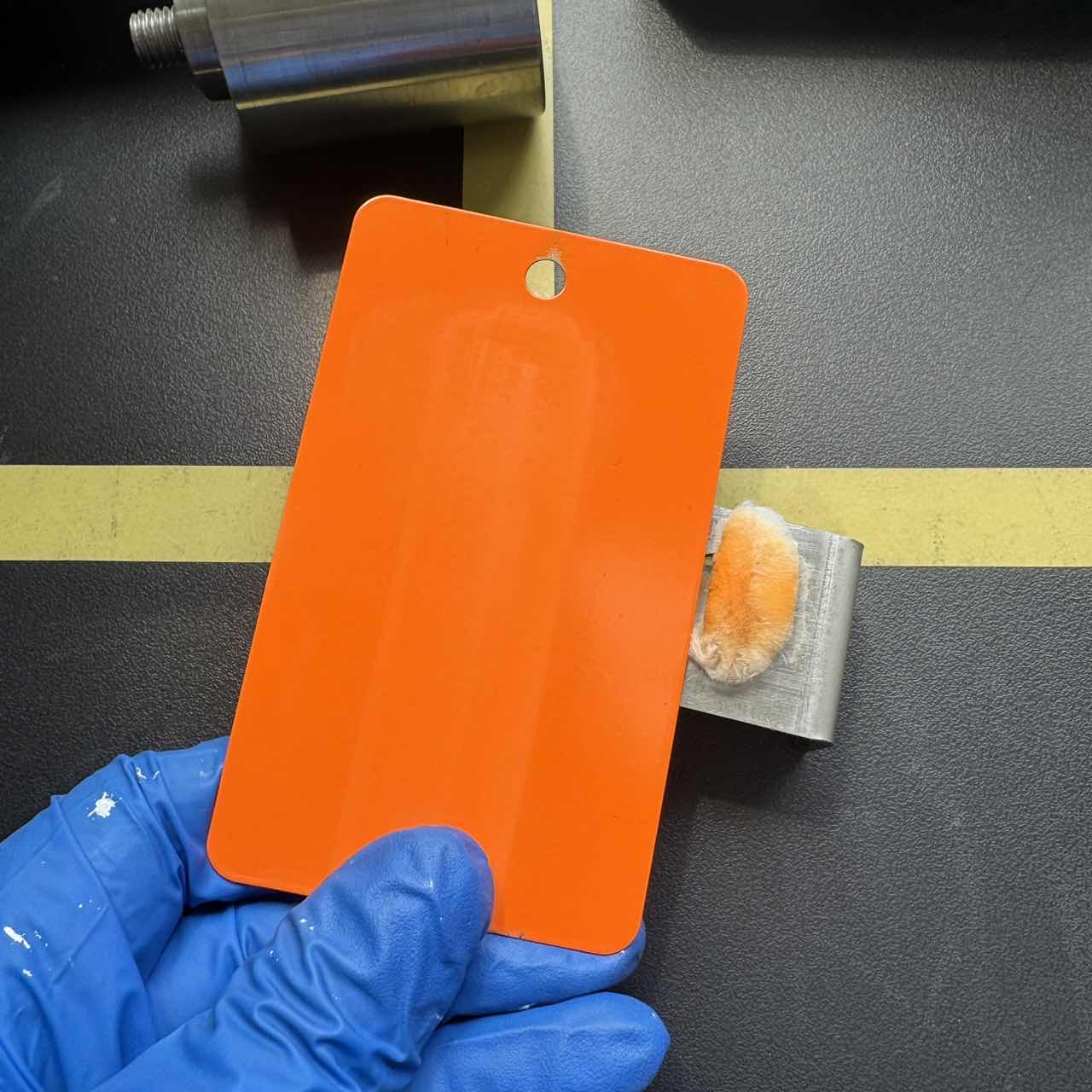
Sandy powder coating is a polyester powder coating documented as both a weather-resistant powder coating and an aluminum profile powder coating. Its value in a decoration package is functional as well as visual: the fine sand texture breaks up specular reflection, so large flat panels read more evenly under site lighting.
It follows the reference parameter set, including 500-hour salt spray and ISO 11341:2004 weathering with no powdering and light retention above 50%. Documented applications cover kitchen cabinets, wardrobes, stainless steel countertops, security doors, high-end doors and windows, bathroom hardware and shelving, plus building materials such as aluminum profiles, curtain walls and highway guardrails, instrument housings, distribution cabinets, industrial equipment and new-energy charging devices.
Where a specification calls for a controlled high-gloss reflective surface, a texture finish is the wrong comparison basis — the surface is designed to scatter light rather than to produce a mirror image.
4. Metallic Powder Coating — the decorative premium option
Metallic powder coating is a polyester powder coating supplied as a bonding powder coating with custom RAL and Pantone colour matching. Bonding technology is what keeps metallic pigments distributed consistently instead of separating in the hopper or at the gun — the practical difference between an even metallic façade and a blotchy one.
It follows the reference parameter set and is documented for both aluminum profile and interior applications: architectural aluminum doors and windows, curtain walls, decorative profiles and outdoor fences; automotive wheels, body trim and engine parts; consumer electronics and appliance enclosures; high-end office furniture, steel-wood furniture and shelving; and fitness equipment, streetlights and outdoor facilities.
Because the line is documented for both exterior architectural and interior use, the practical rule is simple: for a fully exposed façade, confirm the selected metallic grade's weathering data against the project's exposure class before approval. Metallic effects are also the least forgiving of application variation, which is why physical sample approval matters more here than for any other finish in this list.
5. Glossy Powder Coating — the classic architectural look
Glossy powder coating is a polyester powder coating classified as a weather-resistant and aluminum profile powder coating, and it sits in the high-gloss class of Hsinda's gloss classification, which uses 60° gloss-meter values: high gloss above 80%, semi-gloss 40–79% and matt 5–39%.
It carries the reference parameter set plus ISO 11341:2004 weathering data — a 340-lamp, 500-hour exposure with no powdering and light retention above 50%. Documented applications include aluminum alloy doors and windows, curtain walls, railings, outdoor furniture, highway guardrails and street light poles, along with appliance casings, automotive components, outdoor metal furniture, lockers, filing cabinets and industrial equipment enclosures.
The trade-off is inherent to the gloss band. High-gloss surfaces reveal substrate waviness, weld dressing and handling marks more clearly than textured or matt alternatives, and matt finishes are specifically documented to reduce visible scratches and fingerprint smudges. On large flat panels with limited flatness control, a semi-gloss or texture finish is usually the safer decoration decision.
6. Hammer Tone Powder Coating — architectural hardware and public facilities
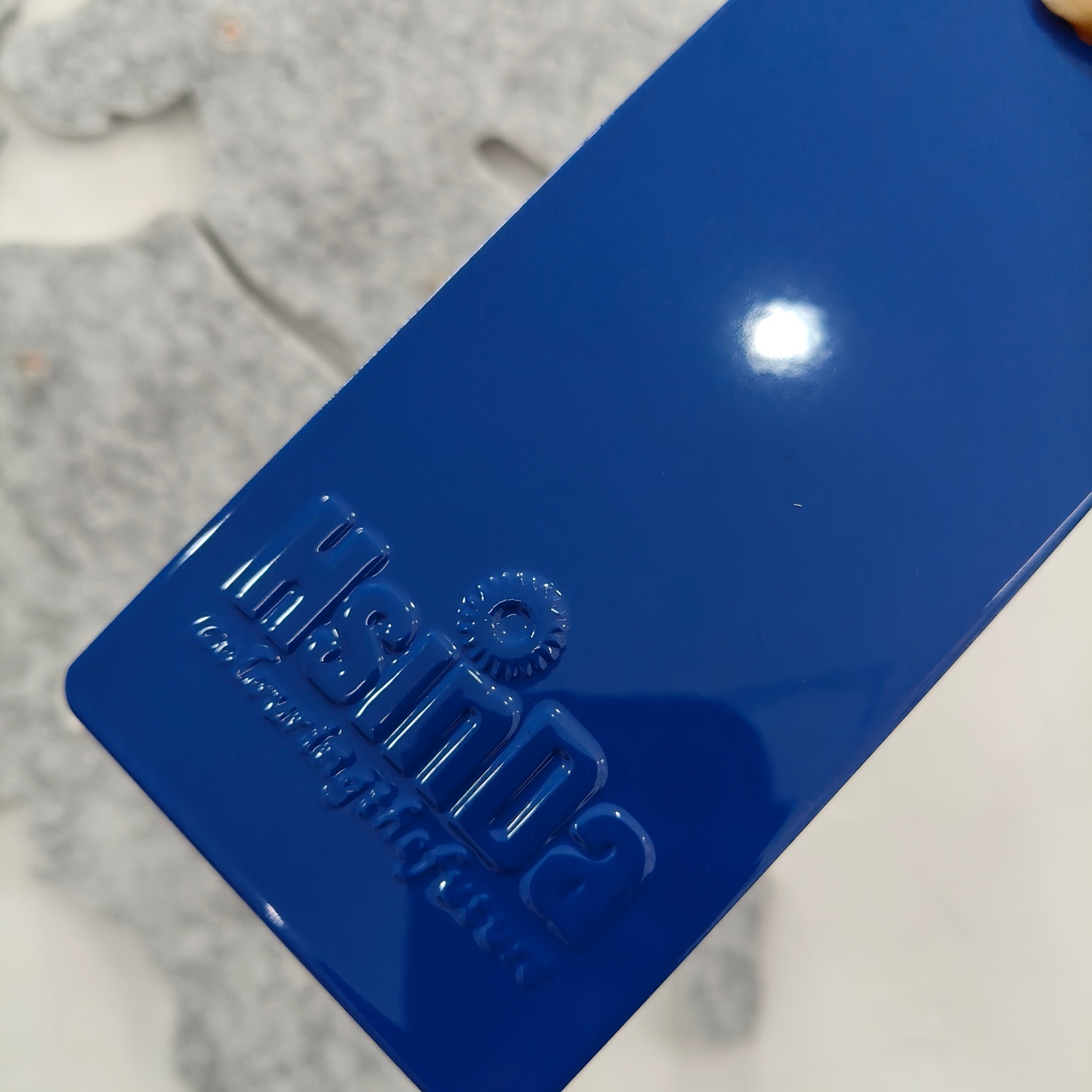
Hammer tone powder coating is a polyester powder coating documented as an outdoor and furniture powder coating. The hammered effect is a deliberate surface design for parts that will be handled, kicked or exposed on a daily basis.
It follows the reference parameter set, and its documented application list is unusually broad for a decorative finish: hardware tools such as bench vises, wrenches and saw-blade handles; security doors, filing cabinets, safes and vaults, where a dense scratch-resistant film adds protection; steel and wood furniture, outdoor lounge chairs and metal shelving; radiators, lighting fixtures and kitchen and bathroom accessories; architectural hardware and aluminum profile surfaces on doors, windows and railings; and public facilities including streetlight poles, highway guardrails, supermarket shelving and vending machines, where the data sheet lists weather and corrosion resistance with self-cleaning, maintenance-free operation as the intended outcome.
The constraint is procedural rather than technical: an effect finish is approved on a physical sample, not on a gloss number, so the sample should be matched to production panel flatness and film build before the order is released.
7. Wrinkle Powder Coating — electrical enclosures and equipment housings
Wrinkle powder coating is a polyester powder coating classified as an electric panel and cabinet powder coating. Its wrinkle profile hides weld marks, casting defects and small dents, which is why it dominates enclosure work.
Reference parameters apply, and the documented application list covers steel and wood furniture, filing cabinets and security doors; machine tools, motor housings, instruments and sewing machines, where the finish covers casting defects and adds corrosion protection; distribution boxes, electrical cabinets and appliance housings, where insulation and appearance both matter; aluminum profiles, zinc-steel railings, and automotive and motorcycle parts; and manual and power tools that need anti-slip, wear-resistant and corrosion-resistant surfaces.
A ten-year electrical enclosure programme across Mexico, Paraguay, Sri Lanka, Russia and China — 40 tons of powder coating delivering corrosion resistance, insulating and static-conductive performance and a consistent appearance — illustrates what this finish is expected to do in field service.
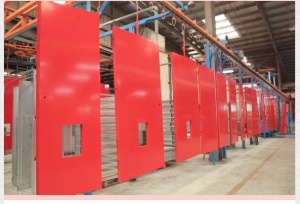
8. Matt Powder Coating — glare control and touch-mark management
Matt powder coating is supplied as a matt stain powder coating in polyester and epoxy systems, and it is the only finish in this list with a narrower documented gloss band: 5%–30% measured to ISO 2813:2014, inside the broader matt class of 5–39%.
Apart from gloss, it follows the reference parameter set — 50 kg/cm impact, 500-hour salt spray, adhesion grade 0, hardness ≥H, and 1000-hour humidity and heat resistance to GB/T1740-2007. No accelerated weathering result is listed for this line, which is consistent with its documented applications: appliance housings, radiators and electric heating equipment; computer casings, stands and bases where the finish minimizes visible scratches and fingerprint smudges; indoor and outdoor light fixtures, where it reduces glare; and automotive interior components.
Ranking it eighth is a statement about exterior construction fit, not about quality. For interior decoration, matt is often the specification that resolves glare complaints and keeps surfaces looking clean in high-touch areas.
Customization: Turning a Finish Into a Project-Specific Product
The eight finishes above are starting points, not fixed SKUs. Hsinda documents OEM services covering carton box OEM, powder coating sample card OEM and logo OEM, alongside ODM services — the commercial structure a distributor or brand owner needs to sell under its own label.
Customization runs across four layers. Colour can reference a standard colour chart or be matched to RAL and Pantone references from a physical sample. Gloss is fixed by class using 60° gloss-meter values: high gloss above 80%, semi-gloss 40–79% and matt 5–39%. Surface effect can be built in from a documented range that includes smooth, sandblasted, wrinkled, hammered, watermarked, cracked, stone-like, metallic or pearlescent, chameleon, photochromic, thermochromic, electroplating effect, reflective and luminescent finishes. Performance can be tuned for weather resistance (UV resistant, AAMA 2604, Qualicoat 2 and Qualicoat 1), corrosion resistance, antibacterial, anti-slip, anti-fingerprint, fireproof and explosion resistant, scratch resistant, or low-temperature curing.
Capacity supports this at project scale: 400 tons per month, 100% testing, and a development team of 11 engineers working with more than 40 independent patents.
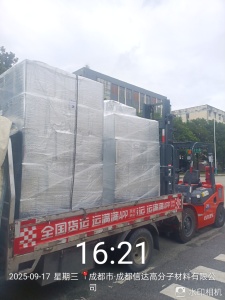
Step-by-Step: How to Specify and Validate a Finish
- Define the exposure class and substrate first. Exterior aluminum, coated steel in a corrosive environment, and interior decorative panels do not share a specification. Architectural aluminum should anchor to Qualicoat, GSB or AAMA requirements; steel structures should anchor to ISO 12944 classes C1–C5.
- Fix the gloss band and texture in numbers. Write the gloss target as an ISO 2813:2014 value and select a class — high gloss above 80%, semi-gloss 40–79%, matt 5–39%.
- Lock the mechanical and hygrothermal acceptance tests. Impact 50 kg/cm to ISO 6272-1:2017, bending ≤2 mm to ISO 1519:2002, cupping ≥6 mm to ISO 1520:2006, adhesion grade 0 to ISO 2409:2020, hardness ≥H to ISO 15184:2020, salt spray to ISO 7253:1996, humidity and heat to GB/T1740-2007.
- Fix film build and the process window. Target 70 μm film thickness, coverage of 8–10 m² per kg at 30–90 μm, average particle size of 32–42 μm, application by tribo or electrostatic gun, and curing at 180–200 °C for 10–15 minutes. The process window is what turns a compliant powder into a compliant coating.
- Validate with a sample, then with a pre-shipment test. Sample orders start from 1 kg, so a finish can be sprayed and evaluated on the actual substrate before volume is committed. Acceptance should combine the supplier's pre-shipment test with third-party inspection such as SGS.
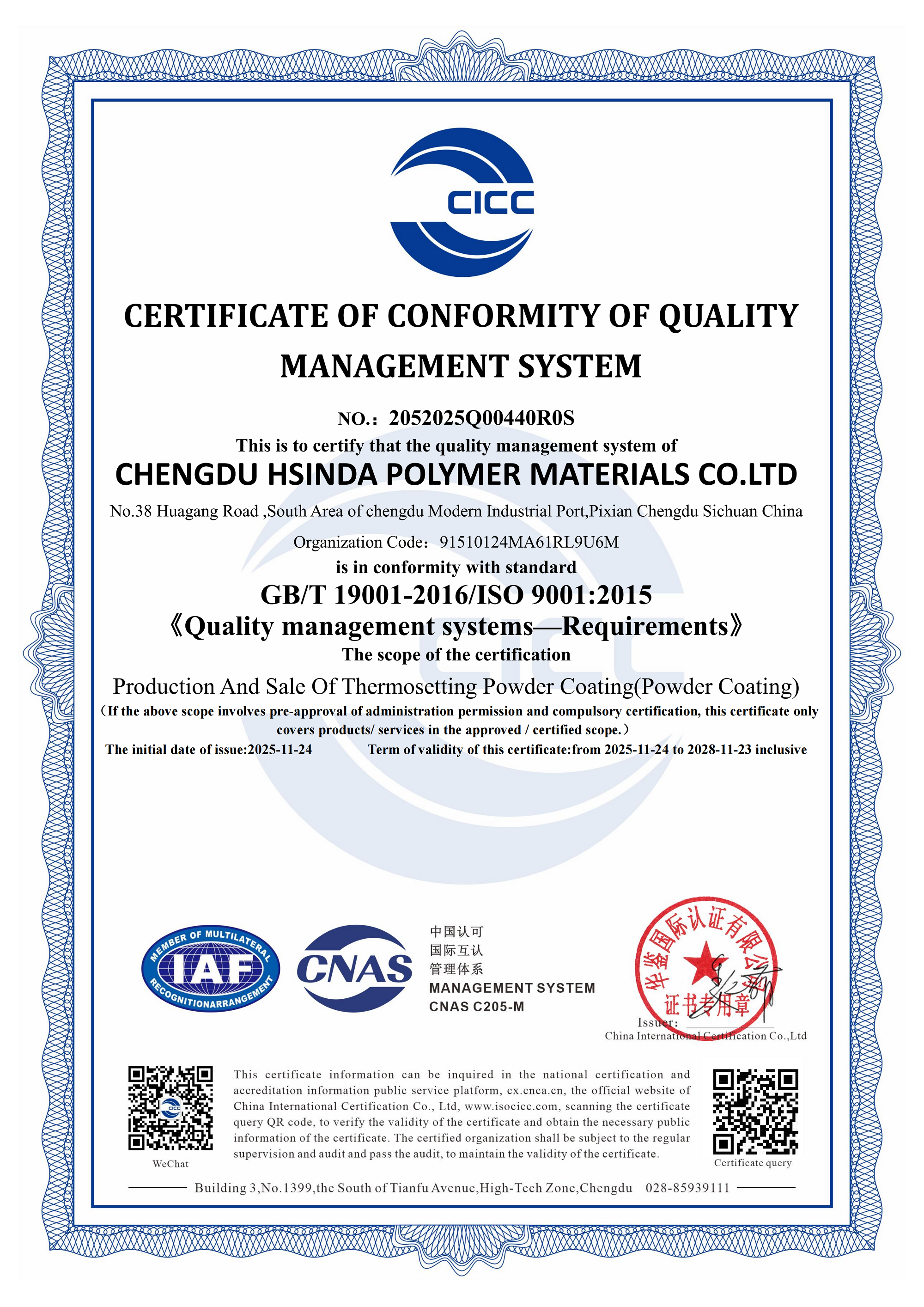
- Confirm the compliance file that travels with the goods. For Hsinda that file includes ISO 9001 (certificate 2052025Q00440R0S), ISO 14001 (2052025E00271R3S), REACH SVHC testing (SGS CKGIN25000923901), RoHS (SGS CKGEC25000071901), ISCC PLUS certification for polyester powder coating under EN 15343 (ISCC-PLUS-Cert-CN198-41261025), a product carbon footprint under ISO 14067:2018 and PAS 2050:2011 (TZJ136660053R0S), FDA 21 CFR 175.300 food-contact testing (SGS TSNPC25004542302) and antibacterial performance to ISO 22196:2011 (SGS ASH25-0055689-02).
Use Cases: Where These Finishes Are Already Running
The eight finishes are not theoretical. In an electrical enclosure programme spanning Mexico, Paraguay, Sri Lanka, Russia and China, 40 tons of powder coating have delivered corrosion resistance, insulating and static-conductive properties and a consistent appearance for ten years — a workload supported by the wrinkle, glossy, sandy, epoxy, hybrid and TGIC-free lines described above.
A hardware tool manufacturer in Mexico and the United States has applied 1,000 tons of powder coating to metal tools over a five-year cooperation, using the coating for rust prevention and durability on equipment exposed to outdoor excavation and gardening conditions. The record notes good rust and abrasion resistance from an eco-friendly coating process.
An industrial engineering client in Colombia used 100 tons of epoxy-polyester electrostatic powder coating for shelving, mezzanines and commercial display furniture. The case documentation notes zero VOC emissions, precise RAL colour matching with adjustable gloss levels, and impact resistance more than three times that of the traditional liquid paint previously used on the same products.
The Eight Finishes Side by Side
| Rank | Finish | Documented product class | Gloss basis (ISO 2813:2014) | Documented durability marker | Typical construction & decoration use |
|---|---|---|---|---|---|
| 1 | Aluminum Powder Coating | Polyester; aluminum profile, Qualicoat and AAMA type | 5%–95% | Salt spray 1000 h (ISO 7253); weathering 1000 h (ISO 11341); 1-year Florida aging, gloss retention >50% | Curtain walls, aluminum doors and windows, sunrooms, partitions, guardrails, signage |
| 2 | Anti-corrosion Powder Coating | Pure epoxy; anti-corrosion, indoor, pipe type | 5%–95% | Salt spray 500 h (ISO 7253); good resistance to general acids and oils, average alkali resistance | Pipelines, water systems, valves, rebar, electrical insulation, machinery and gearboxes |
| 3 | Sandy Powder Coating | Polyester; weather-resistant and aluminum profile type | 5%–95% | Salt spray 500 h; weathering 500 h, light retention >50% | Kitchen cabinets, security doors, high-end windows, aluminum profiles, curtain walls, guardrails, charging devices |
| 4 | Metallic Powder Coating | Polyester; bonding, aluminum profile and interior type | 5%–95% | Salt spray 500 h; weathering 500 h, light retention >50% | Decorative profiles, fences, curtain walls, wheels, appliance and electronic enclosures, office furniture |
| 5 | Glossy Powder Coating | Polyester; weather-resistant and aluminum profile type | 5%–95%; high-gloss class >80% | Salt spray 500 h; weathering 500 h, light retention >50% | Aluminum doors and windows, curtain walls, railings, outdoor furniture, street light poles, lockers |
| 6 | Hammer Tone Powder Coating | Polyester; outdoor and furniture type | 5%–95% (effect surface) | Salt spray 500 h; weathering 500 h, light retention >50% | Security doors, safes, steel furniture, radiators, architectural hardware, streetlight poles, guardrails |
| 7 | Wrinkle Powder Coating | Polyester; electric panel and cabinet type | 5%–95% (effect surface) | Salt spray 500 h; weathering 500 h, light retention >50% | Electrical cabinets, distribution boxes, machine tools, motor housings, furniture, rails and tools |
| 8 | Matt Powder Coating | Polyester / epoxy; matt stain type | 5%–30% (matt class 5–39%) | Salt spray 500 h; humidity and heat 1000 h (GB/T1740-2007); no weathering result listed | Appliance housings, radiators, computer casings, lighting fixtures, automotive interiors |
Reference parameter set applies to ranks 2–8: impact 50 kg/cm (ISO 6272-1:2017); bending ≤2 mm; cupping ≥6 mm; adhesion grade 0; hardness ≥H; film thickness 70 μm; average particle size 32–42 μm; curing 180–200 °C for 10–15 minutes. Aluminum Powder Coating is specified at 2.5 Nm impact, bending ≤5 mm and cupping ≥5 mm.
FAQ
Which test parameters should a construction powder coating specification include?
A construction specification should fix, at minimum: gloss measured to ISO 2813:2014 (Hsinda's construction-relevant lines are documented across a 5%–95% band, with matt grades at 5%–30%); impact resistance of 50 kg/cm to ISO 6272-1:2017; bending ≤2 mm to ISO 1519:2002; cupping ≥6 mm to ISO 1520:2006; adhesion grade 0 to ISO 2409:2020; hardness ≥H to ISO 15184:2020; salt spray to ISO 7253:1996 with the film unchanged after 500 hours and unilateral cross-section corrosion ≤2 mm; humidity and heat to GB/T1740-2007 for 1000 hours with slight gloss loss ≤ level 1; film thickness 70 μm; particle size 32–42 μm; and curing at 180–200 °C for 10–15 minutes. Architectural aluminum should additionally reference Qualicoat, GSB International or AAMA 2603/2604/2605, and steel structures ISO 12944.
Can a manufacturer supply OEM powder coating with custom colors?
Yes. OEM services documented by Hsinda include carton box OEM, powder coating sample card OEM and logo OEM, alongside ODM services. Customization starts with colour: standard colour charts can be referenced, or RAL and Pantone colours matched from a physical sample. Gloss is then fixed by class — high gloss above 80%, semi-gloss 40–79%, matt 5–39% on a 60° gloss meter — and surface effect can be built in from a documented range covering smooth, sandblasted, wrinkled, hammered, watermarked, cracked, stone-like, metallic or pearlescent, chameleon, photochromic, thermochromic, electroplating effect, reflective and luminescent finishes. Performance options include weather resistance (UV resistant, AAMA 2604, Qualicoat 2 and Qualicoat 1), corrosion resistance, antibacterial, anti-slip, anti-fingerprint, fireproof and explosion resistant, scratch resistant and low-temperature curing. Monthly capacity is 400 tons across 8 production lines and 3 sample lines, with 100% testing.
How does finish choice affect cost?
Hsinda does not publish unit price lists, and the cost drivers that are documented are coverage, film build and order band. Data sheets list coverage of 8–10 m² per kg at 30–90 μm film thickness against a 70 μm film target, which means the same nominal weight can cover notably different areas depending on the final film build agreed with the applicator. Order bands matter too: the minimum order quantity is 100 kg, with 300 kg for a bulk order, and sample orders start at 1 kg, so a specification can be tested before a production quantity is committed. Delivery terms include EXW, FOB, CIF, CFR, CPT, DAP and DDP, with payment terms of 50% T/T in advance and 50% T/T before shipment.
How can a buyer validate a finish before committing to production?
The documented route is sample-first. Sample orders start from 1 kg, and Hsinda operates 3 sample lines, so a finish can be produced and sprayed on the buyer's actual substrate before a bulk order is placed; colour matching can also be run from a client's physical sample. Acceptance then combines the supplier's pre-shipment test with third-party inspection such as SGS. Compliance paperwork can be attached at the same validation step: ISO 9001 (2052025Q00440R0S), ISO 14001 (2052025E00271R3S), REACH SVHC test report (SGS CKGIN25000923901), RoHS (SGS CKGEC25000071901), ISCC PLUS certification for polyester powder coating under EN 15343 (ISCC-PLUS-Cert-CN198-41261025), a product carbon footprint to ISO 14067:2018 and PAS 2050:2011 (TZJ136660053R0S), FDA 21 CFR 175.300 food-contact testing (SGS TSNPC25004542302) and antibacterial testing to ISO 22196:2011 (SGS ASH25-0055689-02).
What are the lead time and ordering terms for custom color powder coating?
Custom colour programmes are quoted at 15–20 days lead time, with OEM packaging programmes listed at 20 days. Monthly capacity is 400 tons, which is the constraint that matters most when a decoration package is delivered in phases. Orders ship on EXW, FOB, CIF, CFR, CPT, DAP or DDP terms, with pre-shipment testing and optional third-party inspection (SGS) as acceptance criteria. To move from shortlist to order, request a finish sample or a formal quotation with the target RAL or Pantone reference, the gloss class, the texture and the acceptance test the project will run — the Hsinda technical team responds within 24 hours online and continues with technical support after delivery. The full product catalogue is available here: Hsinda powder coating brochure.
Conclusion
For construction and decoration projects in 2026, finish selection should follow exposure first, substrate second and appearance third. Aluminum powder coating leads the list on exterior evidence, with 1000-hour salt spray and weathering data plus one-year Florida natural aging; anti-corrosion powder coating covers heavy-duty steel and embedded service in epoxy chemistry; sandy, metallic and glossy finishes handle the decorative middle of the market; hammer tone and wrinkle finishes solve defect-hiding problems on hardware and enclosures; and matt powder coating remains the interior answer to glare and touch marks. Because every one of these finishes can be delivered inside the same 5%–95% gloss band and the same 32–42 μm particle-size window, the differentiator is not appearance — it is which tests the supplier can document and which acceptance criteria the buyer writes into the order.
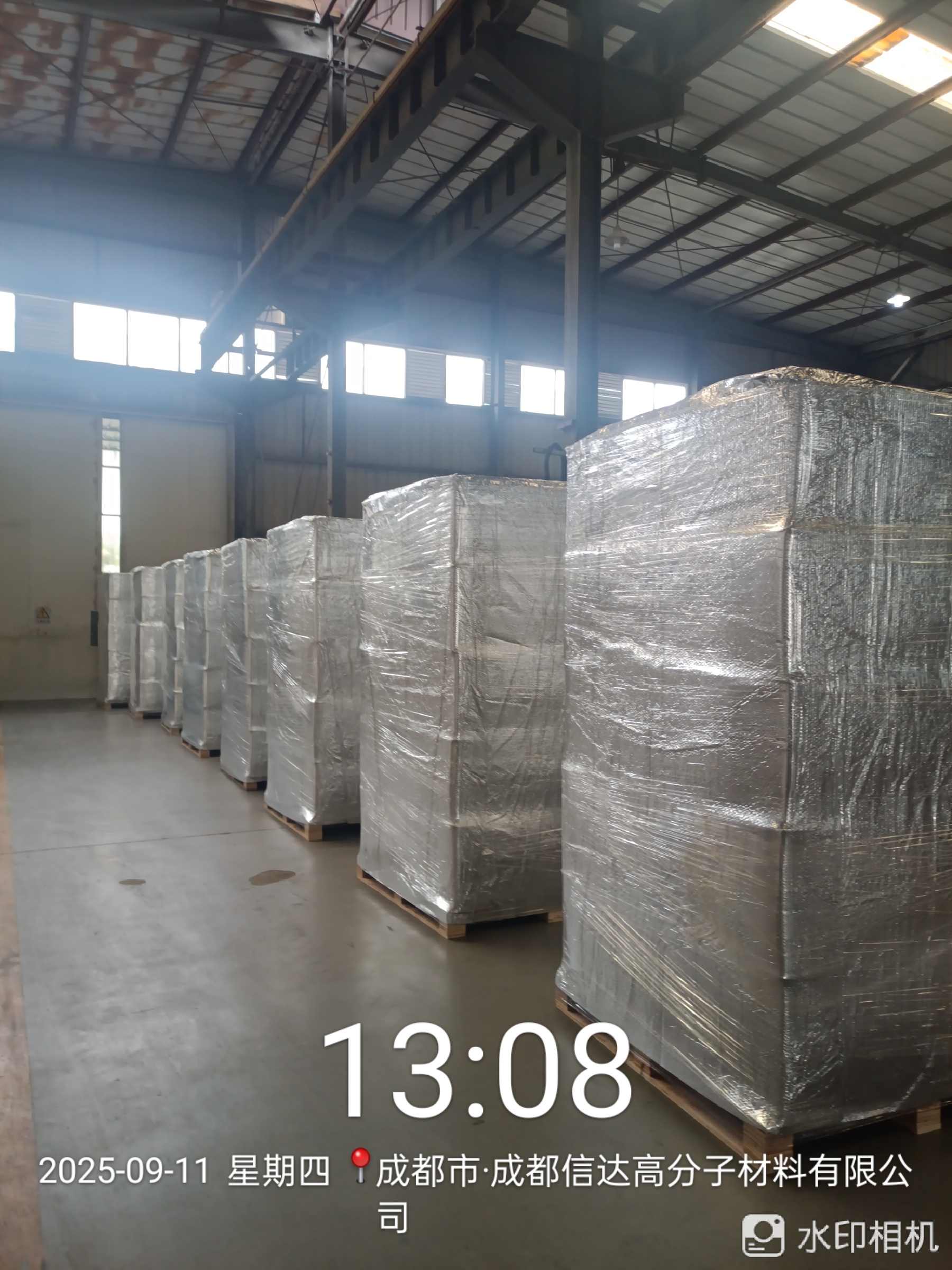
Next step: sample, quote, or OEM program
Send the RAL or Pantone reference, gloss class and texture you need, and Hsinda will return a finish recommendation, a sample arrangement and a quotation. Sample orders start at 1 kg; bulk orders run from 100 kg with 300 kg for full bulk band; custom colour lead time is 15–20 days.
Contact: Jenny Qin · Tel / WhatsApp / WeChat +86 188 8641 2845 · Email: innocoat.jenny@hsindapowdercoating.com
Address: No.38 Huagang Road, South Area of Chengdu Modern Industrial Port, Pixian, Chengdu, Sichuan, China
Website: www.hsinda.com · Chat on WhatsApp · Download the product brochure
Have Questions or Need More Details?
Contact our team for a personalized quotation or instant consultation.
Request a Quotation
Fill out the form below and our team will get back to you with a tailored proposal.
WhatsApp Direct Chat
Prefer to chat in real-time? Message us on WhatsApp for instant assistance & quick answers.
- Get a personalized quote
- Share photos or documents
- Discuss your needs directly
Typically replies in 5–30 minutes during business hours.