Long-Term Powder Coating Partnership: FAQ and After-Sales Support for Construction & Decoration
Long-Term Powder Coating Partnership: FAQ and After-Sales Support for Construction & Decoration
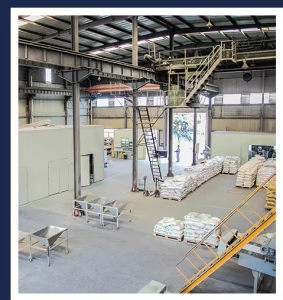
A standing powder coating line is what makes a multi-year supply commitment possible; the sample room only proves the first batch.
A long-term powder coating partnership is judged on the second and third order, not the first. What holds a construction and decoration account together is repeatable film performance, a compliance file that stays current, spray and cure settings the customer's own line can run, and a technical channel that answers within a working day. This article answers the questions that actually come up when aluminium profiles, anti-corrosion steel parts, metallic finishes and custom RAL colours sit inside one supply agreement — and it sets out what after-sales support should contain before it is written into a contract.
Hsinda (Chengdu Hsinda Polymer Materials Co., Ltd), a thermosetting powder coating manufacturer established in 2015 in Chengdu, Sichuan, China, is used here as the reference supplier. The product figures quoted below come from Hsinda's published product documentation and test reports; where a value is company-reported, it is described as such.
Where Long-Term Powder Coating Agreements Actually Break
Partnership failures in this category are rarely chemistry failures. They are gaps in what the agreement made explicit. Five recur most often in construction and decoration accounts.
- Hue is fixed; appearance is not. A RAL code specifies a colour, not a 60° gloss value, a texture or a film thickness. Two batches can match the code and still read differently on a façade in daylight.
- Certificates are collected once and never refreshed. A compliance file built at the sampling stage is often two years out of date by the time a façade contractor is audited.
- Curing is set by oven display, not substrate temperature. A 180–200°C setting with a 10–15 minute hold only means something when it refers to the metal, not the air.
- Technical questions are answered by sales. Adhesion loss, pinholes and gloss drift need a process answer, not a commercial one.
- No retained sample per batch. Without a physical reference from each lot, a colour dispute becomes an argument about memory.
None of these are solved by switching supplier. They are solved by deciding, once, what the partnership will measure — and then measuring it every time.
What Construction and Decoration Buyers Are Actually Buying
Powder coating in this segment is rarely a single product. One purchase order can cover aluminium window and door profiles, curtain wall and sunroom sections, interior partitions, railings, metal shelving, outdoor furniture, electrical enclosure panels and hardware — each with a different exposure profile. Outdoor architectural aluminium is bought for colour retention and chalk resistance. Interior decorative work is bought for surface uniformity and abrasion resistance. Heavy-duty steel is bought for barrier protection.
The supply structure behind those orders is concentrated. Published estimates value the global powder coatings market at USD 16.12 billion in 2025, with Asia Pacific taking 63.10% of revenue and polyester resins accounting for 48.2% of the market in the same year (Fortune Business Insights; Grand View Research). Published valuations differ between research houses because scope definitions differ, so these numbers are useful for supply-structure context rather than for budgeting. On the demand side, the Associated General Contractors of America recorded more than 919,000 construction establishments in the United States in the first quarter of 2023 — a fragmented downstream base that pushes most coating decisions down to fabricators and applicators rather than to a single national specifier.
Two practical consequences follow. First, most construction buyers are sourcing from Asia Pacific whether or not they describe it that way, so supplier-side documentation quality matters as much as resin quality. Second, because the decision sits with the fabricator, the coating specification is usually written by someone who also has to run the line — which is why the questions below are technical and operational rather than purely commercial.
Product Selection: Four Questions Buyers Ask First
1. Which resin system belongs on which surface?
Hsinda's technical documentation organises products by resin chemistry, and the split maps closely onto how construction and decoration jobs are actually awarded.
- Polyester (TGIC-cured). Used for outdoor architectural aluminium, doors and windows, curtain walls, railings, outdoor furniture, guardrails and light poles, as well as appliance casings and automotive components. Weather resistance is documented at 500 hours of 340 nm lamp exposure with no powdering and gloss retention above 50% (ISO 11341:2004), with salt spray unchanged after 500 hours and unilateral corrosion at the cross-section ≤2 mm (ISO 7253:1996).
- Aluminium-grade super-weatherable polyester. The product listed as Aluminum Powder Coating is positioned against the AAMA 2604 and Qualicoat 1/2 weathering levels and carries higher documented limits: 1,000 hours salt spray, 1,000 hours weathering, plus one year of natural Florida exposure with gloss retention above 50%.
- Pure epoxy. Intended for heavy-duty industrial anti-corrosion — oil and gas pipelines, water supply systems, valves and steel reinforcement bars — and for electrical insulation applications. Epoxy chemistry is specified for barrier protection, not for exterior colour retention.
- Epoxy-polyester hybrid. Used for appliance housings, office and residential furniture, automotive interior and chassis parts, and instrumentation enclosures, where adhesion, hardness and chemical resistance matter more than UV exposure.
- TGIC-free HAA polyester. Documented as a VOC-free, REACH-certified option for appliance, furniture, automotive and instrumentation applications where the buyer's compliance team has ruled out TGIC chemistry.
The selection rule is straightforward: exterior aluminium goes to polyester or super-weatherable polyester; interior metal and electrical parts go to epoxy or hybrid; anything facing regulatory scrutiny on the EU side should be checked against the TGIC-free range first.
2. Which performance values should the purchase specification carry?
Vague specifications are the most common cause of a second-order dispute. The table below lists the values Hsinda publishes against its standard thermoset range, so a buyer can copy them into a purchase specification and hold the supplier to the same test method.
| Property | Test method | Standard range | Aluminium-grade range |
|---|---|---|---|
| Gloss | ISO 2813:2014 | 5–95% | 5–95% |
| Impact | ISO 6272-1:2017 | 50 kg/cm | 2.5 Nm |
| Bending | ISO 1519:2002 | ≤2 mm | ≤5 mm |
| Cupping | ISO 1520:2006 | ≥6 mm | ≥5 mm |
| Adhesion | ISO 2409:2020 | 0 grade | 0 grade |
| Hardness | ISO 15184:2020 | ≥H | ≥H |
| Salt spray | ISO 7253:1996 | 500 h, film unchanged, cross-section corrosion ≤2 mm | 1,000 h, same acceptance |
| Humidity and heat | GB/T 1740-2007 | 1,000 h, slight gloss loss, ≤ level 1 | 1,000 h, ≤ level 1 |
| Weathering | ISO 11341:2004 | 340 nm lamp, 500 h, no powdering, gloss retention >50% | 340 nm lamp, 1,000 h, plus 1-year Florida exposure, gloss retention >50% |
Two of these lines carry most of the contractual weight. Adhesion grade 0 (ISO 2409:2020) is the single best early warning of a pretreatment or cure problem, and salt spray with a defined cross-section corrosion limit is far more defensible than a pass/fail salt spray claim. Chemical resistance is documented qualitatively — good resistance to general acids and oils, average alkali resistance — so it should be specified by reference to the actual service environment rather than treated as a fixed number.
3. How do film thickness, particle size and coverage affect the line?
Hsinda documents a reference film thickness of 70 μm, an average particle size of 32–42 μm, a specific gravity of 1.2–1.7, and coverage of 8–10 m² per kg at 30–90 μm film thickness. For a fabricator, the coverage figure is the one that turns into money: it sets how many kilograms a given profile run will consume, and therefore how a standing order should be sized. Particle size matters at the gun — a tighter distribution sprays more consistently through both tribo and electrostatic equipment, which is why the same 32–42 μm band appears across the product range.
4. Which gloss and texture levels can realistically be promised?
Gloss is classified on a 60° meter: high gloss above 80%, semi-gloss 40–79%, and matt 5–39%. Within Hsinda's matt line, the documented gloss band is tighter at 5–30%, which is the range to quote when a designer asks for a genuinely flat finish rather than a low-sheen one. Texture is a separate variable: smooth, sandblasted, wrinkled, hammered, water-marked, cracked, stone-like, metallic or pearlescent, chameleon, photochromic, thermochromic, electroplated-effect, reflective and luminescent effects are all documented as available surface options.
Where texture and gloss combine — a hammer tone at 70 μm, for example — the specification should state both, because a hammer tone at different film thicknesses reads as two different products.
Certifications, Custom Colour and Sampling
The compliance file: what belongs in it, and how to keep it valid
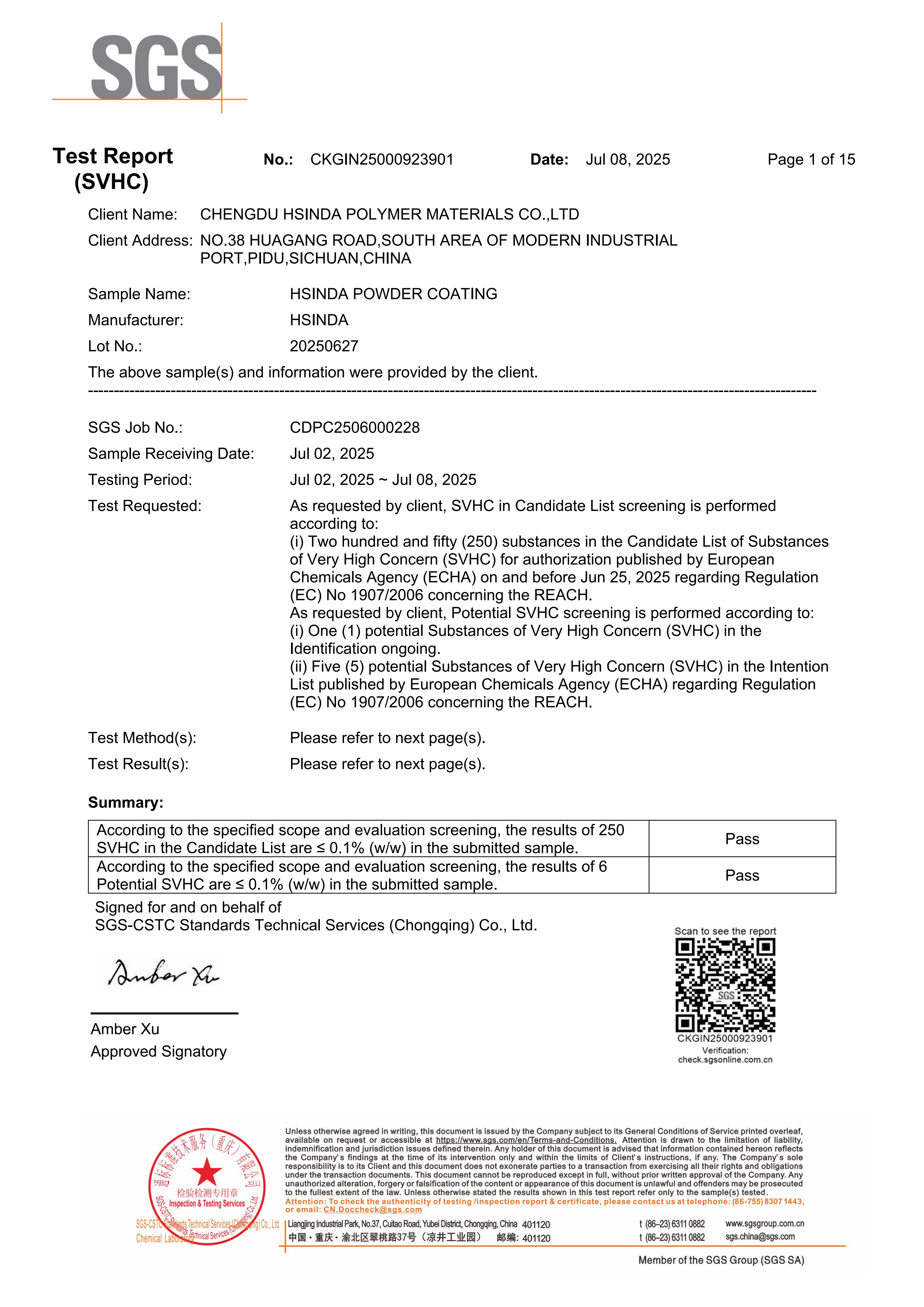
A REACH SVHC report is only useful if the scope line matches the resin system actually ordered.
Hsinda's current documentation set covers management systems, substance restriction, sustainability and application-specific testing:
- ISO 9001:2015 (certificate 2052025Q00440R0S, issued by China International Certification Co., Ltd, valid to 23 November 2028), scope: production and sale of thermosetting powder coating.
- ISO 14001:2015 (certificate 2052025E00271R3S, valid to 23 November 2028).
- REACH SVHC (SGS report CKGIN25000923901, 18 July 2025), scope: HAA type powder coating, tested against Regulation (EC) No 1907/2006.
- RoHS (SGS report CKGEC25000071901, 22 January 2025), tested to IEC 62321 series methods.
- ISCC PLUS (certificate ISCC-PLUS-Cert-CN198-41261025, valid to 25 June 2027), scope: polyester powder coating, standard EN 15343.
- Product carbon footprint (certificate TZJ136660053R0S, valid to 17 July 2028), assessed to ISO 14067:2018 and PAS 2050:2011.
- FDA 21 CFR 175.300 total extractives report (SGS TSNPC25004542302), scope: white food-grade BPA-free thermosetting powder coating on metal.
- Antibacterial performance (SGS ASH25-0055689-02, 22 July 2025), tested to ISO 22196:2011.
A partnership file should record certificate number, issuing body, scope and expiry for each item, and diarise a refresh request 90 days before expiry. The scope line is the part that catches buyers out: a REACH report covering HAA chemistry does not automatically cover an epoxy product ordered for a different part of the same project.
Custom RAL and Pantone colours: freeze the variables, not just the code
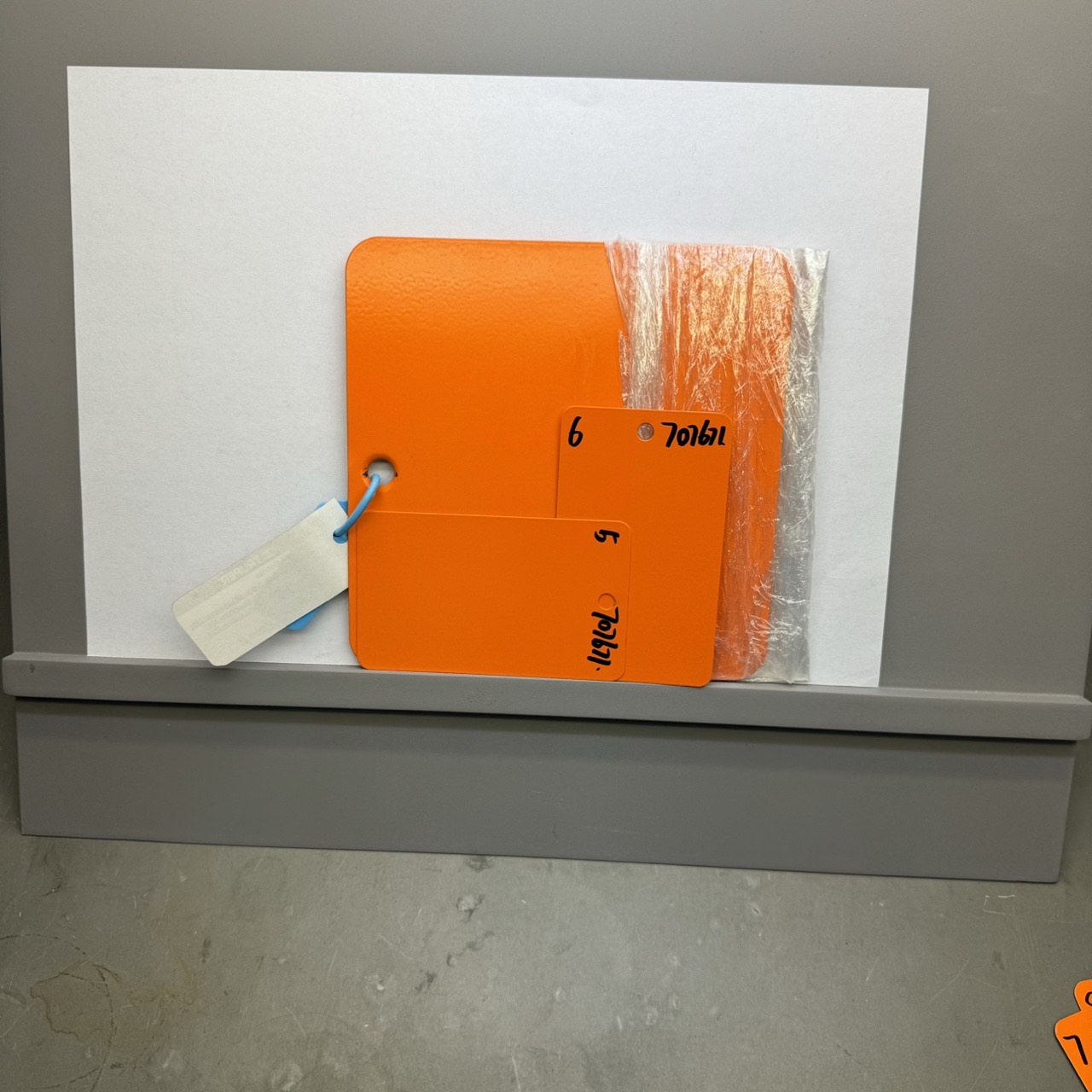
Colour approval should be signed against a physical panel, not a screen preview.
Hsinda matches colour to standard colour charts or produces custom RAL and Pantone matches from a physical sample. The colour code alone is not a specification. Five variables should be frozen before a long-term order is released: the exact colour reference, the 60° gloss target, the texture designation, the reference film thickness, and the resin system. A sixth — the substrate and pretreatment the panel was sprayed onto — determines whether the approval is even transferable to the production line.
Two retained panels per approved colour are worth the cost. One stays with the supplier, one stays with the buyer, and both are dated and signed.
Application Support: Spray, Cure and Acceptance in Seven Steps
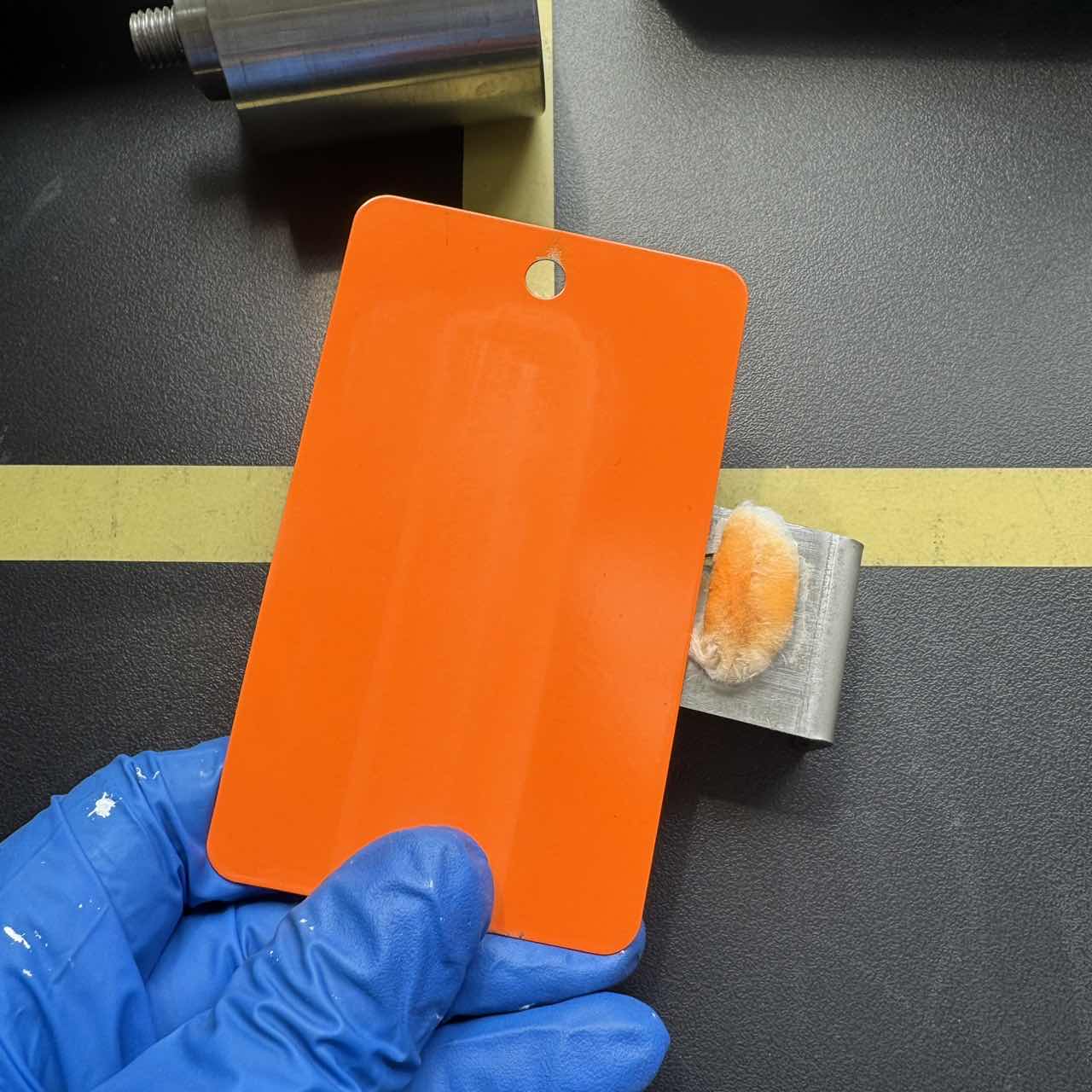
A solvent rub is a fast shop-floor check; the formal record still comes from the ISO methods in the specification.
Most partnership disputes that look like product failures are application issues. The sequence below is the one that keeps parameters comparable between the sample, the first order and the tenth.
After-Sales Support: What Should Be Contracted, Not Assumed
After-sales is where long-term powder coating relationships are actually won or lost, and it is the part most often left as a verbal promise. Hsinda's stated support structure has three components: 24-hour online service, direct technical support, and local distributor support in markets where a distributor is established.
Translated into contract language, that should mean:
- A named technical contact, not a general inbox. Adhesion failures, pinholes, orange peel and gloss drift need a process engineer's answer within one working day.
- Batch traceability on request. Given a production date and colour code, the supplier should be able to identify the batch, the resin system and the retained sample.
- Document refresh without prompting. Certificates with expiry dates — ISO 9001 and ISO 14001 to November 2028, ISCC PLUS to June 2027, carbon footprint to July 2028 — should be reissued proactively, not requested annually.
- Replenishment parameters in writing. Hsinda quotes a 300 kg minimum for customised orders and a 6-ton minimum for OEM packaging programmes, with lead times of 15–20 days for customised production and 20 days for OEM packaging, against a stated monthly capacity of 400 tons and 100% testing. A long-term agreement should convert those numbers into a call-off schedule rather than a fresh quotation each time.
- Local support where the buyer operates. Hsinda's distributor network covers Russia, Bangladesh, Poland, Portugal, the United States, Canada, Sri Lanka, Bolivia and Argentina, with exclusive distributors in Kazakhstan, Uzbekistan and Chile — relevant when a project needs on-site troubleshooting rather than email diagnosis.
Where the Model Has Been Applied
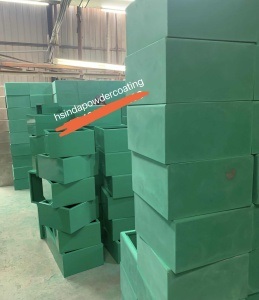
Electrical enclosure work depends on corrosion resistance, insulation behaviour and appearance holding together across repeat orders.
Industrial shelving and warehousing, Colombia. A ten-year relationship covering 100 tons of powder coating for industrial shelving, mezzanines and commercial display furniture. The documented outcomes are zero VOC emissions, no hazardous substances, impact resistance more than three times that of conventional liquid paint, and colour matching to the RAL chart with adjustable gloss levels.
Hardware tools, Mexico and the United States. A five-year programme covering 1,000 tons of coating on wrenches, post-hole diggers, wheelbarrows, shovels and similar outdoor tools. The requirement was rust and abrasion resistance under outdoor excavation and gardening use, alongside an eco-friendly process consistent with the buyer's sustainability positioning.
Electrical enclosures, multi-country. A ten-year, 40-ton supply relationship across Mexico, Paraguay, Sri Lanka, Russia and China, covering panels that house electrical components and support centralised control and distribution. The stated performance requirements were weather resistance, corrosion resistance, insulation or static conductivity, and appearance consistency.
What these three have in common is not the product — shelving, hand tools and enclosures use different chemistries. It is that each relationship outlasted several product changes, which only happens when the colour, the test method and the technical contact are stable across orders.
Resin Systems Side by Side
The table below sets the five systems against the criteria that decide most construction and decoration awards. Values are those published in Hsinda's product documentation; where a system carries no published weathering figure, the cell says so rather than implying one.
| System | Typical construction use | Published weathering | Salt spray (ISO 7253:1996) | Gloss range | Watch-out |
|---|---|---|---|---|---|
| Polyester (TGIC) | Doors, windows, curtain walls, railings, outdoor furniture, light poles | 500 h at 340 nm, no powdering, gloss retention >50% | 500 h | 5–95% | Exterior colour retention depends on pigment choice as much as resin |
| Aluminium-grade super-weatherable polyester | Architectural profiles, glass curtain walls, sunrooms, partitions | 1,000 h at 340 nm plus 1-year Florida exposure, gloss retention >50% | 1,000 h | 5–95% | Highest documented performance; confirm the certificate matches the ordered code |
| Pure epoxy | Pipelines, valves, water systems, rebar, electrical insulation | Not published for exterior weathering | 500 h | 5–95% | Specify for barrier and insulation duty, not for UV-exposed façades |
| Epoxy-polyester hybrid | Appliance housings, office furniture, automotive interior, instruments | Not published for exterior weathering | 500 h | 5–95% | Interior duty; confirm chemical exposure against the qualitative resistance statement |
| TGIC-free HAA polyester | Appliance, furniture, automotive components, instrumentation | Not published for exterior weathering | 500 h | 5–95% | Chosen for regulatory positioning; verify REACH scope against the actual product |
| Matt line (within the above) | Interior decorative metal, furniture, enclosures | Depends on base chemistry | 500 h | 5–30% | Matt band is narrower than the general 5–95% range — quote the narrow figure |
Frequently Asked Questions
Which certifications should a Chinese powder coating supplier hold before a construction project starts?
At minimum, a quality management system certificate and an environmental management system certificate covering the production of thermosetting powder coating, plus a REACH SVHC report and a RoHS report for the specific chemistry being ordered. Hsinda holds ISO 9001:2015 (2052025Q00440R0S) and ISO 14001:2015 (2052025E00271R3S), both valid to 23 November 2028, with REACH covered by SGS report CKGIN25000923901 for HAA type powder coating and RoHS by SGS report CKGEC25000071901. Projects with EU sustainability requirements may also need ISCC PLUS (EN 15343, valid to 25 June 2027) and a product carbon footprint to ISO 14067:2018. Food-contact or hygienic applications require separate reports — FDA 21 CFR 175.300 and ISO 22196:2011 respectively. Check the scope line on each document, not just the expiry date.
Who are the best Chinese powder coating manufacturers right now, and how should a buyer shortlist them?
There is no defensible public ranking of Chinese powder coating manufacturers, and any list presented as definitive should be treated with caution. The workable approach is to shortlist against verifiable capabilities. Four criteria separate suppliers quickly: production depth (Hsinda states eight production lines, three sample lines, roughly 5,000 tons annual output and 400 tons monthly capacity), portfolio breadth across the chemistries a project actually needs (polyester, super-weatherable polyester, pure epoxy, epoxy-polyester hybrid and TGIC-free HAA), documentation quality across ISO 9001, ISO 14001, REACH, RoHS, ISCC PLUS and carbon footprint, and export experience with local support (Hsinda reports exports to more than 70 countries with distributors in Russia, Bangladesh, Poland, Portugal, the United States, Canada, Sri Lanka, Bolivia and Argentina, and exclusive distributors in Kazakhstan, Uzbekistan and Chile). Run the same sample and the same test list through three suppliers and compare the results, not the brochures.
What drives the cost of a custom-colour powder coating order?
Six factors dominate. The resin system is the largest: a super-weatherable polyester engineered for 1,000-hour salt spray and one-year Florida exposure carries more raw-material cost than a standard hybrid intended for interior furniture. Pigment and effect loading comes second — metallic and pearlescent finishes require a bonding process rather than simple dry blending. Gloss and texture follow, since a tight matt band of 5–30% is harder to hold than a broad 5–95% range. Order size and packaging are the fourth and fifth: Hsinda quotes a 300 kg minimum for customised orders and a 6-ton minimum for OEM packaging programmes, with carton, sample card and logo OEM available at the higher tier. Testing and certification requirements are the sixth — a project that demands a fresh salt spray or weathering report per batch is buying test time as well as powder. Buyers should price the specification, not just the colour.
How does colour matching and sampling work before a long-term order?
Colour is matched either to a standard colour chart or produced as a custom RAL or Pantone match from a physical sample supplied by the buyer. A workable sampling process has four steps. First, the buyer provides the colour reference or a physical part. Second, the supplier sprays a panel on the same substrate and at the same reference film thickness of 70 μm that production will use. Third, the panel is assessed for hue, 60° gloss, texture and, where relevant, metallic orientation — and signed by both sides. Fourth, two panels are retained as the permanent reference, one held by each party. Without a signed physical panel and a stated test method, a later colour dispute has no arbitration basis, because a screen preview and a cured film are not comparable objects.
What lead time and after-sales response should be written into the agreement?
Hsinda publishes lead times of 15–20 days for customised production and 20 days for OEM packaging, against a stated monthly capacity of 400 tons and 100% testing. After-sales is structured as 24-hour online service, direct technical support and local distributor support where a distributor is established. A long-term agreement should convert these into commitments: a response window for technical tickets, a call-off schedule tied to the published lead time, a defined retention period for batch samples, and a document refresh clause covering the certificates that carry expiry dates. Buyers planning a 2027 façade programme should note that the ISCC PLUS certificate runs to 25 June 2027 and confirm the renewal position before locking a specification to it. To start a sample or quotation request, send the colour reference, substrate, target gloss and annual volume to the Hsinda team — the catalogue is available for download below.
Conclusion
A powder coating partnership survives on four things: a specification that names the test method, a compliance file that stays current, application parameters measured on the part rather than the panel display, and a technical channel that answers before the problem reaches the client. Chemistry decides whether a coating can meet a requirement; documentation and support decide whether it keeps meeting it in year three.
The questions in this guide are the ones that surface between the second and third order, when the sample is a memory and the production line is the only evidence. Answering them in writing — as a specification appendix rather than a conversation — is what turns a repeated purchase into a partnership.
Request a matched sample, a quotation or the full catalogue
Send the colour reference (RAL or Pantone), substrate, target gloss and expected annual volume, and the Hsinda technical team will return a matched sample panel, a recommended resin system and a call-off quotation. The 2026 powder coating catalogue is available as a PDF download.
Download the Hsinda powder coating catalogue (PDF)
Email: innocoat.jenny@hsindapowdercoating.com | Tel / WhatsApp / WeChat: +86 188 8641 2845
Web: www.hsinda.com
Chengdu Hsinda Polymer Materials Co., Ltd, No.38 Huagang Road, South Area of Chengdu Modern Industrial Port, Pixian, Chengdu, Sichuan, China
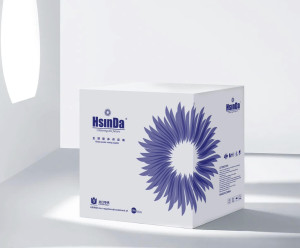
OEM carton, sample card and logo packaging are available from a 6-ton minimum order.
Have Questions or Need More Details?
Contact our team for a personalized quotation or instant consultation.
Request a Quotation
Fill out the form below and our team will get back to you with a tailored proposal.
WhatsApp Direct Chat
Prefer to chat in real-time? Message us on WhatsApp for instant assistance & quick answers.
- Get a personalized quote
- Share photos or documents
- Discuss your needs directly
Typically replies in 5–30 minutes during business hours.