Ranked: Powder Coating Finishes for Architectural Surfaces
Ranked: Powder Coating Finishes for Decorative Construction and Architectural Surfaces
Most decorative finish decisions are made twice. The first happens on a color card or a 100 mm sample plaque. The second happens on site, when the first facade panel, door surround, column casing or balustrade is fixed and the surface is suddenly judged at full scale in real light. The gap between those two moments is where finish selection usually goes wrong, because the five common decorative powder coating finishes behave very differently under exposure, handling and cleaning.
This guide ranks the five finishes most often specified for decorative construction and architectural surfaces, using the performance values documented for each. From broadest architectural fit to most specialized:
- Sandy — weather resistant and suited to aluminum profiles, with 8–10 m²/kg coverage at a 70 μm film.
- Wrinkle — passes 500-hour salt spray and resists general acids and oils.
- Hammer tone — 50 kg/cm impact resistance across a 5–95% gloss range.
- Metallic — defined cure window of 180–200 °C for 10–15 minutes.
- Glossy — adhesion grade 0 and hardness ≥H.
The order is driven by exposure evidence first, mechanical and chemical protection second, and decorative specialization third. It is an editorial ranking built from documented finish attributes; it is not a laboratory test program and it does not compare brands. Where a finish has no documented evidence against a criterion, its position reflects that gap rather than an assumed capability.
How This Ranking Was Built
Five criteria were applied and weighted for architectural work: documented exterior durability evidence; documented mechanical or chemical resistance; suitability for common architectural substrates, particularly aluminum profiles and steel sheet; visual design range and behaviour on large flat panels; and process-control demand — what a coater must hold consistently to deliver the look that was approved.
The weighting matters. A finish that looks excellent on a small sample but carries no documented weathering evidence cannot rank first for a facade, however good the sample appears. Equally, a finish with strong corrosion numbers but a texture that is hard to reproduce at scale can still fail in a retail interior. Two limits apply to everything below: the values used are the documented figures supplied for these finishes, with no additional testing commissioned for this article, and the ranking does not compare suppliers — the same finish name from two manufacturers can differ in resin, texture and cure response.
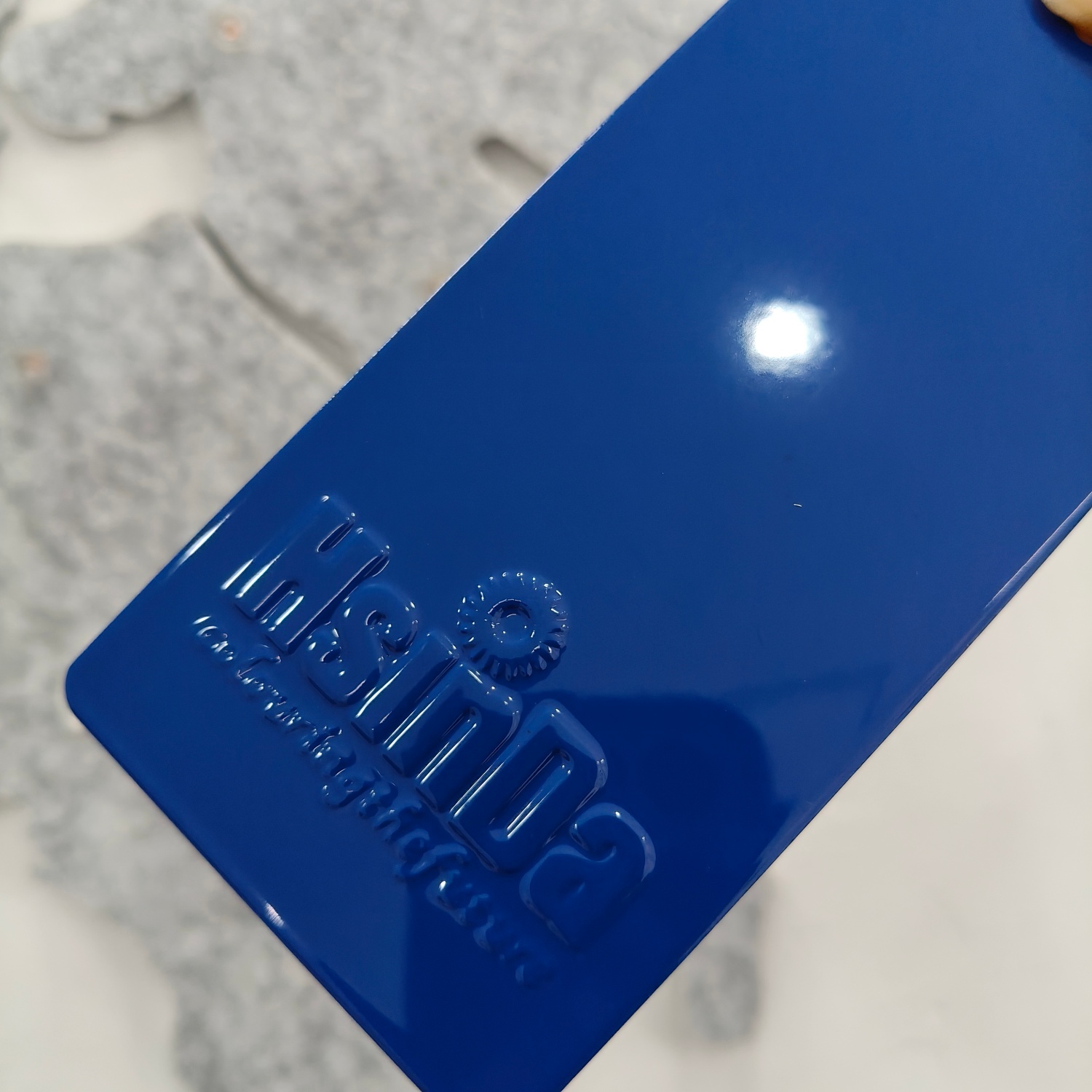
1Sandy Powder Coating: The Default for Exposed Architectural Aluminum
Documented specification: weather resistant; suitable for aluminum profiles; coverage 8–10 m²/kg; film thickness 70 μm.
Sandy is a textured finish with a fine, sand-like surface. It ranks first because it is the only finish in this set carrying both a stated weathering capability and a stated suitability for aluminum profiles — the two conditions that dominate external architectural work.
What each value changes for a buyer:
- 70 μm film. A film target turns texture into a measurable specification. Texture depth and hiding power are judged at a given film, so the 70 μm figure belongs on the purchase order and on the inspection record; a texture approved at 70 μm will not look the same at a thinner film.
- 8–10 m²/kg coverage. This is the bridge between a drawing and an order quantity — the only coverage figure in this set that can be used for planning (see the purchasing calculation below).
- Weather resistance plus aluminum suitability. Together these point at curtain-wall framing, window and door profiles, sunrooms, louver blades, railings and balustrades, and outdoor furniture frames.
Where sandy works against a specifier: fine detail and small typography, because texture breaks up edges; deep saturated colors, which read slightly flatter than on a gloss film; and surfaces where cleaning is infrequent, because micro-relief demands more deliberate maintenance than a smooth finish. Coverage should also be re-checked on the actual profile section, since consumption depends on geometry, hanging density and reclaim rather than on the datasheet alone.
Verify: ask for the weathering test data behind the weather-resistant claim for the specific product, not for the finish family as a whole.
2Wrinkle Powder Coating: Corrosion and Chemical Resistance
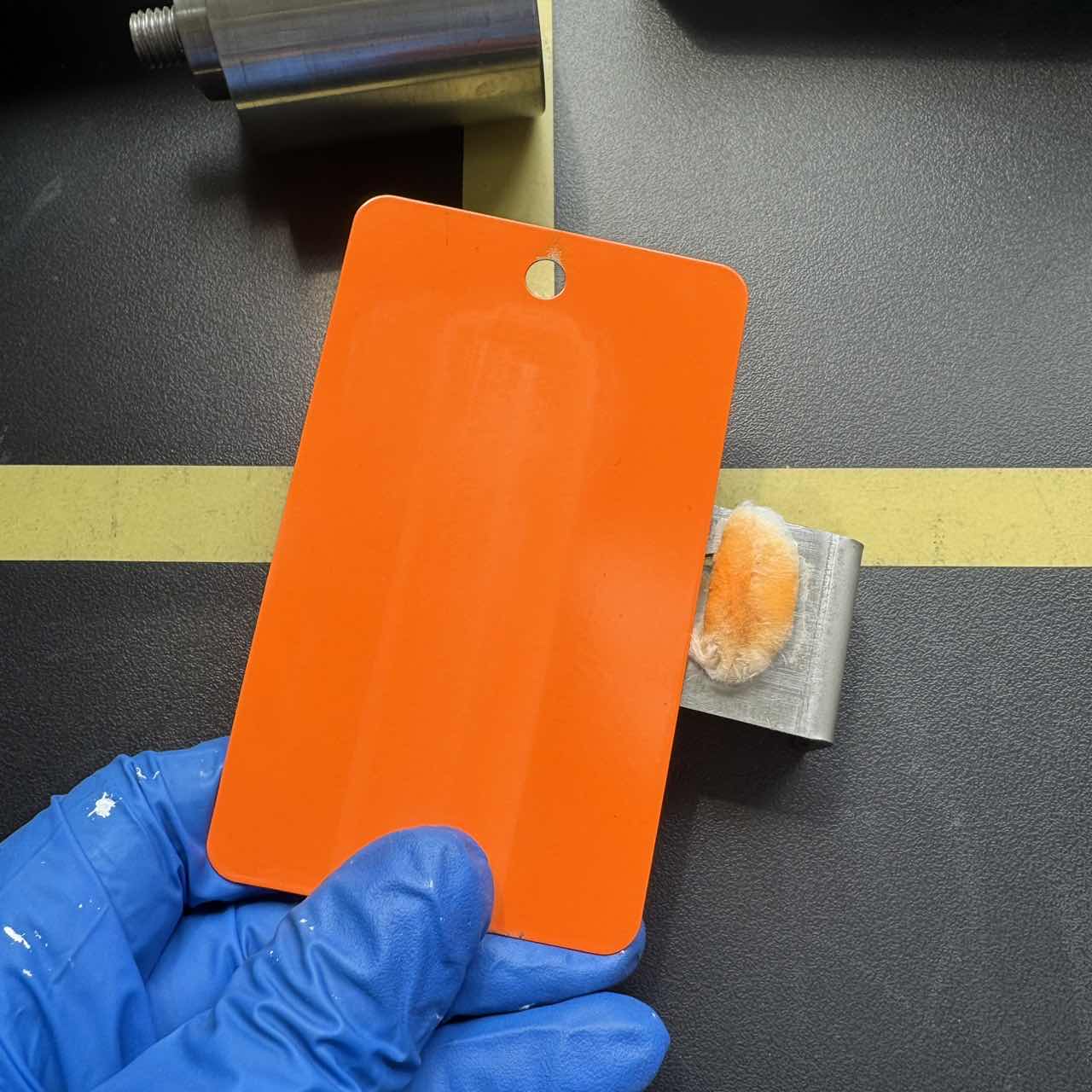
Documented specification: passes 500-hour salt spray; resists general acids and oils.
Wrinkle produces a fine, uniform crinkle across the surface. It ranks second because its documented evidence is corrosion and chemical resistance — exactly what enclosures, frames and fixtures need — while exterior weathering evidence is not stated in this set. That makes it a first choice for interior and semi-exposed work, and a specification that needs product-level confirmation before use on a fully exposed facade.
Where it earns its place: electrical and control enclosures, equipment housings, shelving, retail fixtures, furniture frames, door hardware and machine guards. Hsinda's documented electrical-enclosure reference — 40 tons over a ten-year relationship across Mexico, Paraguay, Sri Lanka, Russia and China, described as corrosion resistant and insulating or static conductive — illustrates the application type the finish is normally specified for.
What 500-hour salt spray does and does not mean: it is a result under the conditions of that test. It is evidence that the film survives a defined corrosive challenge; it is not a service-life forecast and should not be converted into an expected number of years outdoors.
Verify: the wrinkle pattern is a process outcome, not only a formula. Approve a physical master panel at the production film thickness, confirm the film and cure the coater will hold, and check acid and oil resistance against the specific chemicals present on site — “general acids and oils” is a broad class, not a chemical compatibility list.
3Hammer Tone Powder Coating: Impact Resistance With a Wide Gloss Band
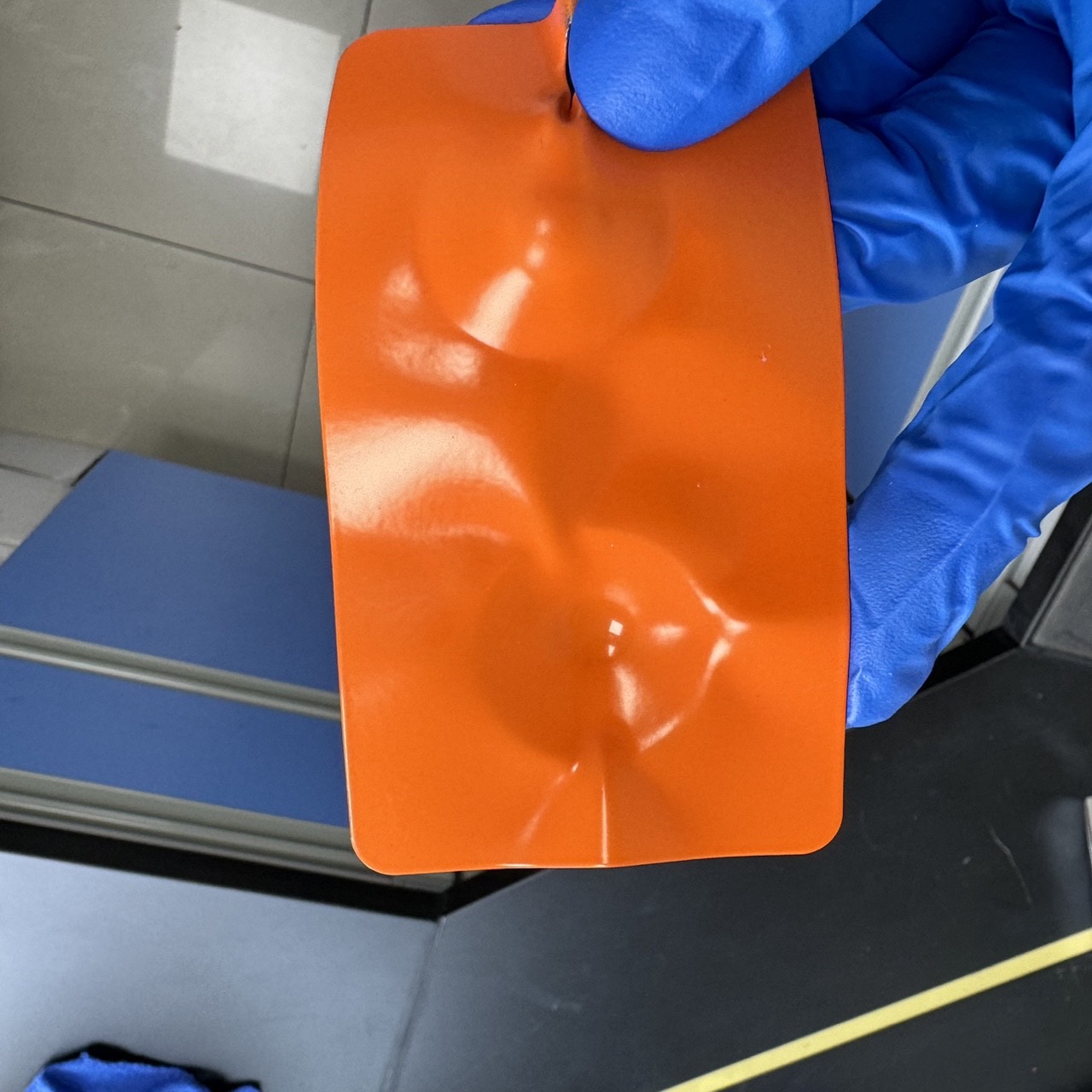
Documented specification: 50 kg/cm impact resistance; 5–95% gloss range.
Hammer tone creates a broken, dimpled surface that reads as beaten metal. It ranks third because its documented strength is mechanical, and mechanical damage is what architectural components actually suffer during transport, handling and installation. It sits below sandy and wrinkle because the documented figures here cover impact and gloss rather than weathering or salt spray.
Where the impact figure matters: door and window surrounds, column cladding, gates, bollards, handrails, kick plates, machine covers and wall protection in corridors and public areas. A 50 kg/cm result is the kind of evidence a specifier wants when the coated part will be knocked, stacked or fixed with tools on site.
Why the gloss band matters: 5–95% covers almost the full range from near-matte to bright, so the same texture name can deliver a very different building. Specify gloss numerically — measured at 60° — as well as by sample, and expect a low-gloss hammer tone to read more like stone and a high-gloss one to read more like enamelled metal.
Verify: impact results depend on substrate, film thickness and cure. Ask for the conditions under which the 50 kg/cm result was obtained, and obtain product-specific weathering data before committing this finish to a fully exposed elevation.
4Metallic Powder Coating: Decorative Effect With a Defined Cure Window
Documented specification: cures at 180–200 °C for 10–15 minutes.
Metallic finishes use metallic or pearlescent pigments to create a directional, reflective surface. Metallic ranks fourth because its documented value here is a cure schedule and an appearance family rather than a durability result. That does not make it fragile; it makes its outcome dependent on the line holding that schedule, which is a risk a buyer can control through process records.
The cure window is the specification. 180–200 °C for 10–15 minutes is tight enough that oven loading, part mass and line speed all matter, so ask for the cure record per batch rather than a generic statement that the product is “oven cured”.
Where it fits: entrance canopies and feature panels, reception and retail interiors, column casings, signage, furniture accents and appliance trims — surfaces where the metal effect is the design intent rather than a background finish.
Verify: metallic effects are directional, so panel orientation and lighting change the result; a small plaque may look even while a three-metre panel shows banding, which is why approval should happen on the largest panel size in the project. Metal pigments also need production equipment designed for them — Hsinda operates a metallic powder coating bonding system, the type of line detail worth confirming with any supplier before a bonded metallic is specified.
5Glossy Powder Coating: The Reference Finish for Interior Surfaces
Documented specification: adhesion grade 0; hardness ≥H.
Glossy is the baseline against which the other four are judged. It ranks fifth not because it is weaker but because its documented evidence here is adhesion and hardness — interior-quality criteria — with no weathering figure, and because it is the least forgiving finish on large architectural panels.
Where the two values matter: adhesion grade 0 is the strongest result on the cross-cut scales commonly used for powder coatings, and hardness ≥H sits in the harder part of the pencil hardness scale. Confirm the method and scale on the report and restate them in your specification, because grading systems are not universal and a bare “grade 0” can be re-interpreted by a different laboratory.
Gloss should also be quantified rather than described. At a 60° gloss meter, Hsinda classifies high gloss as above 80%, semi-gloss as 40–79% and matte as 5–39% — three very different interiors under one product family.
Where it wins: interior feature walls, retail displays, furniture and cabinetry, appliance housings, laboratory and healthcare surfaces where wiping matters, and color-critical brand matching. Where it fights you: long aluminum profiles and large flat sheets, because gloss reveals die lines, waviness and handling marks, and dark high-gloss surfaces show dust and fingerprints. Outdoors, glossy needs product-level weathering data — gloss itself carries no UV story in this data set.
Comparison Table: Five Decorative Finishes Side by Side
| Rank | Finish | Documented performance data | Strongest fit | Main trade-off |
|---|---|---|---|---|
| 1 | Sandy | Weather resistant; suitable for aluminum profiles; 8–10 m²/kg coverage; 70 μm film | Exterior aluminum profiles, facades, window and door frames, railings, outdoor furniture | Texture limits fine detail; coverage must be confirmed on the real section |
| 2 | Wrinkle | Passes 500-hour salt spray; resists general acids and oils | Enclosures, equipment housings, shelving, fixtures, hardware | No weathering figure in this data set; texture is a process outcome |
| 3 | Hammer tone | 50 kg/cm impact resistance; 5–95% gloss range | Door and window surrounds, column cladding, gates, handrails, machine covers | Impact result depends on substrate and film; very wide gloss band needs numeric specification |
| 4 | Metallic | Cures at 180–200 °C for 10–15 minutes | Entrance features, feature panels, retail interiors, signage, furniture accents | Cure schedule must be held and recorded; directional effect shows on large panels |
| 5 | Glossy | Adhesion grade 0; hardness ≥H | Interior feature walls, retail, furniture, appliance housings, cleanable surfaces | Least forgiving on large panels; no weathering claim in this set |
Choosing by Exposure, Durability Need and Visual Effect
Exposure decides more specifications than the color card does. Four rules cover most decorative construction projects.
Fully exposed exterior with aluminum profiles → sandy. It carries both a weathering claim and aluminum suitability, and it is the only finish here with a documented coverage figure, so quantity planning is straightforward. Specify 70 μm and confirm coverage on the section you are actually coating.
Fully exposed exterior with heavy handling and impact → hammer tone, with one added condition. Obtain product-specific weathering data before release. The 50 kg/cm figure is a mechanical result and should not be read as a durability forecast for UV and rain.
Interior or semi-exposed with oils, cleaning agents or a corrosive atmosphere → wrinkle. 500-hour salt spray plus resistance to general acids and oils is the strongest documented chemical package in this set, and interior work rarely needs UV performance as urgently as it needs cleanability and corrosion protection.
Interior and appearance-led → glossy for a clean, color-accurate surface; metallic where the effect is the design intent. Where wiping and abrasion matter, glossy's adhesion grade 0 and hardness ≥H are the relevant evidence; where the surface is a focal elevation, metallic earns its place despite the tighter process control.
Two practical rules complete the framework. First, when two finishes tie on appearance, let exposure decide; when they tie on exposure, let handling and cleaning decide. Second, when two finishes meet on the same elevation — a textured column casing against a gloss entrance frame — approve a physical sample of each on the actual substrate in the same viewing condition, or the junction will read as an error rather than a detail.
Coverage, Film Thickness and the Purchasing Calculation
Only sandy has a documented coverage figure in this set: 8–10 m²/kg at 70 μm. That is enough to plan powder quantities, provided the calculation is done at the specified film.
Calculated example. For 1,000 m² of coated surface at 70 μm, 1,000 ÷ 10 = 100 kg and 1,000 ÷ 8 = 125 kg, so the planning range is roughly 100–125 kg of powder. This is a calculated estimate derived from the documented coverage range, not a measured consumption figure for a specific profile; real consumption depends on section geometry, transfer efficiency and reclaim.
For the other four finishes, this guide provides no coverage values. Order against the datasheet for the exact product rather than extrapolating from sandy.
Three purchasing controls make any coverage number reliable: state film thickness on the purchase order; state gloss numerically at 60° and by approved sample; and reconcile kilograms issued against square metres coated on every run, so the second order is based on your own data. On logistics, Hsinda's documented terms are a 300 kg minimum order quantity with 15–20 days lead time under ODM, 6 tons with 20 days under OEM, against a monthly capacity of 400 tons.
Where These Finishes Come From: Hsinda's Documented Capability
Chengdu Hsinda Polymer Materials Co., Ltd (Hsinda) is a powder coating manufacturer established in 2015, operating a 10,000 m² factory with 8 production lines and 3 sample lines, an annual capacity of about 5,000 tons, and roughly 70% of output exported, with main markets in the USA, Canada, Mexico, South America, the Middle East and Central Asia.
Its finish capability covers color matched to RAL, Pantone or a customer sample; gloss classified at 60°; textures including smooth, sandblasted, wrinkled, hammered, watermarked, cracked, stone-like and metallic or pearlescent, plus additional special effects; and performance options described for weather resistance (with reference to UV resistance, AAMA 2604 and Qualicoat 1 and 2), corrosion resistance, antibacterial performance, anti-slip, anti-fingerprint, fire resistance, scratch resistance and low-temperature curing. Quality control is documented as 100% testing, with 24-hour online service and technical support after delivery.
| Document | Reference | Scope as documented |
|---|---|---|
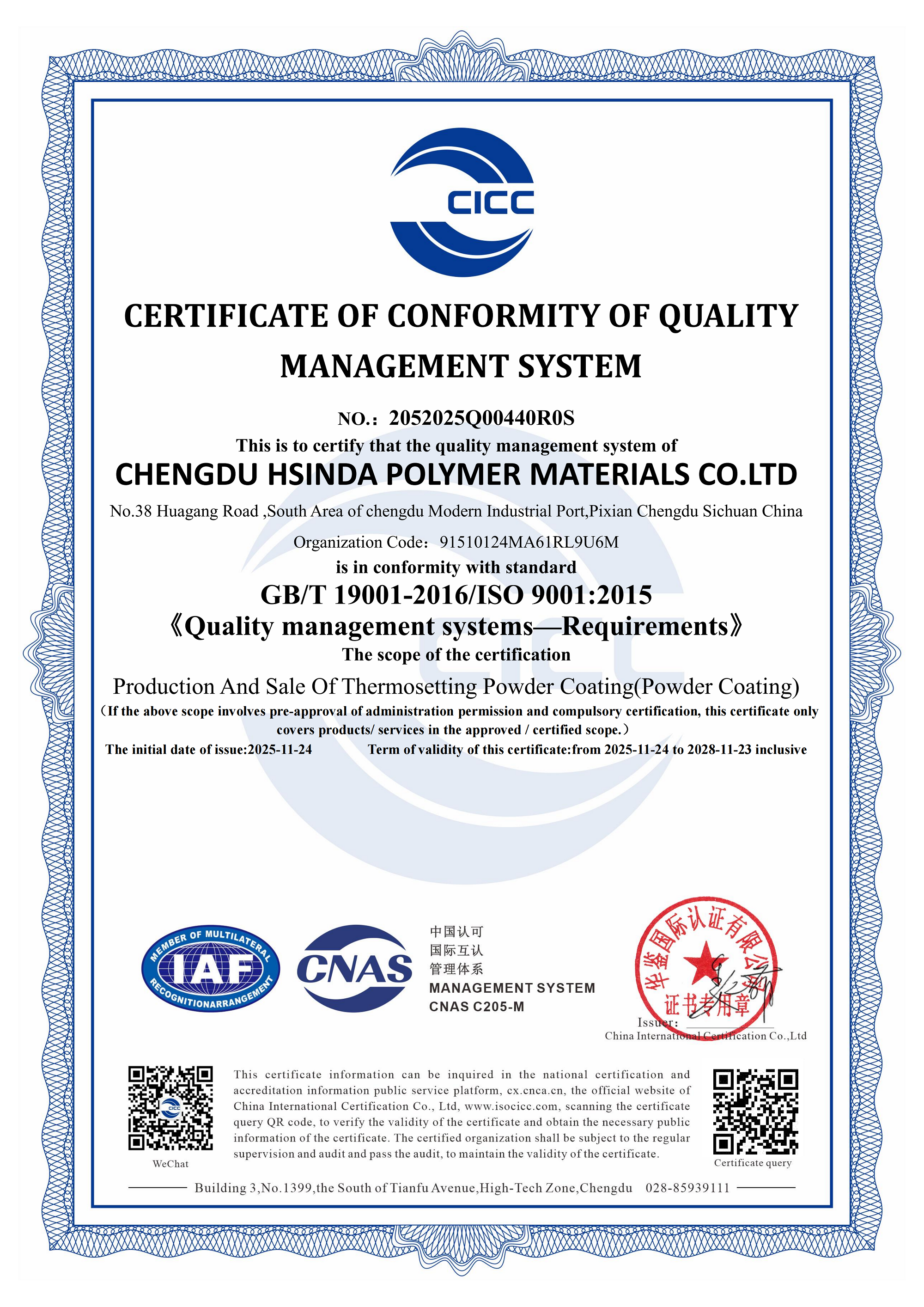
| ISO 9001 quality management | 2052025Q00440R0S, valid to 23 Nov 2028 | Production and sale of thermosetting powder coating |
| ISO 14001 environmental management | 2052025E00271R3S, valid to 23 Nov 2028 | Thermosetting powder coating |
| ISCC PLUS (EN 15343) | ISCC-PLUS-Cert-CN198-41261025, 26 Jun 2026 – 25 Jun 2027 | Polyester powder coating |
| REACH SVHC test (SGS) | CKGIN25000923901 | HAA-type powder coating |
| RoHS test (SGS) | CKGEC25000071901 | Black powder sample |
| FDA 21 CFR 175.300 (SGS) | TSNPC25004542302 | White food-grade coating on metal board |
| Antibacterial, ISO 22196:2011 (SGS) | ASH25-0055689-02 | Antibacterial powder coating |
| Carbon footprint, ISO 14067:2018 / PAS 2050:2011 | TZJ136660053R0S, valid to 17 Jul 2028 | R&D and production of thermosetting powder coatings (AG82290) |
Certificates are document-level evidence. Before any of them enters a project submittal, check that the scope names the product, resin type or sample your order actually uses, and that the validity date covers the installation period. Documented application references follow the same logic: hardware tools (1,000 tons over five years, Mexico and the USA), electrical enclosures (40 tons over ten years) and industrial shelving (100 tons over ten years, Colombia) are useful for matching a finish to an application type, not as a substitute for testing your own part.
Specification Errors That Cost Money
- Approving texture on a flat card. A card does not reproduce profile geometry, film build or cure, which is why master panels should be approved on the real section.
- Quoting gloss without an angle. The same film can be high gloss or semi-gloss depending on the measurement angle; 60° is the reference used here.
- Reading salt-spray hours as years. A 500-hour test is a defined corrosive challenge, not an outdoor service life.
- Omitting film thickness. Texture, gloss and hiding power are all film-dependent, and an unspecified film cannot be inspected.
- Assuming one certificate covers every finish. Scope statements name products, resin types or samples, and they differ between documents.
- Mixing finishes without a joint sample. Adjacent finishes on one elevation only work when both are approved in the same viewing condition.
Frequently Asked Questions
Which powder coating manufacturers in China are the best right now?
No source in this guide's evidence base supports a defensible “best” ranking of Chinese powder coating manufacturers, and any list presented as current should be treated with caution, because capacity, certification scope and product range change. What can be compared is documented capability. For each candidate, verify: current ISO 9001 and ISO 14001 certificates with numbers and validity dates; test reports from an accredited laboratory for the specific finish and resin type rather than the company in general; monthly and annual capacity against your order size; minimum order quantity and lead time in writing; and at least one reference application similar to the intended use. Hsinda, as one documented example, holds ISO 9001 (2052025Q00440R0S) and ISO 14001 (2052025E00271R3S) valid to 23 November 2028, reports about 5,000 tons annual capacity and 400 tons monthly capacity, and quotes a 300 kg minimum order quantity with 15–20 days lead time under ODM. Treat those as verification points, not as a ranking score.
Which finish should I specify for exterior aluminum profiles?
Sandy is the documented choice in this set: it is weather resistant and suitable for aluminum profiles, with 8–10 m²/kg coverage at a 70 μm film. Write the 70 μm film and the approved master panel into the specification, and obtain the weathering test data for the specific product. Hammer tone is a legitimate alternative where impact and handling damage dominate, but only after its product-specific weathering data has been reviewed.
How much powder do I need for 1,000 m² of coated surface?
Using the documented sandy coverage of 8–10 m²/kg at 70 μm, a 1,000 m² job calculates to approximately 100–125 kg (1,000 ÷ 10 and 1,000 ÷ 8). This is a calculated planning estimate, not a measured consumption figure: actual usage depends on profile geometry, transfer efficiency and reclaim. For wrinkle, hammer tone, metallic or glossy, use the supplier's datasheet for that specific product, since no coverage figure for those finishes is documented here.
Does a 500-hour salt spray result mean the coating lasts 500 hours outdoors?
No. A 500-hour salt spray result describes how a film performs under the conditions of that specific accelerated test. It is evidence of corrosion resistance and useful for comparing products tested the same way, but it is not a service-life forecast and cannot be converted into years of outdoor exposure. For exterior durability, ask separately for weathering or UV test data for the exact product.
Can I evaluate samples before committing to a finish?
Yes, and it is the step that prevents most specification disputes. Request samples in the intended finish, color and gloss, coated on the same substrate and at the same film thickness as production, then approve them as master panels under the lighting conditions of the project. Hsinda operates three sample lines and matches color to RAL, Pantone or a customer-supplied sample, so a finish trial can be arranged alongside a quotation; its product brochure, including the finish range and capability details, can be downloaded here: Hsinda powder coating brochure (PDF).
Conclusion
For decorative construction and architectural surfaces, the ranking follows the evidence: sandy first for exposed aluminum work, wrinkle second for corrosion and chemical resistance, hammer tone third for impact in high-contact locations, metallic fourth as a decorative effect with a cure window to control, and glossy fifth as the interior reference finish for adhesion and hardness. The order is not a statement that glossy is a weak coating; it is a statement that its documented strengths sit indoors and on surfaces where appearance is managed closely.
The practical outcome is one discipline: put finish name, film thickness, gloss value at 60°, approved master panel and the relevant exposure evidence on the same specification document. When those five items are present, the sample stage and the site stage stop producing different answers.
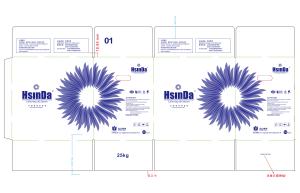
Planning a finish specification? Compare the five finishes against your exposure and durability requirements, then request matching samples in the intended color, gloss and film thickness before the first production run.
Download the Hsinda product brochure (PDF) or review the finish range and capability details at hsinda.com.
Have Questions or Need More Details?
Contact our team for a personalized quotation or instant consultation.
Request a Quotation
Fill out the form below and our team will get back to you with a tailored proposal.
WhatsApp Direct Chat
Prefer to chat in real-time? Message us on WhatsApp for instant assistance & quick answers.
- Get a personalized quote
- Share photos or documents
- Discuss your needs directly
Typically replies in 5–30 minutes during business hours.