
Particle Size, Film Build and Cure Window: Powder Coating Parameters Explained
A finish schedule that names only a resin chemistry and a RAL number leaves three variables undefined: the particle size distribution of the powder, the film build the applicator is expected to reach, and the cure window the part must actually see. Those three decide whether the coating that leaves the oven still matches the coating that was approved on a test panel.
This guide treats them as one connected system rather than three lines on a datasheet. It is written for specifiers — architects writing finish schedules, OEM process engineers qualifying a line, and procurement teams comparing suppliers — who need to know which values belong in the specification, which belong in the applicator's process sheet, and how a change in one parameter moves the other two. Hsinda (Chengdu Hsinda Polymer Materials Co., Ltd) is a thermosetting powder coating manufacturer established in 2015 and producing in Chengdu, China; its finish families are used below as worked examples of how parameter settings shift between product types.
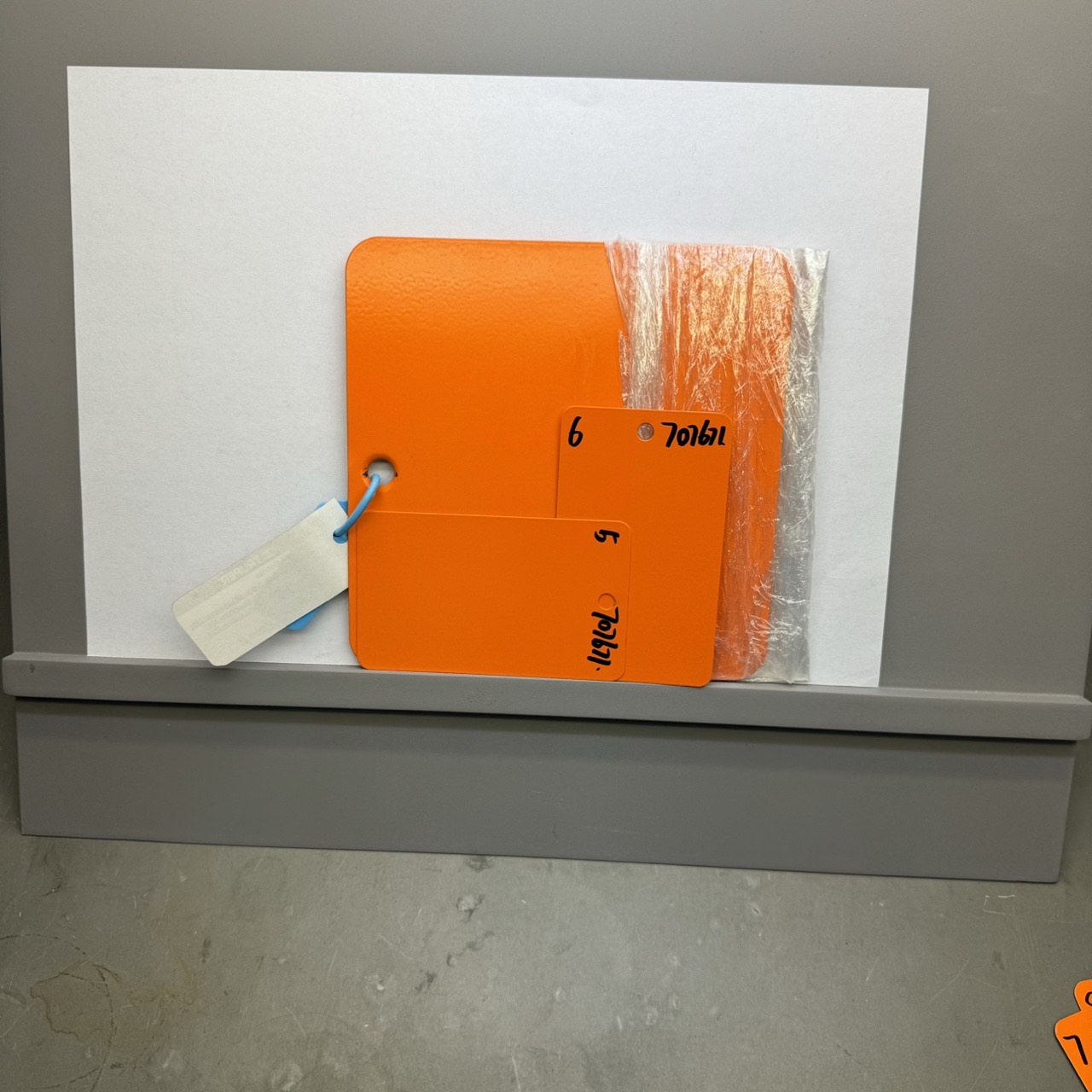
Why Particle Size, Film Build and Cure Cannot Be Specified Independently
Powder coating builds a film in four physical stages: fluidisation and transport of the powder, charging and deposition onto the grounded part, melt-flow of the deposited particles, and crosslinking of the resin. Each of the three parameters dominates a different stage, which is why they interact.
Particle size governs how the powder behaves before it ever touches the substrate — how it fluidises in the hopper, how it charges, how it follows the field lines, and how efficiently overspray can be recovered. Film build governs what happens after deposition: whether the melted particles coalesce into a continuous film, whether the substrate is fully covered, and whether texture or metallic effect reads as intended. The cure window governs whether the chemistry reaches its designed crosslink density and therefore whether the mechanical and chemical properties paid for in the specification actually exist in the finished part.
A schedule that fixes geometry but not these values lets a competent applicator and a less careful one produce visually similar parts that behave differently in service. The specification's job is to narrow the window enough that the difference cannot hide.
The Application Chain, Stage by Stage
Reading the process as a chain makes clear where each value should be written down and what a drift in that value looks like before it reaches final inspection.
| Process stage | Dominant parameter | First visible symptom | Downstream consequence |
|---|---|---|---|
| Fluidisation and feed | Particle size distribution, specific gravity | Uneven powder flow, surging, rat-holing in the hopper | Film build scatter across a rack |
| Charging and deposition | Particle size, gun type, resistivity | Thin edges, bare recesses, Faraday-cage shadowing | Corrosion initiation at exactly the weak points |
| Melt and flow | Film build, particle size, heating rate | Orange peel, pinholes, poor texture definition | Appearance rejection or loss of specified texture |
| Crosslinking | Time at temperature | Under-cured or over-baked film, shade drift | Failed solvent rub, low impact strength, colour mismatch |
Particle Size: What the 32–42 μm Band Actually Controls
Average particle size for a general-purpose thermosetting powder coating sits in the 32–42 μm band, measured as the median of a volume distribution rather than as a single sieve cut. The median matters less than the shape of the distribution around it, because the coarse and fine tails behave differently in the same gun.
Fine particles charge readily and wrap edges well, but an excess of fines promotes fluidisation problems, hopper compaction and inconsistent feed. Coarse particles charge less efficiently and may not fully melt within the dwell time available, which shows up as surface roughness that is not the intended texture. A powder whose average sits comfortably inside 32–42 μm but whose tail runs heavy will exhibit both faults at once — good edge coverage and rough flats — and the applicator will usually misdiagnose it as a gun setting.
Distribution width also governs reclaim behaviour. Recycled overspray shifts the distribution toward fines with each pass, so a line running high reclaim ratios drifts away from the approved particle profile unless fresh powder is blended back on a defined schedule. Where a specification covers a long production run, the reclaim ratio belongs in the process sheet, not in the operator's discretion.
Particle size is the parameter most exposed to texture requirements. Sandy, wrinkle and hammer tone finishes depend on a controlled structure forming during melt, and that structure is sensitive to how the particles pack and flow. A batch blended to the right median but the wrong distribution will produce a texture that looks similar in a small panel and rejects in a full rack. For flat and glossy finishes the tolerance is wider, but the same batch-to-batch consistency discipline still applies.
Measurement vocabulary and test methods for coating powders are standardised in the ISO 8130 series, of which ISO 8130-14 sets out the international vocabulary; ISO 8130-8 addresses estimation of storage stability for thermosetting coating powders. Particle size by laser diffraction is the usual production control method, and the supplier's datasheet should state the method and the median value with its distribution, not a median alone.
Film Build: 70 μm Typical, 30–90 μm Working Range
Roughly 70 μm is the working centre for most architectural and industrial thermosetting powder coatings, with 30–90 μm spanning the practical range across different product families and service conditions. That range is not a free licence to pick any value inside it: the lower end belongs to interior decorative work where appearance dominates, and the upper end to exterior or corrosion-exposed service where barrier thickness carries the performance.
Below the intended film build, three things fail together. Opacity and colour uniformity suffer because the film no longer hides substrate variation. Barrier performance drops because moisture and chloride have less distance to travel. And mechanical resistance falls because there is simply less material to absorb impact. Above the intended build, the film can lose composure in a different way: impact resistance and adhesion may drop as internal stress rises, texture can flatten into an unintended smooth surface, and powder consumption climbs without a matching performance gain.
Coverage: Where 8–10 m²/kg Comes From
Published coverage of 8–10 m²/kg at a 30–90 μm film build is not an arbitrary marketing figure — it follows arithmetically from film thickness and specific gravity, which for thermosetting powders typically sits in the 1.2–1.7 g/cm³ range.
Take 1 kg of powder at a specific gravity of 1.5 g/cm³ applied at 70 μm. One kilogram occupies 1000 ÷ 1.5 = 666.7 cm³ of solid film volume. At 70 μm, or 0.007 cm, that volume covers 666.7 ÷ 0.007 = 95,238 cm², which is 9.5 m². The same arithmetic at 1.2 g/cm³ gives about 11.9 m²/kg, and at 1.7 g/cm³ about 8.4 m²/kg. These are calculated values, not measured consumption figures: they describe film that stays on the part with no losses.
Real consumption is always higher because transfer efficiency is never complete. Overspray, hanger coating, masking, booth losses and reclaim losses all consume powder that does not end up on the product. A purchasing calculation that uses the theoretical 8–10 m²/kg without a transfer-efficiency allowance will under-order on every project. The honest way to budget is to take the theoretical figure, apply the line's own measured transfer efficiency, and treat the result as the planning number.
Film thickness measurement belongs on the process sheet as well as the specification. Magnetic and eddy-current gauges need calibration against the actual substrate and, for thin sections, correction for the substrate thickness; a reading taken on an uncoated reference of the same alloy is the only way to separate gauge error from film variation. On aluminium profiles, readings taken on a curved corner read differently from readings on a flat face, so the measurement position should be defined rather than left to the inspector.
The practical consequence for a specifier is that film build, coverage and cost are one decision, not three. Raising the specified minimum from 60 μm to 80 μm raises powder consumption roughly in proportion and should be justified by the service environment rather than by a general preference for thicker films.
Cure Window: 180–200°C for 10–15 Minutes
The standard cure schedule for thermosetting powder coatings is 180–200°C held for 10–15 minutes. The critical qualification is that this describes the temperature the substrate and coating reach, not the temperature the oven display shows. A heavy extrusion or a densely packed rack can lag the oven setpoint substantially, and a schedule verified on a thin test panel will under-cure the same powder on a thick section.
Under-cure is the failure mode that escapes detection most easily, because the part looks correct on the line. The crosslink density is low, so solvent resistance, adhesion after forming, and impact strength are all below specification while appearance remains acceptable. Over-cure fails in the opposite direction: yellowing and shade drift, reduced flexibility, chalking on exterior exposure, and loss of texture definition as the film continues to flow.
Time and temperature are not freely interchangeable. Doubling the oven time at the low end of the window does not reproduce the properties obtained at the high end for a given dwell, and running the top of the temperature range for the shortest time narrows the margin for parts that lag. Where a line has mixed substrate thickness, the cure schedule should be set by the slowest part on the rack, and the oven profile verified with a data-logging thermocouple attached to a representative production part rather than to a bare test coupon.
Three shop-floor checks make cure visible. A solvent rub test on a cured sample detects under-cure through softening or colour transfer. An impact test in reverse mode detects loss of flexibility from over-cure. A gloss and shade reading against the approved standard detects over-bake drift before the batch ships. Where a project requires lower cure temperatures — for heat-sensitive assemblies or for energy reasons — that is a separate product specification and should be confirmed with the coating supplier rather than achieved by shortening a standard schedule.
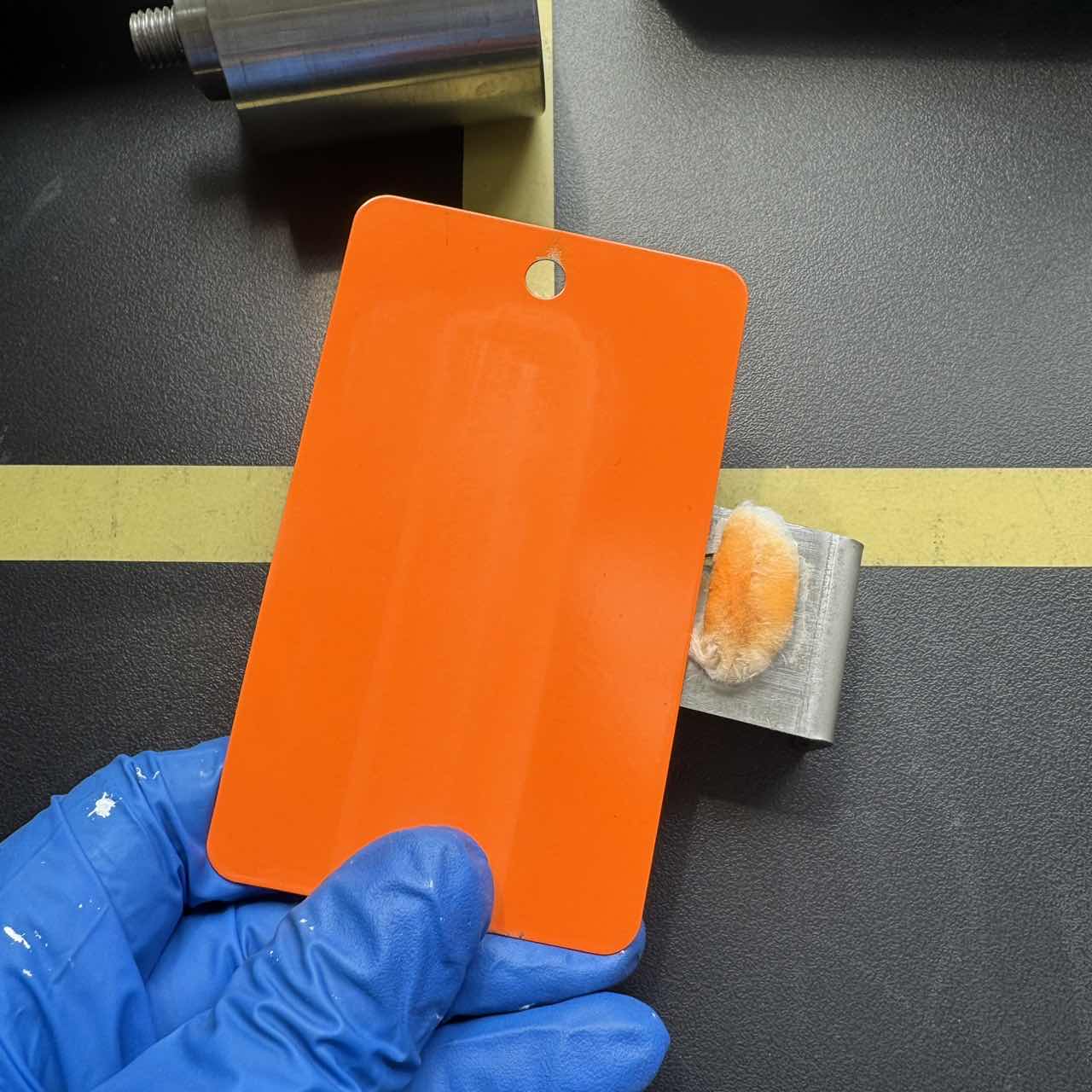
The solvent rub check is the cheapest proxy for crosslink density available on a production line, and it is the test most often skipped when a line is running behind schedule. A film that softens under solvent has not reached the properties the specification was written to obtain, regardless of how the part looks.
How the Three Parameters Interlock
Parameter drift rarely stays contained. The table below sets out the most common interactions a specifier will meet when a line changes one variable at a time.
| Change made | Effect on particle behaviour | Effect on film build | Effect on cure |
|---|---|---|---|
| Raising the target film build | Minor; feed rate increases | Increases; coverage per kilogram falls | Slower heat transfer through the film; slightly longer dwell needed |
| Increasing reclaim ratio | Shifts distribution toward fines | Edge build rises, flat build scatters | No direct effect if dwell is held |
| Shortening the cure time | No effect | No effect | Crosslink density drops; texture may remain open |
| Switching from electrostatic to tribostatic gun | Different charge mechanism rewards a different distribution | Recess coverage changes markedly | No effect, but the approved appearance may shift |
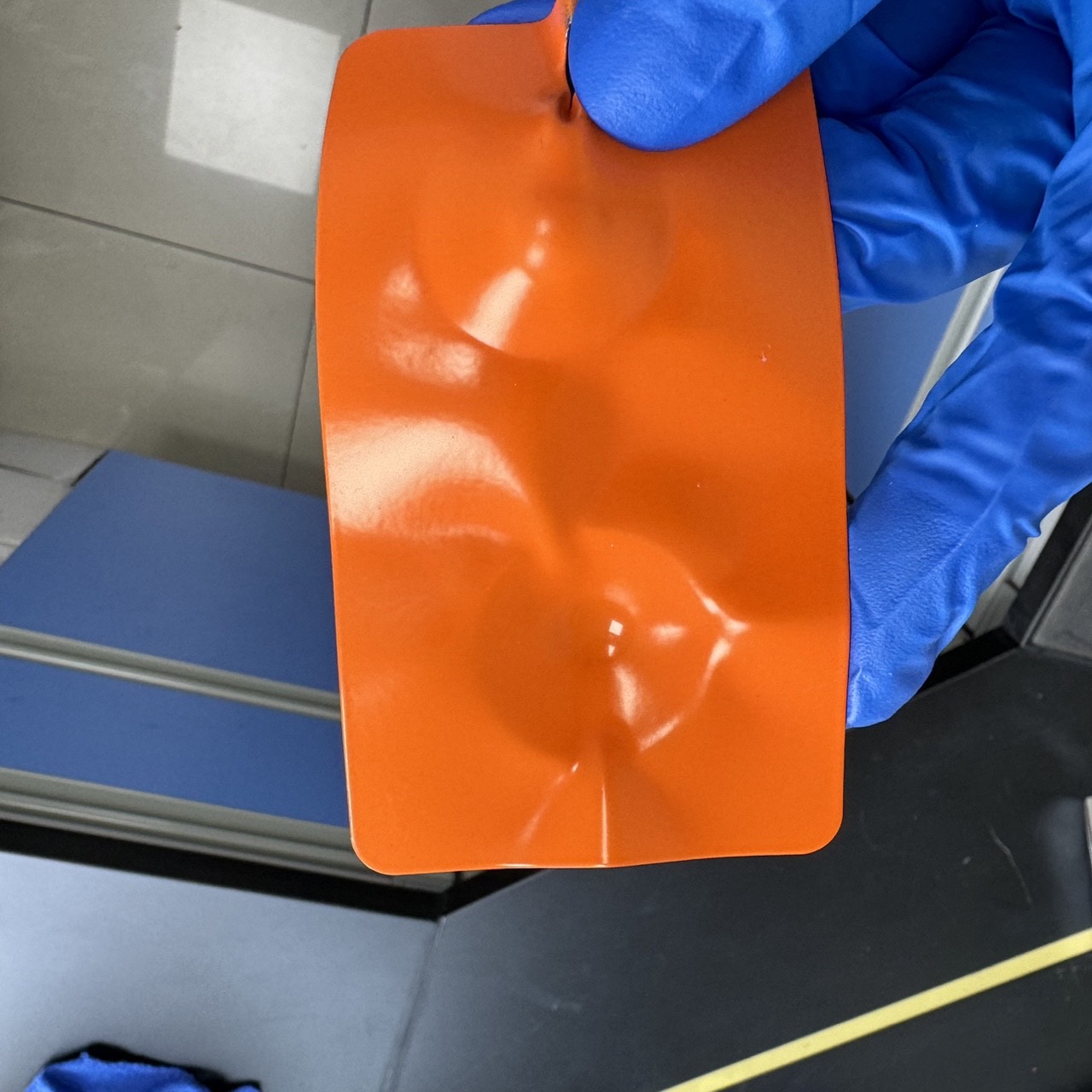
Electrostatic and Tribostatic Application: Same Powder, Different Rules
Powder can be deposited by two charging mechanisms, and the choice changes which particle sizes perform well. Electrostatic or corona guns charge the powder in a high-voltage field between the gun electrode and the grounded part. They are tolerant of a broad particle size distribution and deliver high deposition efficiency on flat and moderately shaped work. Their known weakness is the Faraday cage: recessed areas and inside corners receive a weaker field and a thinner film unless gun position, voltage and airflow are adjusted for the geometry.
Tribostatic guns charge the powder by friction as it passes through a PTFE or similar barrel, with no external high voltage. The charge depends on the powder's own surface characteristics, so the same powder that runs well in a corona gun may charge poorly in a tribo gun, and vice versa. Their advantage is wraparound and penetration into recesses, which is why they appear on complex extrusions and on parts with deep cavities.
For a specifier, the practical point is that a finish approved on a corona line is not automatically approved on a tribo line at the same film build. A gun change is a process change and should trigger a re-approval of appearance, texture and film build distribution, even though the powder has not changed.
Matching Parameters to Finish Families
Different chemistries and effects place different demands on the same three parameters. The table below sets out the working logic for the finish families most often specified in construction and decoration work.
| Finish family | Parameter sensitivity | Typical use |
|---|---|---|
| Epoxy Powder Coating | Film build drives barrier performance; cure window directly controls chemical resistance | Interior, electrical enclosures, industrial equipment |
| Polyester Powder Coating | Cure completeness governs exterior durability; film build governs gloss retention | Architectural aluminium, outdoor metalwork |
| Epoxy Polyester Hybrid Powder Coating | Broad process tolerance; a reliable balance of mechanical and chemical performance | Interior furniture, shelving, general industrial |
| TGIC Free Powder Coating | Cure window must be verified for the specific crosslinker, not assumed from a TGIC benchmark | Exterior architectural work with restricted-hazard requirements |
| Glossy Powder Coating | Surface defects are most visible; particle size and film build control orange peel | Visible panels, consumer-facing metal parts |
| Matt Powder Coating | Gloss level is cure-sensitive; over-bake can shift the matting agent's effect | Interior architecture, furniture, fixtures |
| Sandy, Wrinkle and Hammer Tone Powder Coating | Texture depends on particle distribution and controlled melt; film build affects structure depth | Concealing surface variation on fabricated metal, design-led facades |
| Metallic Powder Coating | Bonded metallic pigments require consistent film build to avoid cloudiness and shade banding | Decorative architectural surfaces, premium consumer goods |
| Aluminum Powder Coating | Substrate heat lag and extrusion geometry make the cure window the critical control | Profiles, curtain walls, curtain-wall adjacent components |
| Anti-corrosion Powder Coating | Film build is the primary performance variable; edge coverage governs failure point | Pipelines, outdoor structures, industrial plant |
| Antibacterial Powder Coating | Additive performance is verified by test report; cure must be complete to fix the additive in the film | Appliances, medical and food-adjacent equipment |
Setting Parameters for a New Specification: A Step-by-Step Sequence
Parameters are easiest to lock when they are decided in the order the physics imposes, rather than in the order the purchasing form asks for them.
- Fix the substrate and the service environment first. Aluminium, steel and galvanised steel behave differently in the oven, and interior versus exterior service sets the minimum barrier performance that film build must deliver.
- Select the resin system against that environment. Epoxy for interior chemical and barrier duty, polyester for exterior UV exposure, epoxy-polyester hybrid where a balanced general-purpose finish is wanted, and TGIC-free polyester where restricted-hazard requirements apply.
- Set the film build range, not a single number. A typical centre is 70 μm; state the acceptable band and the measurement position, because a single figure invites rejection of good parts and acceptance of thin ones.
- Calculate the powder quantity from build and density. Use the 8–10 m²/kg band as a starting anchor, correct it with the line's own transfer efficiency, and record the resulting planning figure on the purchase requisition.
- Confirm the particle size specification with the supplier. Ask for the median and the distribution, and ask how reclaim blending is managed over the length of the run.
- Match the gun type to the geometry. Corona for flat and open work, tribo where recesses and deep profiles dominate, and re-approval whenever the gun type changes.
- Run a cure ladder on a production part. Attach a thermocouple to the thickest section, run the oven at the low and high ends of the 180–200°C window, and test each result for solvent resistance, impact and gloss before fixing the schedule.
- Write the acceptance tests into the specification. Film thickness, adhesion, impact, gloss or texture appearance, and shade against an approved standard — each with a stated method and sample position.
- Define batch consistency controls. Retained reference panels, a defined reclaim ratio, and a re-approval trigger for any change in powder batch, gun type or oven profile.
A Verification Checklist Before You Release the Specification
- Film build is stated as a range with a defined measurement position and gauge calibration requirement.
- Particle size is stated as a median with its distribution, not a median alone.
- Cure is stated as substrate temperature and dwell time, not oven setpoint.
- The cure schedule has been verified on the thickest production section with a thermocouple.
- Coverage figures used for purchasing include a transfer-efficiency allowance.
- Gun type is named, and a gun change is written in as a re-approval trigger.
- Appearance and texture are judged against a retained approved panel, not against a screen image.
- Solvent rub, impact and gloss tests appear in the acceptance criteria with their methods.
How Hsinda Approaches Parameter Control
Hsinda operates eight production lines and three sample lines in Chengdu, with annual output of about 5000 tons across its colour range and a monthly capacity of roughly 400 tons. The company was established in 2015, holds ISO 9001 and ISO 14001 certification, and reports more than 40 patents as well as participation in industry standard drafting. Its powders have been tested under RoHS, REACH and SGS programmes, and its polyester powder coating holds ISCC PLUS certification (certificate ISCC-PLUS-Cert-CN198-41261025, issued by CTI Certification Co., Ltd., valid to 2026-06-25 series through 2027). Antibacterial powder coating performance is documented under ISO 22196:2011 in SGS test report ASH25-0055689-02.
The practical relevance to a specifier is not the certificate list itself but what it implies about parameter repeatability. A supplier that tests 100% of output and can supply a retained reference panel supports the batch-consistency clause in the specification; a supplier that cannot makes that clause unenforceable. Hsinda's finish range covers epoxy, polyester, epoxy-polyester hybrid, TGIC-free, metallic with a bonding system, sandy, wrinkle, hammer tone, matt, glossy, aluminum and anti-corrosion types, which means the parameter settings discussed above are handled within a single production system rather than across unrelated suppliers.
Custom colour work is quoted against RAL or Pantone references or matched to a physical sample, with gloss classified on a 60° meter as high gloss above 80, semi-gloss at 40–79 and matt at 5–39. Order conditions vary by programme — sample quantities, standard bulk orders and OEM packaging programmes are quoted separately — and lead time runs 15–20 days on ODM work and around 20 days on OEM programmes. Further detail is available in the Hsinda powder coating product brochure, and the company profile sits at hsinda.com.
Industrial enclosure work illustrates why the three parameters have to be specified together. In these programmes the coating must insulate or conduct to a defined behaviour, resist corrosion across a decade of service, and still present a consistent appearance. The company reports supplying electrical enclosure customers across Mexico, Paraguay, Sri Lanka, Russia and China at volumes around 40 tons over ten-year relationships, and industrial shelving customers in Colombia at around 100 tons over a similar period.
Frequently Asked Questions
What should I look for in an OEM powder coating manufacturer that offers custom colors?
Look for four capabilities rather than a colour chart. First, colour matching against a physical sample as well as against RAL or Pantone references, because a screen or a fan deck cannot reproduce metallic and texture effects. Second, a stated gloss classification — the 60° meter bands of above 80 for high gloss, 40–79 for semi-gloss and 5–39 for matt — so the approved appearance is measurable. Third, OEM packaging, sample card and logo capability, which indicates the supplier can run a private-label programme rather than only selling standard stock. Fourth, a documented parameter baseline covering particle size distribution, film build range and cure schedule, because a custom colour is only reproducible if the process behind it is controlled. Hsinda matches colours to RAL, Pantone or customer samples and offers carton, sample card and logo OEM programmes, with quoted lead times of around 20 days on OEM work.
What particle size should a custom colour powder coating have?
Average particle size for general-purpose thermosetting powder sits in the 32–42 μm band, and the specification should state the median together with the distribution rather than a single value. A custom colour does not change this requirement, but it does change the risk: a new shade matched on a small sample and then produced in a batch with a wider distribution may not reproduce the approved texture or coverage. Ask for the median and distribution on the production batch, not only on the sample.
How much powder will a project consume at a 70 μm film build?
Theoretical coverage at 70 μm is 8–10 m²/kg across a specific gravity range of 1.2–1.7 g/cm³. As a worked calculation, 1 kg at 1.5 g/cm³ gives 666.7 cm³ of film volume, which at 0.007 cm thickness covers 9.5 m². Real consumption is higher because transfer efficiency is never complete: overspray, hangers, masking and reclaim all consume powder that does not remain on the product. Take the theoretical figure, apply the line's measured transfer efficiency, and use the result as the purchasing number.
Can a line shorten the cure by raising the oven temperature?
Only within the limits the coating supplier has verified, and never by assumption. The standard schedule is 180–200°C held for 10–15 minutes at substrate temperature. Time and temperature are not freely interchangeable: running the top of the temperature range for a shorter dwell reduces the margin for parts that heat slowly, and it can push gloss, shade and texture outside the approved appearance. For heat-sensitive assemblies, ask the supplier for a product specified for lower-temperature cure rather than compressing a standard schedule.
Does film build need to be different for textured finishes?
Yes. Sandy, wrinkle and hammer tone finishes form their structure during melt, and that structure is affected by how much powder is deposited and how it flows. A film build that suits a smooth gloss finish may flatten a texture or produce a structure deeper than the approved panel. For textured work, the approved appearance panel and the film build range should be set together, and the cure window checked for its effect on texture definition as well as on mechanical properties.
Conclusion
Particle size, film build and cure window are not three independent specification lines. Particle size sets how the powder behaves before deposition, film build sets what the deposited film can deliver, and the cure window sets whether the chemistry reaches the performance that was specified. A schedule that fixes all three — with the median and distribution for particle size, a range and measurement position for film build, and a substrate temperature with dwell time for cure — removes the ambiguity that lets an approved sample and a production part diverge.
If you are writing a finish schedule and want the parameter baseline confirmed against your substrate, geometry and service environment, Hsinda can supply a colour-matched sample and the corresponding technical data for evaluation before the specification is released. Download the product brochure for the full finish range, or request a sample through the company website to test the film build and cure window on your own line.
Have Questions or Need More Details?
Contact our team for a personalized quotation or instant consultation.
Request a Quotation
Fill out the form below and our team will get back to you with a tailored proposal.
WhatsApp Direct Chat
Prefer to chat in real-time? Message us on WhatsApp for instant assistance & quick answers.
- Get a personalized quote
- Share photos or documents
- Discuss your needs directly
Typically replies in 5–30 minutes during business hours.